


Cubs Video
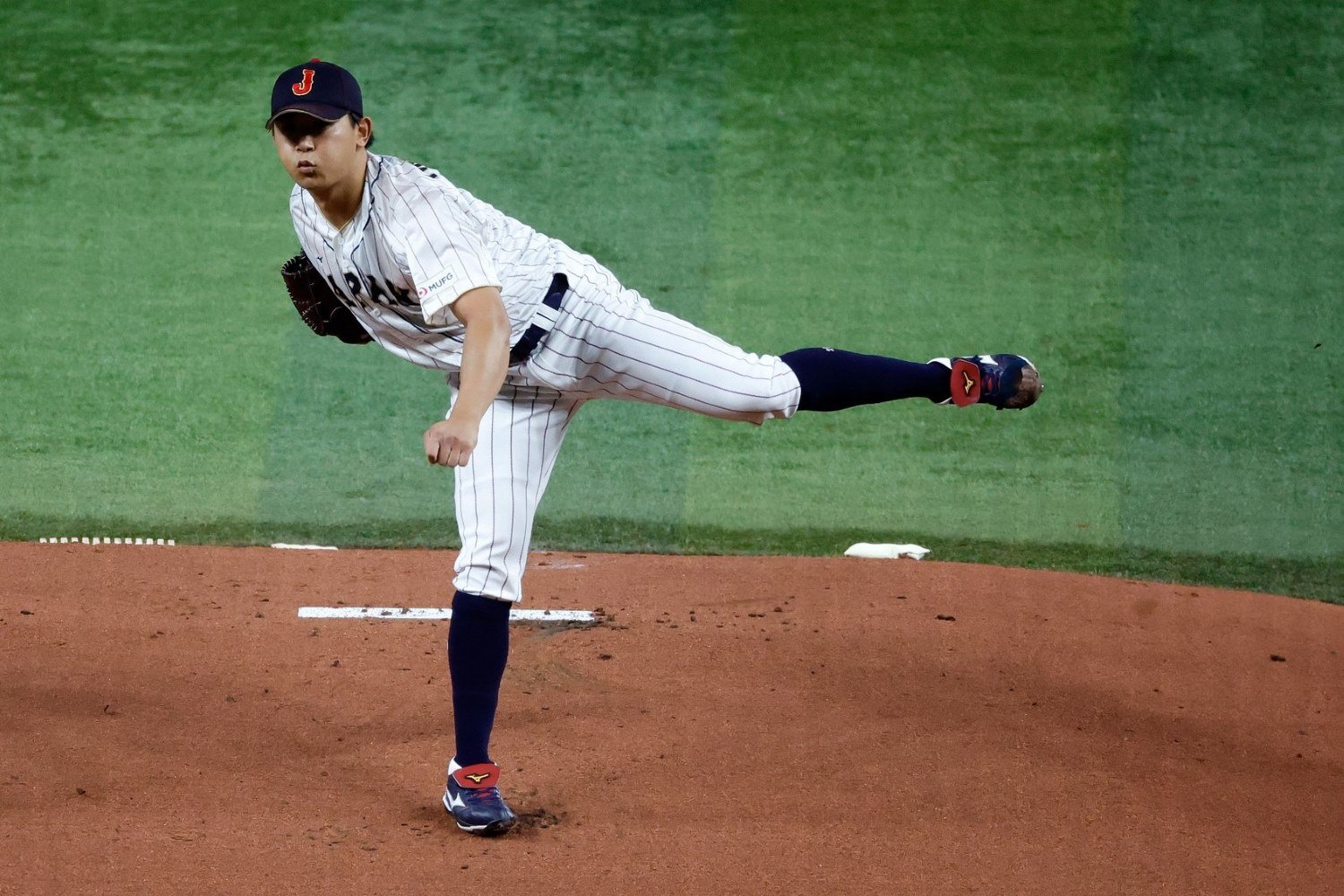
It's true: Shota Imanaga doesn't throw all that hard. While he's touched 96 miles per hour a few times relatively recently, he more frequently sits between 91 and 93 miles per hour. In an MLB where the average four-seamer hums in at 94, that marks him as below-average in one regard. When you combine that apparent weakness with the fact that he's left-handed and his relatively small frame, you can talk yourselt into viewing him as a guy who will be lucky to hold up the back end of an MLB rotation. Multiple evaluators have done just that, led by the venerable Baseball America.
While the non-velocity concerns raised by some are valid (and will be briefly treated here, in due time), the dismissiveness with which Imanaga's potential to be an above-average starter has been downplayed is half-baked. Take every pitcher who threw at least 200 four-seam fastballs last year, and their per-pitch run value on that offering has a correlation factor of 0.27 with velocity. In one (much too simplistic) reading of the data, then, velocity can explain about 27 percent of a pitcher's fastball effectiveness.
I don't know whether that number surprises you. It feels right to me, but in the modern game, we hear so much about velocity that the relationship might sound unexpectedly weak. It's true, though, and we've advanced enough in our collection of data about pitching to say with some certainty that other attributes affect the effectiveness of fastballs, too. Imanaga doesn't have even average velocity, but he does do a couple of other things well. We know that his spin rate and his vertical approach angle (VAA) are both substantially better than average.
As it turns out, if you have to choose, you want the guy with those two attributes, rather than the guy with the more commonly cited one. Spin rate (0.25) and VAA (0.25) have almost as strong a correlation with run value per pitch as does velocity. Now, the three attributes overlap, and don't add up to explain three-quarters of fastball effectiveness. But it's not as though every pitcher with a good spin rate has a good VAA, and that citing the two is thus redundant. Velocity carries a correlation coefficient of 0.23 with spin rate and of 0.25 with VAA. Spin and VAA share a coefficient of 0.22, meaning they're no more likely to coincide than velocity and either of them are. These are interrelated characteristics, then, but each has independent value, and a guy with Imanaga's combination of the two newer, less heralded markers is as valuable (or more so) than one who throws hard but lacks anything special in terms of spin or VAA.
The best comp for Imanaga's fastball characteristics might be Andrew Heaney, another high-spin, flat-VAA, relatively low-velocity lefty. Heaney certainly has profiled as a back-end starter for much of his career, but that's much more because his slider usually doesn't miss bats and because his changeup is inconsistent than because of that fastball. When he's had those elements working, as was the case during his 2022 stop with the Dodgers, he's been dominant. If Imanaga is able to sustain his higher-end velocities better than expected, he starts to profile more like Freddy Peralta, anyway, but Heaney would hardly be a disappointing comp.
That brings us to Imanaga's other offerings. He has a sweeper and a splitter right now, each of them effective in their own ways. In fact, he throws two different flavors of changeup--one a split-change from an unusual, four-seam grip, and one more of a straight change. The splitter is the pitch that will devastate big-league hitters, assuming he can find a feel for it with the different ball they use here in the States.
I believe completely in the value of Imanaga's fastball. The splitter is always a tough pitch to project, but he seems to have the feel and the experience with it to adapt. The differentiator for him will be the breaking ball. I called it a sweeper a moment ago, and that's what it is, but the team and Imanaga might come together to decide that that pitch is better shoved into a tertiary, complementary role, with a more vertical, 'gyro' slider taking over as the primary breaker. That kind of pitch would work better against right-handers and give Imanage three different looks against them.
A sweeper, as we discussed over the weekend, is an unavoidably platoon-vulnerable offering. For a lefty, it often has limited utility. Imanaga might overcome that, but reshaping the breaking ball might be the key to making him the partner the Cubs want for Justin Steele at the front of the rotation. His fastball, despite the malign with which it has been treated in some corners, needs no such adjustment.
Does Imanaga's lack of raw heat concern you? Will Imanaga miss enough bats to dominate in MLB? Here's the place to discuss it.





Recommended Comments
Create an account or sign in to comment
You need to be a member in order to leave a comment
Create an account
Sign up for a new account in our community. It's easy!
Register a new accountSign in
Already have an account? Sign in here.
Sign In Now