


Cubs Video
The 2024 Chicago Cubs weren't a bad offensive baseball team. They were 12th in the league in runs scored (736), eighth in steals (143), and were top 10 in on-base percentage (.317). But they also lacked impact. Their team ISO (.151) sat 21st, while they made contact at the league's 16th-best rate (76.8 percent).
Two weeks into the 2025 season, I'm not thinking about last year's group anymore. But while I thought Kyle Tucker's addition and Seiya Suzuki's subsequent move to a (physically) safer role as the designated hitter would correlate with an increase of "impact," the team is generating runs in a way that perhaps I didn't initially expect.
This iteration of the Cubs is one carried by their offense. A team that ranks just 16th in starting ERA (3.81) and features the 24th-ranked bullpen ERA (5.21) hasn't really been fazed by their shortcomings on that side of the ball—not when they've scored more runs and stolen more bases than anyone else in the league, by a pretty wide margin. These two things are related.
Nobody in the league has scored more runs than these Cubs, whose 94 sit well ahead of the second-place New York Yankees (78). They also feature the league's fourth-best strikeout rate (19.3%), best walk rate (13.0%), and are running the ninth-best ISO (.170). Yes, the Cubs have a couple of extra games on their line, but it's not as if they were stuffing the sheet with those two games in Tokyo.
Perhaps most notable, though, is the fact that they've also stolen 25 bags, which leads the league. Better still, they've only been caught once. Boston hasn't been caught yet, and each of the Giants and Angels have been caught once, as well, but those three teams have combined for 34 steals.
Pete Crow-Armstrong is an obvious culprit here. He only has a .300 OBP through 60-ish plate appearances, but it seems like he's working his way on base in other ways (fielder's choices, etc.). He's stolen six. Nico Hoerner is tied atop the leaderboard, though, with six of his own. Jon Berti has swiped five in limited service, while each of Kyle Tucker, Dansby Swanson, Ian Happ, Michael Busch, and Seiya Suzuki have at least one steal on the books.
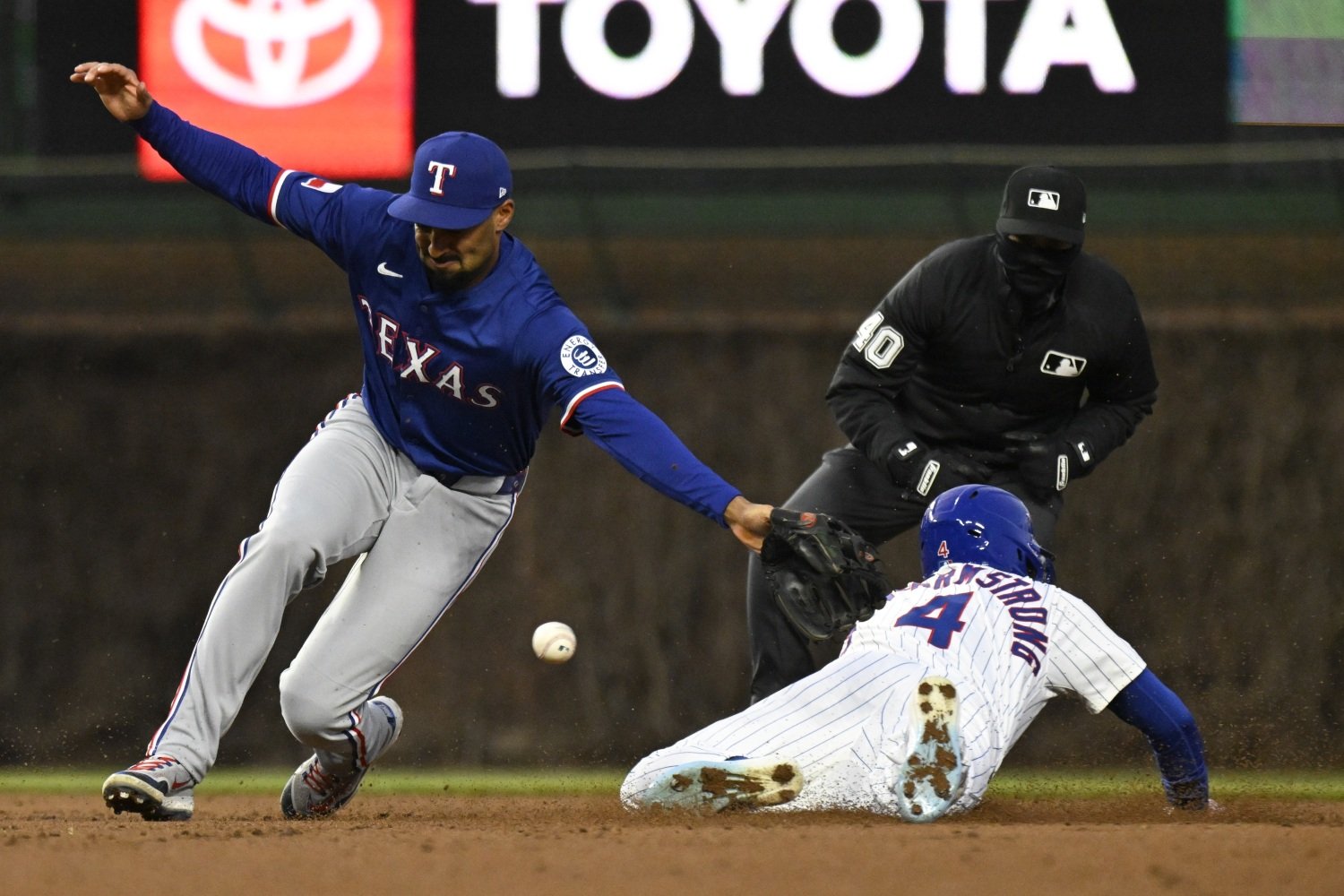
Monday night's game against the Texas Rangers demonstrated the team's ability to take advantage of in-game context. They were able to take advantage of a slow-to-the-plate Nathan Eovaldi and stole five bases in that game alone. Given the Cubs' standing last year in the stolen base rankings, it's not a surprise. But it feels like the additions of Tucker and Berti, in particular, give them additional personnel to feel comfortable in making the attempts.
But it's not just the steals that are working for the Cubs. It's their overall aggression and efficiency. Statcast has the Cubs as attempting advances on 46 percent of their opportunities. That comes in above their estimated advance attempts, and is the highest rate of attempts in all of baseball. They've been safe on such advances 38 times. The raw number trails only Boston and Arizona, while their success rate per opportunity is ahead of the entire league.
In a more comprehensive sense, FanGraphs's baserunning metric (BsR) measures baserunning runs that take into account extra bases, outs on bases, steals, and contact into double plays. The Cubs are at a 3.2 there, which is also tops in the league. For context, they finished at a 10.6 last year.
It certainly helps that the Cubs are, in fact, fast. We know about Crow-Armstrong. However, I'd like to submit the following into evidence:

Crow-Armstrong is a boon to your team's baserunning output. But getting Suzuki, Matt Shaw, Dansby Swanson, and Nico Hoerner at the higher end of their positional groups means that over half the Cubs' lineup is among the fastest at their position. And it's not as if the rest are all slow. Busch and Happ sit right about average in their speed. The book on Tucker has long been that he's not fast, but he's smart. So the collective is one built to do exactly what the team is doing, considering their only slow and bad baserunners come from the position that is supposed to be slow and bad at baserunning.
We knew the Cubs would be better on offense. It'd be really difficult to add someone like Tucker and get worse. But while we expected a bit more on the impact side to manifest in terms of power given the factors noted at the top, it's actually been the baserunning driving the bus—which is a good thing! For two reasons.
First, it's sustainable. Unlike hitting into some batted-ball luck or performing outside a career trend, it's an element over which you can exert control. Second, and perhaps more importantly, it's cold. If you're setting the stage for generating offense at a point in the calendar where power production is going to be pinned down by the temperature, the warmer temps to come should almost serve as something of a bonus.






Recommended Comments
There are no comments to display.
Create an account or sign in to comment
You need to be a member in order to leave a comment
Create an account
Sign up for a new account in our community. It's easy!
Register a new accountSign in
Already have an account? Sign in here.
Sign In Now