


Cubs Video
If you're a baseball fan, you have at some point lamented that there aren't more triples in the big leagues. It might be the most universal opinion in the wide and varied community that is the baseball world. Triples are the most interesting play in baseball, and while the overall trend for the last century has been toward a more athletic, more impressive, (eventually) more compelling game, the most exciting individual outcome has become tragically rare.
Many blame this on the fading role of speed in the game since the dawn of the PEDs Era in the late 1980s. Players are bigger, stronger, and the fastest of them are even faster, but there are fewer players who have what we used to call plus speed, and some of the fastest ones hit the ball over the fence too consistently to put all that speed into action on the field. There's an attribution error in play there, though, because here's the twist: triples aren't as much about speed as you think.
Look at the all-time leaderboard for triples, and you'll see a solid wall of grayscale faces under squashed, logo-free hats. Of the top 50 hitters with the most triples in baseball history, only two spent any significant period of their careers playing after World War II. Those two guys—Stan Musial and Roberto Clemente—start to point us in the direction of a revelation. Study the many players above and around them on the career list, and you'll take another step toward that epiphany. They probably were fast, for the most part, but these were also some of the best power hitters of the Dead Ball (and early Live Ball) Era. It's just that, given the equipment and the dimensions of most parks during those players' careers, it was hard to rack up home runs. Hitting a triple wasn't just like hitting a double, only you were fast enough to take another 90 feet by becoming a blur between bases. It was a sign that you could hit the ball far enough to force defenses to spend extra time chasing it.
The disappearance of triples in the modern game is much more about shrinking parks, a livelier ball, and better, deeper-positioned outfield defenders than it is about diminishing speed in the game. More long hits clear the fences. When they don't, they're pursued by faster people with stronger arms, to fences closer to the cutoff man waiting for the throw to the infield—and those people play deeper, in the first place, so they get to the ball more quickly than players did even a decade ago. That's why, after flatlining at what seemed to be a practical minimum for the previous 30 years or so, the global triples rate fell through that false floor and found a new one after Statcast data came into play.

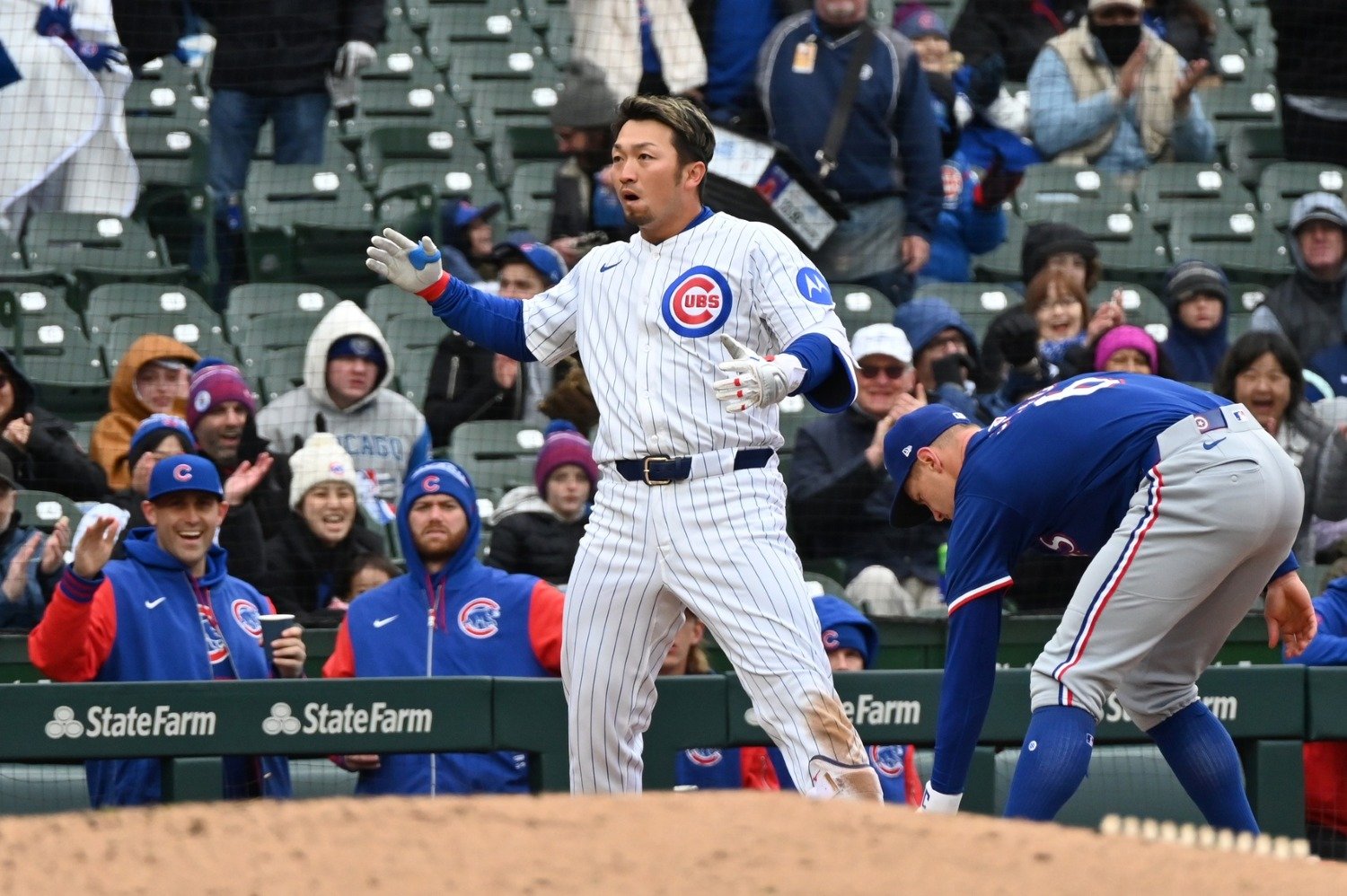
However, in parts of four big-league seasons, Seiya Suzuki has 16 career triples. That's despite having speed on par, perhaps, with the best years of Musial or Clemente, but nowhere near that of the guys you think of hitting lots of triples: Willie Wilson, Brett Butler, José Reyes, and other gap-splitting speedsters. Suzuki has tripled in almost 1% of his career trips to the plate, well over double the league-wide clip. Why? For the same reasons why Clemente was great at it. He hits the ball hard, everywhere, and opponents don't understand how or respect him enough in the process.
Firstly, let's talk about the disrespect defenses show Suzuki. It's perplexing. Here's the player- and ball-tracking map of Suzuki's triple Tuesday night in Pittsburgh.

This ball was not that resoundingly struck. It was hit well, to be sure, but under 100 miles per hour off the bat. With better positioning, it might have been catchable. More plausibly, Tommy Pham could have gotten to it much more quickly and held Suzuki to a double. In reality, though, the Pirates left fielder was playing just 293 feet away from home plate. That's why you see the depth of the angle he had to take back to the ball, and why it took so long to get there that Suzuki was at third before the Bucs could relay the ball back in.
Pham's was egregiously bad positioning, but this is a habit for the whole league. You can call it general disrespect, or speculate that teams are trying to position their left fielders to collect the scalded ground balls Suzuki often shoots through the left side of the infield, but the fact is that Suzuki has batted-ball quality similar to that of the Athletics' Brent Rooker and the Rangers' Wyatt Langford. The league doesn't defend him as cautiously as they defend Suzuki. Here's the average starting depth of each outfielder against each of those three hitters, and against right-handed batters, on average.
| Player | LF | CF | RF |
| Brent Rooker | 305 | 328 | 297 |
| Wyatt Langford | 307 | 327 | 298 |
| Seiya Suzuki | 302 | 322 | 293 |
| League - RHH | 301 | 322 | 291 |
One reason why Suzuki can often take third, then, is the fact that teams don't play deep enough against him. He hits balls over fielders' heads that should be caught, because they don't believe he's going to hit it that far until he does.
There's certainly more to it than that, though, and we'd give Suzuki too little credit if we acted as though this is fully avoidable problem the league is creating for itself. After all, as mentioned above, he does hit it hard through the infield often, which requires outfielders to be ready to come get the ball in front of them.
More than that, though, Suzuki also has a tendency to hit balls that fool you. When he drives the ball to the middle of the field, it often has a bit more juice on it than the center fielder thinks. Something about his swing—which is decidedly unique, in the way that he generates his cleanest contact to center, whereas most modern hitters gear up to maximize their power to the pull field—is hard to read.
Leody Taveras could have cut this ball off, if he had fully realized how hard it was hit. He didn't. A lot of Suzuki's triples look something like this; they involve a fielder slightly underestimating how well he hit it, and either taking a poor route or failing to field it cleanly when they get to the ball. Often, there's a combination of the player having been out of position when the ball was hit and their not being ready for the carry on it when they try to finish a play.
Suzuki's doubles look a lot like the typical double. His triples are unusually well-struck.
| Doubles | Triples | |||||
| Player | Exit Vel. | Launch Ang. | Distance | Exit Vel. | Launch Ang. | Distance |
| League (s. 2022) | 97.9 | 17 | 261 | 98.6 | 19 | 292 |
| Seiya Suzuki | 98.8 | 16 | 257 | 102.6 | 18 | 319 |
Now, there's another element to a triples hitter, beyond power and speed. You also have to be a heads-up, high-motor player. Suzuki has those traits in spades, too, which is the final ingredient in the soufflé. He gets out of the box well, notices when a fielder has trouble with the ball, and knows where each park might have a quirk that allows him to take an extra base—like the deep corners at his own home, Wrigley Field.
The ability to surprise teams. A systematic defensive weakness of which he's well-wired to take advantage. Very real power and good speed, and the awareness to maximize the value of them. Suzuki is a unique player, and it's allowed him to hit a bunch of triples, in a league slowly losing that skill—despite not fitting the archetype many have in their heads of a triples hitter. It's a delightful thing to watch, and a source of sneaky added value for the Cubs' star slugger.





Recommended Comments
There are no comments to display.
Create an account or sign in to comment
You need to be a member in order to leave a comment
Create an account
Sign up for a new account in our community. It's easy!
Register a new accountSign in
Already have an account? Sign in here.
Sign In Now