


Cubs Video
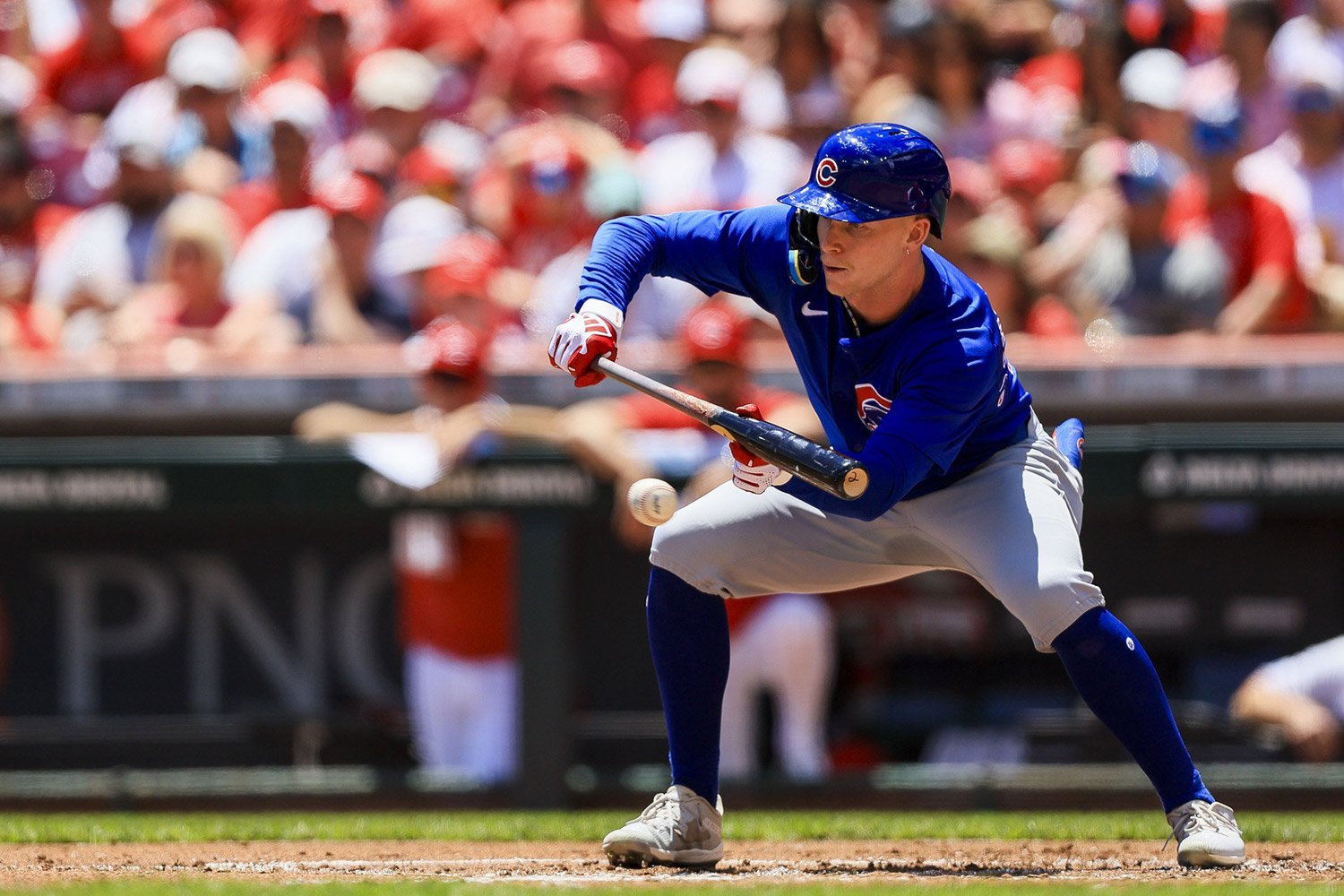
Last Wednesday, with two on, two out, and the Cubs trailing by two in the bottom of the sixth, Pete Crow-Armstrong stepped to the plate. This was a fantastic opportunity for the North Siders, who were going for the sweep against the Miami Marlins, to scratch a few runs across the board and get back in the ballgame. Except that Crow-Armstrong, who, through Saturday’s games, has been the 19th best qualified hitter in baseball by wRC+, bunted. He did succeed in doing so, despite it being a terrible bunt, thus loading the bases for Nico Hoerner.
For what it’s worth, and you likely already know this, Nico Hoerner struck out to end the inning, and the Cubs went on to lose the game, 3-1. The end result is somewhat irrelevant. Hoerner could have hit a grand slam there, and I’d probably still be writing this article. For me, the ends don’t always justify the means. In this case, they did. I am here to talk about one of the Cubs’ best hitters deciding to bunt with two on and two out while down two runs.
I have been here before with the young center fielder. On August 1 of last year, I wrote an article pleading with him to stop bunting so much. Through that point of last season, Crow-Armstrong was hitting just .222 on 13 bunt attempts, which was the worst mark in baseball of anyone that had put down at least 10 bunts.
He has been considerably better since. He had a .625 batting average on bunts in August and September of last season, according to Baseball Savant. He also had four sacrifice bunts, which of course, don’t count against his batting average. I’m not sure it’s fair to ever give Crow-Armstrong a sacrifice bunt, because every bunt he lays down is an attempt at a hit. If it ends up as a sacrifice, that is simply a positive consequence. That being said, I’ll be nice and not knock him for it.
This year, he’s hitting .400 on five bunt attempts, with three sacrifices. Hooray! I would have been thrilled with that last season. Now, I'm not, mostly because Crow-Armstrong is a good hitter these days. A flawed one, sure, but the current results can’t be argued with.
Back to Tuesday night’s decision to bunt. In deciding to bunt, he took away any chance that he had to drive in a run. The best-case scenario that he created for himself was for the Cubs to end up with the bases loaded and two outs. Using the Win Probability Added (WPA) Inquirer at FanGraphs, we can calculate the average WPA that Crow-Armstrong was providing by bunting, or by swinging away.
For example, if he bunts, we can assume that would result in a single 40 percent of the time, and an out 60 percent of the time, since he is hitting .400 on bunts this season. The Cubs would go from a 24.7 percent chance of winning with runners on first and second with two outs, to a 29.9 percent chance of winning with the bases loaded and two outs, a 5.2 percent difference. He has a 40 percent chance of creating that 5.2 percent difference, so if we multiply those two together, we get 2.1 percent.
But he also has a 60 percent chance of making an out, and in this case, an out would drop the Cubs’ win probability by 6.6 percent. Multiply those together, and we get -4 percent. If we subtract that from our first number, we get -1.9 percent. This means that, with Pete Crow-Armstrong squaring to bunt in that situation, he is subtracting 1.9 percent from the Cubs’ win probability, on average.
Now, let’s run that same calculation, for this particular scenario, based on his full season statistics. Let’s also assume a single scores one run, and a double scores two:
|
Event |
% chance of happening |
WPA added or lost |
Average WPA added or lost |
|
Single |
13.51% |
13.4% |
1.8% |
|
Double |
5.95% |
30.6% |
1.8% |
|
Triple |
0.54% |
31.4% |
0.2% |
|
HR |
6.49% |
45.9% |
3% |
|
BB/HBP |
5.41% |
5.2% |
0.3% |
|
Out |
68.11% |
6.6% |
-4.5% |
|
Total |
2.6% |
Adding all of that up, and we can see that an average plate appearance from Pete Crow-Armstrong in that situation would result in 2.6 percentage points of win probability added. A much better figure than the average bunt, which as we saw above, would result in a 1.9 percentage point loss in win probability.
Is this logic perfect? No, and I can mention the variables that this does not address, some of which support the bunt, and some of which do not:
-
The next batter was Nico Hoerner, who is a decent player and has been a roughly league average hitter for several seasons now. He is also one of the Cubs’ worst hitters. It’s not like Kyle Tucker was due next.
-
A single will not always score one run, and a double will not always score two.
-
The pitcher was Calvin Faucher, an above-average relief arm. Perhaps Crow-Armstrong didn’t like the matchup.
-
There is some very small chance that the Marlins throw that ball down the right field line and the Cubs score two runs on the bunt, especially given the weather conditions at the time. I am assuming there is a zero percent chance of that happening in the above calculations.
I don’t think any of that is bridging the gap between average WPA on a bunt vs. swinging away, though. Ironically enough, Pete Crow-Armstrong stepped to the plate with two on and two outs in a tie game on Friday afternoon against the White Sox. He swung away, and deposited the ball into the right field bleachers, giving the Cubs a 5-2 lead that they would never look back from, adding 26% to the Cubs’ win probability.
Hopefully he learned his lesson. Pete Crow-Armstrong is just a good hitter now. Period. He’d do well to remember that.





Recommended Comments
Create an account or sign in to comment
You need to be a member in order to leave a comment
Create an account
Sign up for a new account in our community. It's easy!
Register a new accountSign in
Already have an account? Sign in here.
Sign In Now