


Cubs Video
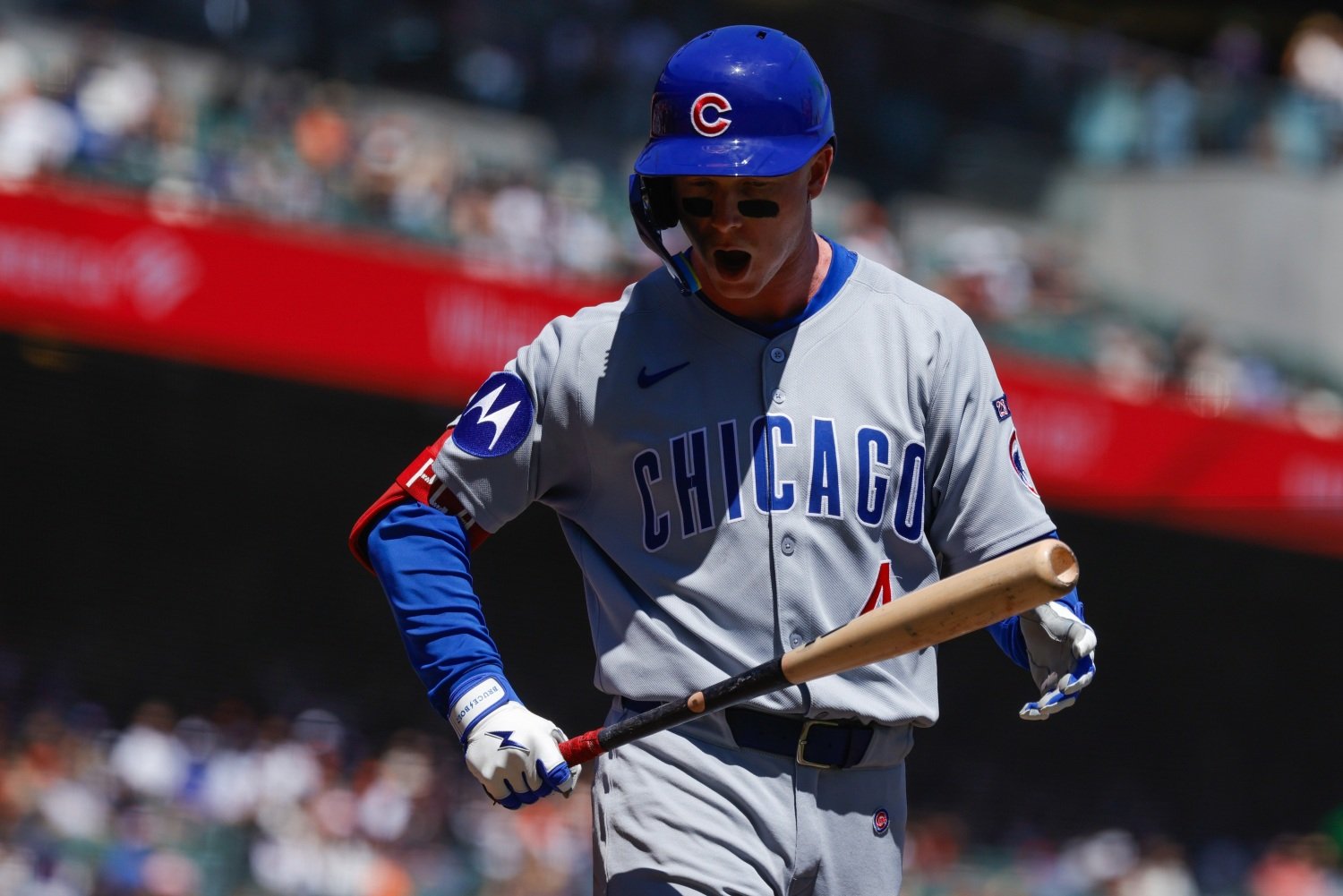
In one sense, there was always a clear and present danger that Pete Crow-Armstrong would regress from the heights to which he soared in the first half of this season. His hyper-aggressive approach left no real floor beneath him; a cold snap from him was bound to be uglier than the same level of struggle by most other hitters. Nonetheless, the profundity and the shape of his tailspin since the start of the second half—.212/.261/.363, with just three home runs and seven walks in 162 plate appearances, against 41 strikeouts—is jarring. Even that sample lumps in a relatively hot second half of July, during which Crow-Armstrong clubbed a bunch of doubles. Since August 1, he's batting .162/.217/.231, and has only five total extra-base hits.
It's simple, in a way: Crow-Armstrong hasn't yet been able to correct the problematic overstriding that crept into his swing way back in June. It's left his swing a mess, and lately, it's made him look shockingly uncomfortable in the batter's box. As strange as it sounds, often, hitters are aware of problems like these but find them hard to solve. Crow-Armstrong knows he's been making himself late on fastballs and more prone to chasing soft stuff through this mechanical flaw, but in the heat of battle, it's hard to pay off the early work he and Cubs hitting coaches have put in to fix that issue.
You can see this in something like his Attack Angle, which is what Baseball Savant labels the angle between the ground and the movement of the sweet spot of the bat at the player's contact point on a given swing. It's a number that gives us a sense of a player's timing: a lower Attack Angle means a hitter isn't working up through the ball as much at contact, which means they're a bit later than when they have a higher number. Higher/earlier isn't always better, and every hitter has their own ideal range of attack angles based on their bat path and timing signature. For Crow-Armstrong, though, a steeper-than-average attack angle is where all his best production comes.
Pete Crow-Armstrong, Run Value Per 100 Pitches by Attack Angle
- Under 6°: -3.4
- 6°-12°: -5.6
- 12°-18°: 1.1
- 18°-24°: 5.5
- Over 24°: -3.8
Understanding that, look at this chart of his Attack Angle by month, broken down by pitch category.
.jpeg.ca1ceca4e40dc91683bd8da0ae9c22fe.jpeg)
It's only a moderate problem that Crow-Armstrong isn't getting up to 20° or so against softer stuff. The big problem is that he's been on the wrong side of 10° against fastballs since the start of August. That, in turn, stems from the aforementioned overstriding. As he described to me in July, that flaw lengthens the portion of his swing behind his body and makes it harder for him to work underneath his front side. It leaves him late on heaters far, far too often.
There's one more illustrative quirk to help understand what's going on, though. In Crow-Armstrong's first 445 plate appearances of this season, he was hit by a pitch three times. In his last 118 times up, he's been plunked four times. You've probably noticed him seeming to spin out of the way of dangerous-looking high fastballs more often lately, too. It happened as recently as Sunday—a couple of times.
You might be tempted to think that pitchers have seen Crow-Armstrong getting longer to the ball and decided to start pounding him up and in, even to a reckless extent. Alas, it's even worse than that: Crow-Armstrong is doing this to himself.
Here's a side-by-side look at Crow-Armstrong's stance and stride, for May (when he was devastatingly good) and August (when he was atrocious).
(11).png.c19f7ec1578f8ea932ef6e5642d76b07.png)
There's no secret knowledge required here. Just look at the images. He's starting a hair farther off the plate, but he's crept slightly forward in the batter's box, and his stance is less spread-out. He's overstriding, and he's striding right into the ball with his overlong, late-starting swing. He's jamming himself hopelessly on almost everything. There's no path to consistent, solid contact with this stride signature and Crow-Armstrong's lack of plate discipline.
That's not good news. It's like a diagnosis of cancer that, while not fatal, requires major surgery. Crow-Armstrong's poor plate discipline leaves him with no way to get right at the plate except to fix this major mechanical problem—no secondary way to succeed or mitigate failure—and this is the kind of mechanical problem that usually only gets fixed in offseasons. There's a chance that he can correct it, and if he does, he could quickly get back to doing what he did until roughly mid-July. Fatigue (mental and physical) is surely a factor here, but it's not as though the league has simply figured him out and switched to doing something he can't combat. Unfortunately, though, the solution to the problem he's having is tougher to unlock than it would be if pitchers were attacking him differently. It's all in his body, his eyes, and the hitting computer that is his brain. To get turned around before next February would take a possible but difficult (and very rare) feat of self-correction, in the midst of the grind of his first full season in the majors.
This is actually something the Cubs do well. They fixed Crow-Armstrong himself last July, and Miguel Amaya, too. They fixed Seiya Suzuki with a hard reset in 2023 and Matt Shaw with one this summer. However, it's awfully late in the campaign (and some of the bad habits his body is in are awfully ingrained) to get him right now. If Craig Counsell still believes it's possible to catch the Brewers for the division title (it's not) or that it's important to hold onto the top Wild Card seed in the National League (it is), he's unlikely to sanction a multi-day reset for Crow-Armstrong. He believes too much in the value of his center fielder's glove to give time for the resurrection of his bat. That dilemma is a thorny one, and it might become the limiting factor for a Cubs team that wants to go deep into October—but that also has to get there, first, and that can't afford not to have Crow-Armstrong running down balls in the outfield any more than they can afford not to have him hitting the ball.
At this juncture, it's unlikely that Crow-Armstrong will rediscover the magic at the plate in 2025. That's a major disappointment, but a hard reality. If he does turn things around, it will be the best story yet in a season full of interesting ones. It could even be the defining narrative of a team that goes all the way to the World Series. For now, though, temper those expectations—or at least, root for a few days worth of Kevin Alcántara and Willi Castro in center field.





Recommended Comments
Create an account or sign in to comment
You need to be a member in order to leave a comment
Create an account
Sign up for a new account in our community. It's easy!
Register a new accountSign in
Already have an account? Sign in here.
Sign In Now