


Cubs Video
I'm a ruminator, and one of my unfortunate habits is the rewatch. When I find a great piece of media, I prefer to marinate in it—to revisit and reexamine it—than to venture forth and try to find the next thing with something to say. Eventually, I do find new things, but I spend a lot of time going back to things I've seen and read and heard before, whether it be by actually consuming them again or by considering them in the context of some other experience or product.
In season 4 of The Wire, the show's most unabashed villain takes the stage. Marlo Stanfield isn't soulless; that's just a front he uses to project and accumulate power. But the process of proving himself hard, cold and ruthless has transformed him in ways he can't perceive. Marlo is a fool. He believes he's building a kingdom—making himself ruler of all he surveys. In reality, he's renting that world, the same way a drunk rents a bottle of whiskey. Just like the drunk is destroyed by that which he clamors to obtain and arrogantly believes he controls, Marlo is hollowed out by his consumption of power. But just like the drunk, he's dangerous and destructive to others, too, for every second he breathes and refuses to reform.
One episode opens with Marlo at a convenience store, where he buys a bottle of water—and, at the same time, brazenly steals something from the counter while the cashier is distracted by the transaction, in full view of the security guard near the door. It's a cheap display of immaturity and greed—the kind of thing a fool mistakes for power. It's an assertion of power over the guard, which is made plain to us when the guard follows Marlo outside. He confronts Stanfield, telling him he understands the power imbalance at play but challenging the budding kingpin to show more respect for his community and for working people.
"You want it to be one way," says the dead-eyed Marlo. He repeats it several times, flustering and (eventually) spooking the guard. Finally, he lets the other shoe drop, just before walking away. "But it's the other way."
In the scene itself, that means what it appears to mean. The guard, by putting on that uniform each day and trying to enforce a bare-minimum kind of order and justice at the store, is offering a mission statement for life. He wants a world where the rules apply to everyone; he wants even the drug lords of the projects to see a few lines they won't cross unless it's absolutely necessary. Marlo's reply is, essentially: no.
The scene is also a metamessage to the audience of the show, which sometimes lamented the extremes to which creator David Simon pushed the characters and the awful fates met by just about anyone who tried to make a positive difference. By that point in the show's life, Simon had heard those criticisms; they did not deter him. In fact, he himself characterized the show as "angry" more than once. His background was in journalism. He wanted to press reality (as he saw and understood it) up against the TV screen and make the world reckon with it. To the viewers, this scene said, "You want a world where morality matters. You want to believe that the powerful harbor a secret wish to consort with the powerless, and conform to their hopeful view of the world. You, who watch this from (in many cases, if not most) seats of privilege and comfort and whiteness, want to believe you've helped create and now occupy a governable, essentially fair world. You don't."
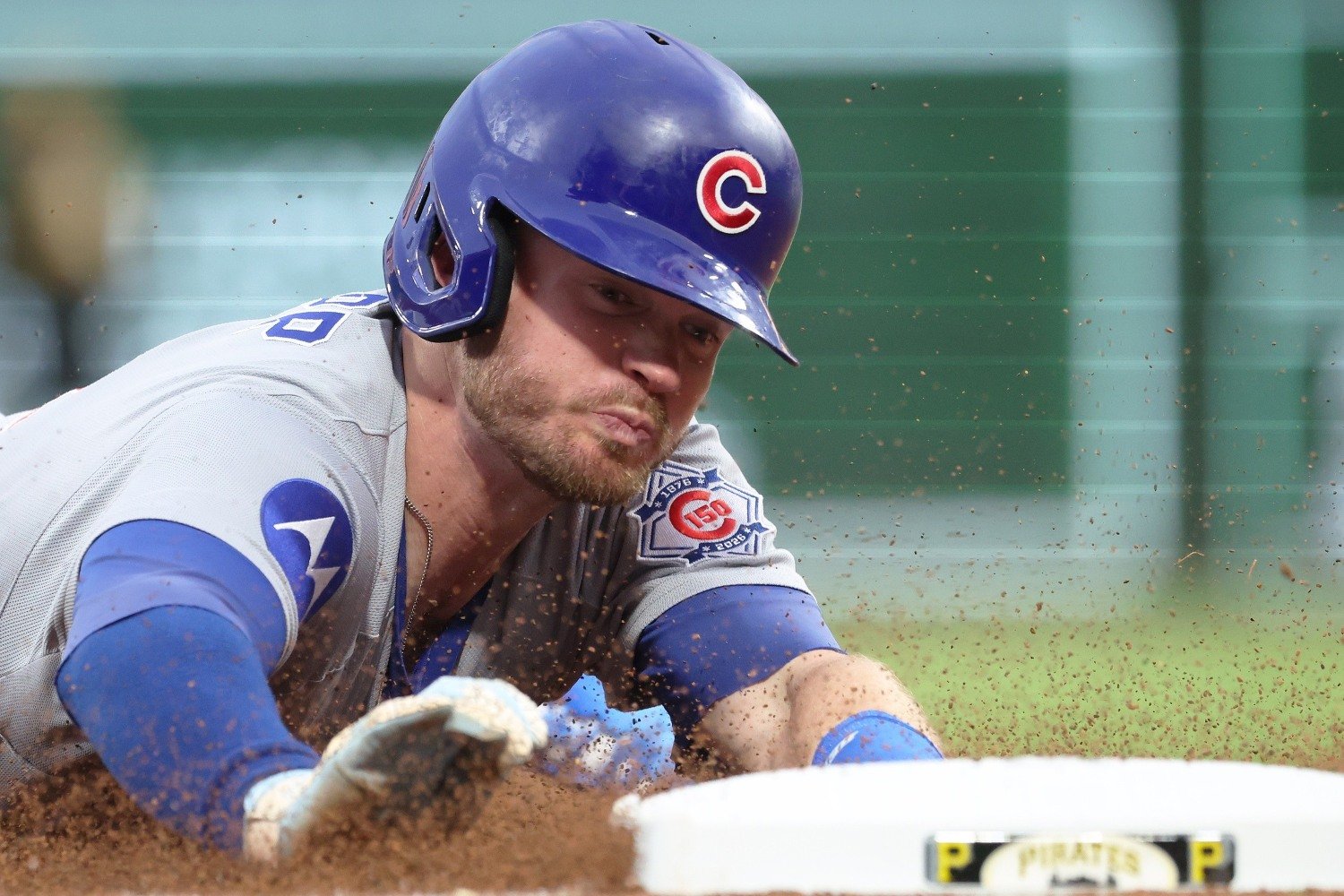
All of this ran through my head in the top of the seventh inning Friday night. In a 1-1 game, Ian Happ swung at an 0-2 pitch diving toward his back foot, and he hit a nothing ball—a tapper toward first base. The Pirates' Ryan O'Hearn came to collect the ball and flipped casually to Wilber Dotel for the out—or was it one? Happ, to the surprise of the Pirates, had absolutely busted it out of the box and all the way up the first-base line. The play was shockingly close. In fact, the Cubs asked for a replay review. And in fact, Happ had been safe. He beat out an infield single, on a ball that had no business being one. It took the failures of two Pirates defenders to turn that sure out into a hit, but by hustling unreservedly at the end of what should have been a third straight empty, frustrating plate appearance, Happ created a chance for a game-winning rally.
On a 2-2 count, Nico Hoerner then hit a flare to center field. Happ got a perfect read, knowing not only that the ball would fall in but that it would die (it was off the end of Hoerner's bat) and take time for center fielder Jake Mangum to field and fire in. He made it to third base on the play, putting him in position to score the go-ahead run. The combined exit velocities of Happ's and Hoerner's hits (121.8 MPH) was lower than those of two individual batted balls in the career of Pirates outfielder Oneil Cruz, who has twice hit it harder than 122 MPH. But because of Happ's hustle and his smarts, he had a great chance to tick the telling tally in a crucial game.
He didn't, though. Pedro Ramírez struck out looking, and Carson Kelly grounded into a fielder's choice. The rally died. You want it to be one way, in baseball and in life. You want effort and preparation and instinct and solemn, high purpose to be rewarded. But it's the other way. Baseball, like the world, is not a democracy or even a meritocracy but an oligarchy. Talent tells. Hustlers and scrappers can hustle for scraps once the big dogs eat.
Of course, the Cubs were the big dogs in this fight, really. They pushed the game all the way to a 10th inning, and then they won it. Happ made a dazzling defensive play, because although he's not a superstar, he's immensely talented in his own right. In the bottom of that same seventh inning, the Pirates took their turn putting runners on the corners with one out, and they managed to hit the fly ball the Cubs needed from Ramírez.
It was a medium-depth fly to left field, shallow enough to give Happ a chance to throw out the runner in terms of sheer distance, but it wasn't hit as lazily as one might have liked. Happ had less time to get behind it and start his movement toward home plate than he'd have liked; he had to generate all the power for a strong throw in a short span and (because a crow hop was a luxury he could ill afford) a small space. Doing that is difficult, and being accurate while doing it is almost impossible. Happ doesn't have an elite outfield arm in terms of sheer arm strength. But in this way, he's elite. He got off the throw, and fast. It was strong, and it was true, and the play wasn't even terribly close.
Happ was the Manfred Man in the top of the 10th inning, too. He came around to score the go-ahead run on a hard single to center by Dansby Swanson, and though his nimbly-adjusted slide to the inside of home plate first left him coming in too fast and his front foot bouncing over the plate, his tucked leg still reached its destination before the tag from an awkwardly lunging Henry Davis. It was another great bit of baseball from Happ, and although the play was breathtakingly close to heartbreaking, it turned out all right.
That's not meant to imply that Happ's refusal to jog it out in the seventh or his perspicacity on the bases in that inning somehow earned him a smile from karma in the 10th. The Cubs won the game because of Happ's talent in left field, and because they've patched together an adequate string of pitching performances lately in front of an elite defense, and because Pete Crow-Armstrong is an incandescent superstar. Crow-Armstrong homered in the sixth to give the Cubs their only run in regulation, and when pitcher Yohan Ramírez fell behind 2-0 on him in the 10th, the Pirates intentionally walked Crow-Armstrong to load the bases with two outs. First base wasn't even open; they already trailed; and Ramírez has poor control. Seiya Suzuki exploited the moment by waiting out Ramírez and accepting an RBI walk, pushing across the insurance run that would prove to be the margin of victory. Crow-Armstrong's maturation into a patient hitter who won't get himself out earned him that free pass. In the past, the Pirates could and would have kept pitching to him in that spot, expecting him to expand his zone. He's a truly great player right now. Suzuki is a fearsome and disciplined hitter, too.
There is another reading of Marlo's encounter with that security guard that's worth pondering, though. Maybe it's one only watching the series from a place of privilege and comfort would ever produce, but here goes: Marlo is, in a sense, wrong. The guard is, in a sense, right. Don't get me wrong: the world is as ruthless and as avaricious as Marlo Stanfield is. But real goodness is also unkillable. Marlo has that guard killed, and Simon would probably prefer that we take a sobering, dour lesson from that: the powerful will respond to your demands for dignity only by pulverizing you. Certainly, whether a person lives or dies is the ultimate equivalent to pointing toward the outfield and saying, "Scoreboard." What matters most, to most people, is who lives and who dies. What matters most, to most baseball fans, is which team wins each game.
Why did Stanfield really have that guy killed, though? To make an example of him, sure, a little. To announce his dominance over everything and everyone. But deeper, down on a level Marlo couldn't even reach or understand, he did it because the guard had revealed the truth to him. Whether we try does matter, and so does whether we persist when our first attempts fail. Morality does matter. The world will not reward your good thoughts, words or deeds, in an extrinsic way; the world will come closer to punishing you for them. But it's your duty to think good thoughts, say good words, and do good deeds, anyway. Sometimes, you'll have enough power and enough opportunity and enough luck to be celebrated for that goodness. Sometimes, you won't. But life isn't counted out in dollars or in influence. Those are outputs. The real measure of our time is our inputs.
Happ struck out both times he saw Jared Jones Friday night. In his third at-bat, against Dotel, he swung at a bad pitch, took a good pitch, then swung at another bad one. He happened to just touch that third offering, though, and when the least window opened for him to turn a bad day for the better, he seized on it like he understands the difference between a thing done well and a thing done ill. He was fully present. To him, the right things mattered, and doing things right was his way of expressing what mattered.
As most Cubs fans know, Happ is from Pittsburgh. Many forget (or never knew) that, 11 years ago, he lost his father to brain cancer, just a few months after he was drafted by the Cubs. The emotions tying him to Pittsburgh aren't simple; they must be equal parts joyous and painful. When he takes the field in his hometown, his surface-level stoicism burns off a bit, and you can see the same attention to detail and insistence on consistency that was handed down to him by Keith Happ, an agronomist for the United States Golf Association. He was a .306/.387/.528 career hitter at PNC Park before Friday. On a night when his bat wasn't doing the job, he found no fewer than three other ways to will the Cubs to a win. Not all of those efforts directly contributed to the win, in a tangible way, but that's not the same as saying they didn't all matter. They did.
You can't win 'em all. Nor can you run 'em all out. Nobody is on their game and on fire with intelligent intensity all the time. Games played the way Happ played Friday night deserve special recognition, though. It's easy to give that recognition, because he ended up making a big and obvious contribution to an important victory. Even if the Cubs had lost, though, that seventh-inning sequence would have been valuable. Not all rewards are extrinsic. You can win every day, if not every game—one way, or the other.
Are you optimistic about the Cubs right now?

Follow North Side Baseball For Chicago Cubs News & Analysis



-
 1
1
-
 1
1


Recommended Comments
Create an account or sign in to comment
You need to be a member in order to leave a comment
Create an account
Sign up for a new account in our community. It's easy!
Register a new accountSign in
Already have an account? Sign in here.
Sign In Now