


Cubs Video
It's a race to 27 outs. There's never a doubt, with Craig Counsell, that that's what a playoff game is about. He uses an extremely short leash on starting pitchers in October, because as much as starters might be the drivers of narratives about teams and their seasons, they're not the best batter-for-batter options to win the race to 27—at least not beyond the middle of the game. Counsell got 4 2/3 innings from Matthew Boyd Thursday in Game 4 of the NLDS, which is just over halfway to 27. It's the most he's asked of any pitcher in the Cubs' seven playoff contests.
That won't change Saturday night. The Cubs and Brewers will reconvene where their season series (and this postseason showdown, too) began, at Uecker Field in Milwaukee, with both teams' seasons in the balance. The candidates to give Counsell meaningful length are Shota Imanaga (the most likely starter) and Colin Rea, with Michael Soroka and Aaron Civale as less likely options. No matter who gets the longest assignment(s), though, a good chunk of the game will be handed off to some combination of the five pure relievers Counsell really trusts.
There are three key questions the manager has to answer, when trying to select where and how to use his bullpen in a high-stakes game like Saturday's.
- Which relievers are especially good matchups for particular opposing batters?
- Who's been overexposed during the short series, especially to particular batters?
- How tired is everyone involved, and what constraints does that fatigue place on their availability?
The first and third considerations are obvious, but the middle one can often be hugely important, too. We talked about this during the Padres-Cubs Wild Card Series, and with good reason. The more a given batter sees a particular pitcher within a series, the better they hit them. It's not unlike the times-through-the-order penalty, for the number of times batters see a starter within a game.
One major drawback of the way Counsell has deployed his pitchers is that, once a series reaches its terminal stage, there's not much novelty left to mine out in that bullpen. If the skipper trusted Soroka to come in and try his hand again, he'd have a pocket of the lineup at which to aim him that hasn't seen much of him yet, but the trust circle only circumscribes five players right now: Brad Keller, Daniel Palencia, Drew Pomeranz, Caleb Thielbar and Andrew Kittredge. Most of the Brewers have already seen each of those guys a time or two—and the "or two" there is very important. Seeing a reliever twice in a series is normal, and doesn't seem to make a huge difference. That third time can be real trouble. Here's the chart showing how many times each relevant matchup has already happened in the last week.
| Pitcher/Batter | Yelich | Chourio | Turang | Contreras | Vaughn | Frelick | Durbin | Perkins | Bauers | Ortiz | Collins |
| Keller | XX | X | X | X | X | X | X | ||||
| Palencia | XX | X | XX | XX | XX | XXX | X | X | |||
| Pomeranz | XX | X | XX | X | X | X | X | ||||
| Thielbar | XX | X | X | X | X | ||||||
| Kittredge | X | X | X | X | X |
It might well have passed without your notice, but in the top of the sixth inning on Thursday night, there was a warning Counsell will need to heed in Game 5. Palencia, working for the third game in a row, got two quick outs, but then he allowed a scorched line-drive single to Andrew Vaughn, who was seeing him for the second time in the series. After that, Caleb Durbin lifted a fly ball to left field for the third out. It wasn't all that threatening to look at, but it left his bat at 90.1 miles per hour and with a 31° launch angle. That's a very narrow miss. If Durbin is just a hair quicker, that's a home run. It was, not entirely coincidentally, the third time he'd faced Palencia in the series.
Counsell has deployed Palencia and Keller in a relatively matchup-agnostic way. They are, for him, situation guys, rather than pocket-of-the-order guys; their stuff and their skill are meant to work against anyone. Such hurlers aren't immune to this kind of effect, though, so if Palencia is to be used in Game 5, it needs to be at the bottom of the Milwaukee order. If Durbin bats seventh, that'll mean squeezing him into the 8-9-1 lane between Durbin and Jackson Chourio, who has already seen Palencia twice, himself.
If Durbin bats sixth, there's a bit more breathing room, but only if Jake Bauers starts in place of Vaughn. You can't—you absolutely can't—let Palencia face Frelick, who hit all 12 of his home runs this season against right-handed pitchers, for a third time in this series. It needs to be Blake Perkins, Joey Ortiz, Christian Yelich, and (if necessary) Chourio, who famously got the better of Palencia with the killing blow in Game 2 but popped up on the first pitch in Game 4. Chourio still hasn't seen a slider from Palencia, and has only seen four pitches against him, period. This is the nuance and complexity the Cubs coaching staff has to consider going into this game. Everything matters that much, and every decision has that many layers and dimensions.
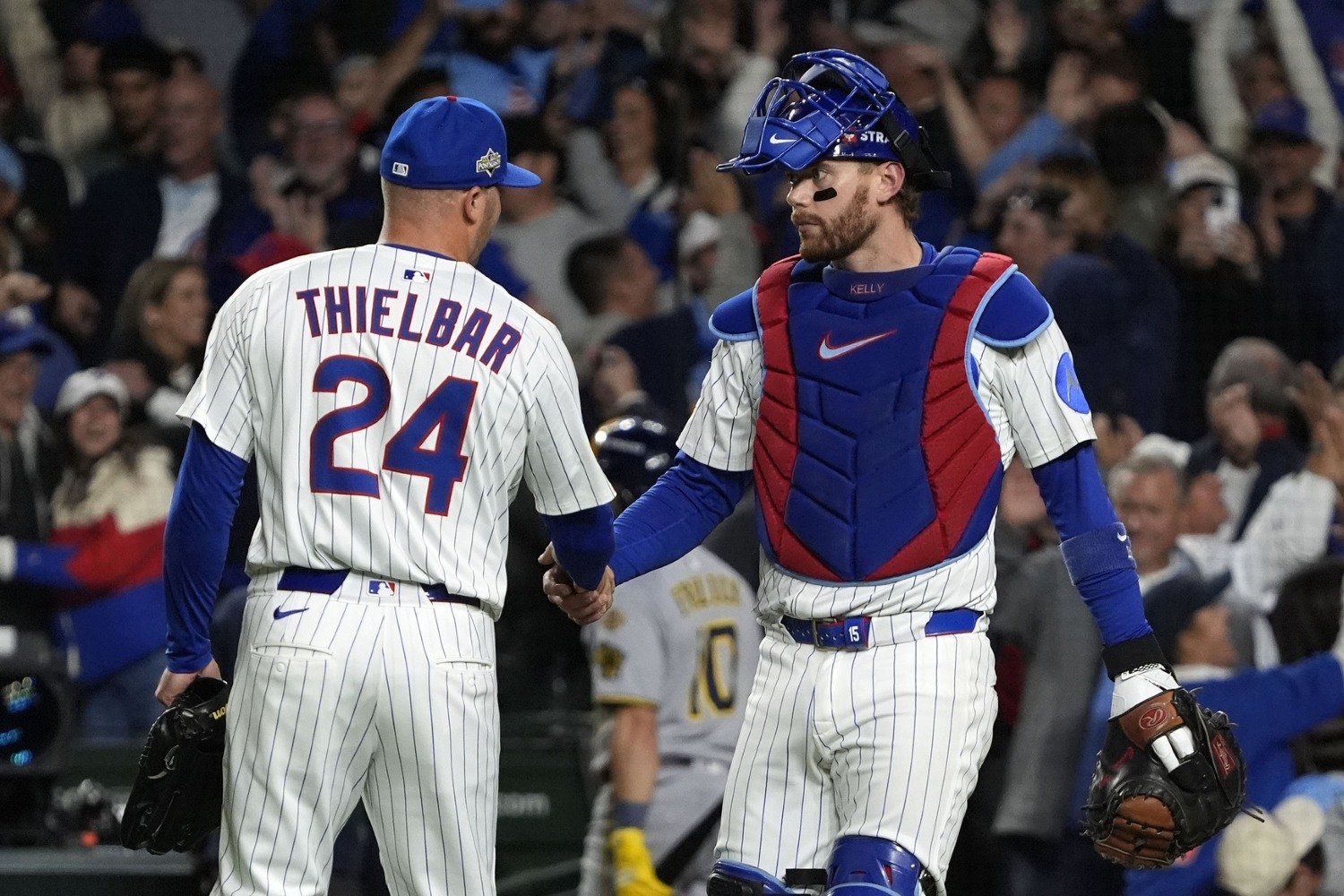
Caleb Thielbar would also best be used against that wheel from the bottom to the top of the likely Milwaukee lineup card, since he has yet to face Perkins, Bauers, Ortiz, Yelich or Chourio in this series. Because the only batter he's faced more than once is Brice Turang, though, Thielbar can be deployed pretty flexibly. Expect him to get three outs for the Cubs somewhere in the second half of the game, and to see Counsell prioritize shielding Palencia from overexposure over getting the matchup of handedness or personnel exactly right for Thielbar.
Andrew Kittredge is the skeleton key. Used so heavily in the Wild Card Series, he's been given lighter duty so far, which makes him an obvious choice for at least three outs on Saturday. His best stretch would include Turang, William Contreras, Vaughn, Frelick and Durbin, who generally do bat in connected (if somewhat interchangeable) places in the Milwaukee order, since he hasn't faced any of them yet in the series. Neither Turang nor Frelick is a great fit for Kittredge, from the Cubs' perspective, but he'll probably have to face at least one of them in any road map to the end of the game that results in a Cubs win. If he could start a clean inning against Turang, he'd be in decent shape, with a chance to erase him via a double play even if he reaches base. If Kittredge has to come into a dirty inning, it should be against Contreras.
Pomeranz is a bit of a spent weapon. He's already seen Yelich and Turang twice each, and Frelick once. More than Thielbar, he's a matchup lefty; good righties make nervous fits for him. Only if there's a chance to attack Frelick with two outs in an inning or to make him the key man in a stretch where there's some margin for error should Counsell turn back to Pomeranz in Game 5.
That leaves Keller, and again, it's more likely that he's used situationally than that Counsell thinks especially hard about matchups with him. If at all possible, Keller should be kept away from Yelich, against whom he's already pitched twice in the set, but the rest of the Milwaukee lineup is in play. It helps that he has yet to see Turang or Frelick at all, in the postseason. It's not hard to imagine another five-out save from Keller, although if he starts his appearance seven spots from Yelich and ends up having to face him with two outs in the bottom of the ninth, it might very well be that overexposure decides the series.
Let's address the third question, posed way back at the top of this piece. How much has everyone been used, and what does that tell us about their availability? Counsell said Friday afternoon that he's not ready to name a starter, but that everyone except Boyd is available. 'Available' can mean a lot of different things, though.
| MON | TUE | WED | THU | FRI | TOT | |
| Palencia | 18 | 0 | 15 | 10 | 0 | 43 |
| Soroka | 0 | 0 | 0 | 0 | 0 | 0 |
| Keller | 0 | 0 | 19 | 15 | 0 | 34 |
| Kittredge | 0 | 0 | 18 | 0 | 0 | 18 |
| Pomeranz | 9 | 0 | 15 | 15 | 0 | 39 |
| Thielbar | 0 | 0 | 11 | 10 | 0 | 21 |
| Rea | 60 | 0 | 0 | 0 | 0 | 60 |
| Civale | 0 | 0 | 0 | 0 | 0 | 0 |
| Brown | 0 | 0 | 0 | 0 | 0 | 0 |
Count this as another reason to expect less of Palencia and Pomeranz, along with the matchup exhaustion effects explained above. Each has pitched three times in the last five days, including in both home games of the series. Both Keller and Thielbar also appeared in Games 3 and 4, but not having worked in the first two contests means each is that bit fresher, in addition to not having been seen as much by Brewers batters. Rea, Civale, Soroka and Ben Brown are fresh as daisies—but again, that only matters insofar as Counsell believes any of them can get big outs for him in the first place.
It's some combination of Imanaga and Rea for, one hopes, 12-15 outs. It's Kittredge and Thielbar for a solid six, with an option for as many as nine. It's Palencia and Pomeranz if you find just the right crease and it's Keller the rest of the way. Does that get the Cubs to 27 "before"—that is, with fewer runs crossing the plate first—the Brewers? It's impossible to know. Milwaukee has a pitching advantage, going into this game. They have smoother avenues to Out 27. Nonetheless, the Cubs have a road map of their own. If they stick to it and their offense punches through against the high-octane arms they'll see in the top halves of innings, they can advance to the NLCS and get ready for another date with the Dodgers.





Recommended Comments
Create an account or sign in to comment
You need to be a member in order to leave a comment
Create an account
Sign up for a new account in our community. It's easy!
Register a new accountSign in
Already have an account? Sign in here.
Sign In Now