



Cubs Video
This has been a strange spring for Matthew Boyd. He missed a chunk of Cubs camp to join Team USA for the World Baseball Classic, but returned after pool play so he could prepare for the honor and duty of starting on Opening Day. Unfortunately, the Nationals had a good plan against him that day, and he struggled mightily. He looked better the next time out, against the Angels, striking out 10 in 5 2/3 innings, but then he hit the injured list with a triceps strain and lost three weeks. Since re-joining the rotation, he's been uneven. He entered Sunday's start against the Diamondbacks with a 7.00 ERA for the season.
In a solid win to extend the Cubs' winning streak to five, Boyd brought that ERA down to 6.00. He pitched six innings of two-run ball, allowing four hits and a walk but striking out five. It was a great way to reassert his place at (or near) the top of the team's rotation, made all the more welcome by the news that Justin Steele won't be back as soon (or, we might fairly speculate, as strong) as previously hoped. Chicago won't go far without a strong season from Boyd, and Sunday brought some evidence that he can step into the breach and be the stopper (or, in this case, the perpetuator) the team needs him to be.
Specifically, the changeup was a reliable, even devastating weapon. Boyd threw 35 of them, the highest single-outing total of his Cubs tenure, and it worked wonders. Diamondbacks hitters whiffed on seven of 18 swings against it and watched another seven sail by for called strikes. The change earned Boyd three of his five punchouts and eight total outs, but Arizona didn't collect a hit against it. Some of that can be chalked up to working against a team that leans heavily on switch-hitters and some veteran right-handed bats, but another key consideration is this: Boyd will have to pitch backward more this year.
That's not because his stuff is down, though his fastball is sitting much more at 91-92 than the 93-94 he often had early in starts last year. He threw at least 95.0 MPH 81 times last regular season, getting as high as 96.9. So far this season, he's only touched 95.0 four times, and never gotten above 95.3. Velocity isn't the whole story with Boyd, especially because he changes speeds so well with his changeup, curveball and slider. Hitters have to respect those much slower offerings, so they can't take full advantage of a heater that lacks elite heat.
Rather, the reason why Boyd might need to pitch off the changeup more is his fastball's location. Boyd likes to use that four-seamer to ride the top rail of the strike zone, inducing chases and whiffs by forcing hitters to stretch their strike zone vertically in both directions. Last season, 45.6% of Boyd's fastballs were between 2.8 feet and 4.0 feet above the ground when they crossed the plate, just above the league's average. This season, that number is nearly 60%, in a small sample.
As we've discussed, though, the top of the strike zone has come down. That's a problem for Boyd, and pitchers like him. He needs hitters to climb the ladder with him, both to set up his softer stuff and to get the ball above their barrels. He doesn't have elite carry on his fastball, nor overpowering velocity. He gets value from the way his low arm slot flattens out the approach angle of a high fastball, and the way it thus tantalizes and thwarts a hitter. But look what's happened to pitches in the aforementioned height zone, under ABS standardization (and the umpires' responses thereto).
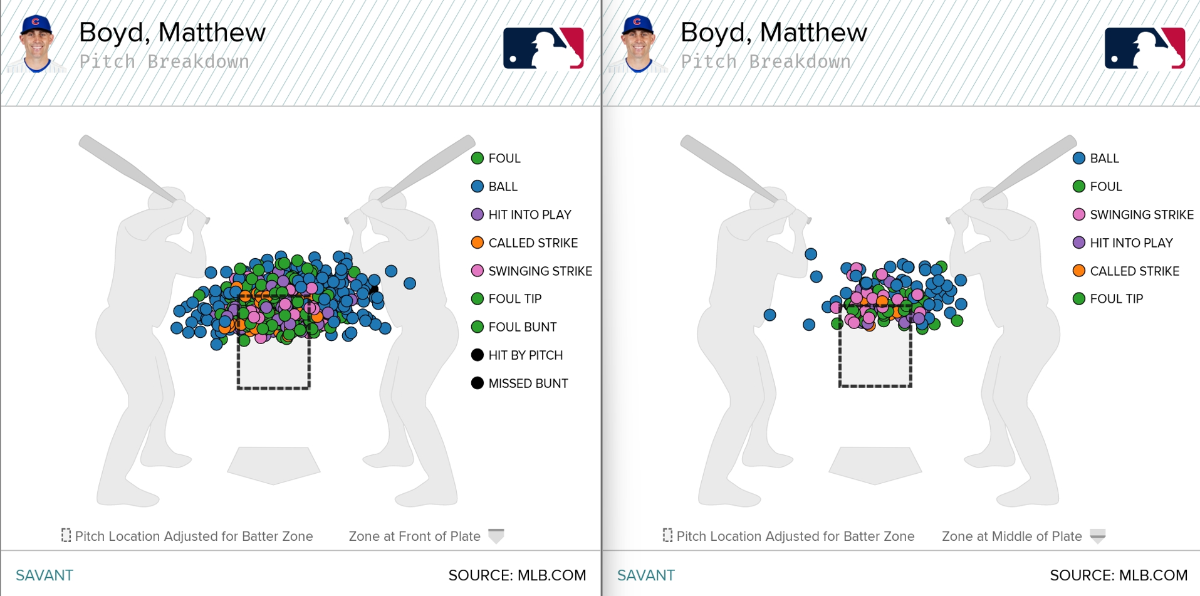
A much higher percentage of those balls are now above the zone, or close enough thereto that batters need not chase them. That's made it hard for Boyd either to get quick outs or put away hitters there, or to set opponents up for a change of eye level using that pitch.
Working backward might be the best and only salve, for now. If Boyd can establish the bottom edges of the zone and/or get hitters behind in the count with his slow stuff, he can speed them up and fool them with the high fastball afterward. That was always one option, but because of the aforementioned lack of velocity or extreme raw movement, it was never a great one. Now, it might be the way he needs to go for a while. On Sunday, at least, he showed he can be that flexible and clever, but more adjustments lie ahead.





Recommended Comments
Create an account or sign in to comment
You need to be a member in order to leave a comment
Create an account
Sign up for a new account in our community. It's easy!
Register a new accountSign in
Already have an account? Sign in here.
Sign In Now