


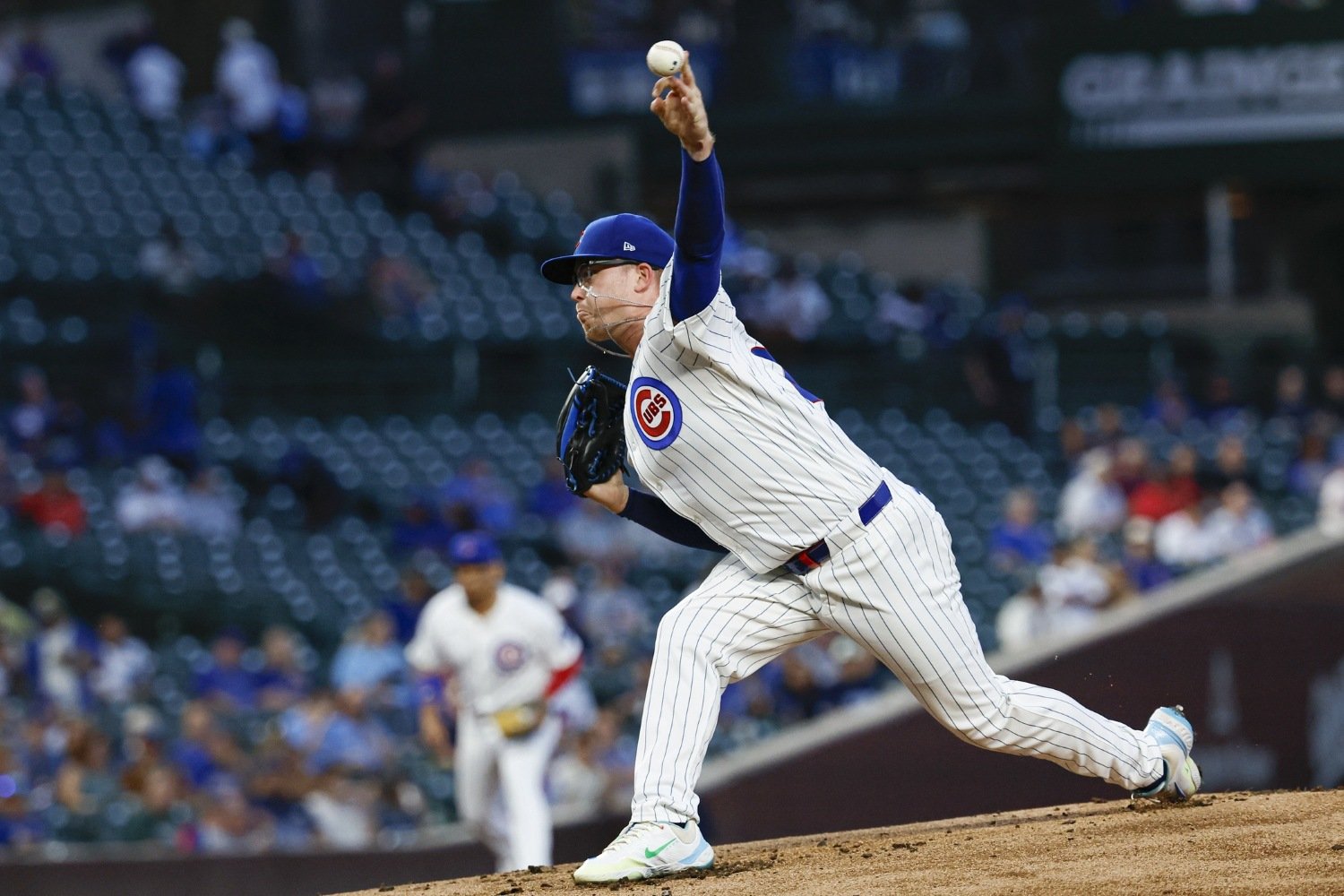
Cubs Video
It was not a good season for Jordan Wicks in 2024. There were some encouraging signs, like a slight uptick in velocity and some sustained carry on his four-seamer, but injuries cut the center out of his season, and he spent a chunk of the time during which he was healthy at Triple-A Iowa, trying to work through the problems he created for himself when he set out to solve the problems he'd had upon first arriving in the majors in 2023. He had tried to design a new pitch mix, but had to retreat from that—and didn't find any strikeouts on the other side of his reinvention.
In terms of motor preference, Wicks is a natural pronator. That means that, when his arm is free and working the way it more easily does, he turns his thumb downward and/or his palm outward through release of the ball, rather than coming out around the ball and turning his palm inward, toward his right side. Guys who naturally pronate can create good carry on the four-seamer, but the pitches in which they specialize tend to be the ones that move to the arm side—sinkers and changeups.
Indeed, if you go back to when Wicks was first entering professional baseball, you'll read many scouting reports praising his change and his feel for the sinker, but concerns about whether he would ever develop a very good breaking pitch. As indicated in the video above, there are ways to make a breaking ball work from a high slot and with pronation as a motor preference, but they're somewhat limited.
Wicks tried to break through that wall in 2024. He showed up in the spring with a sweeper, which was on trend for the league as a whole, but it was a strange choice for his combination of arm angle and natural arm action. It might or might not have led to his forearm trouble. We can't say that for sure, but we can observe that the flexor-pronator muscles in the forearm are more prone to injury when one works against that internal wiring, as it were. We can also say that, while the movement on the sweeper was tantalizing, Wicks showed no real command of it. Here's a now-familiar face touching up a bad miss in a pitcher-friendly count, and nearly taking a misplaced sweeper out of the park in April.
So, between whatever role throwing that breaking ball played in his injury early on and the struggles he found in actually executing it, Wicks made the decision to scrap the sweeper and go to more of a gyro slider. Here are his average movement coordinates by pitch type, with each dot representing one appearance, for 2024. Inside the green circle are the sliders (sweepers, really) he threw over the first two months. Inside the red square are the sliders to which he turned thereafter.
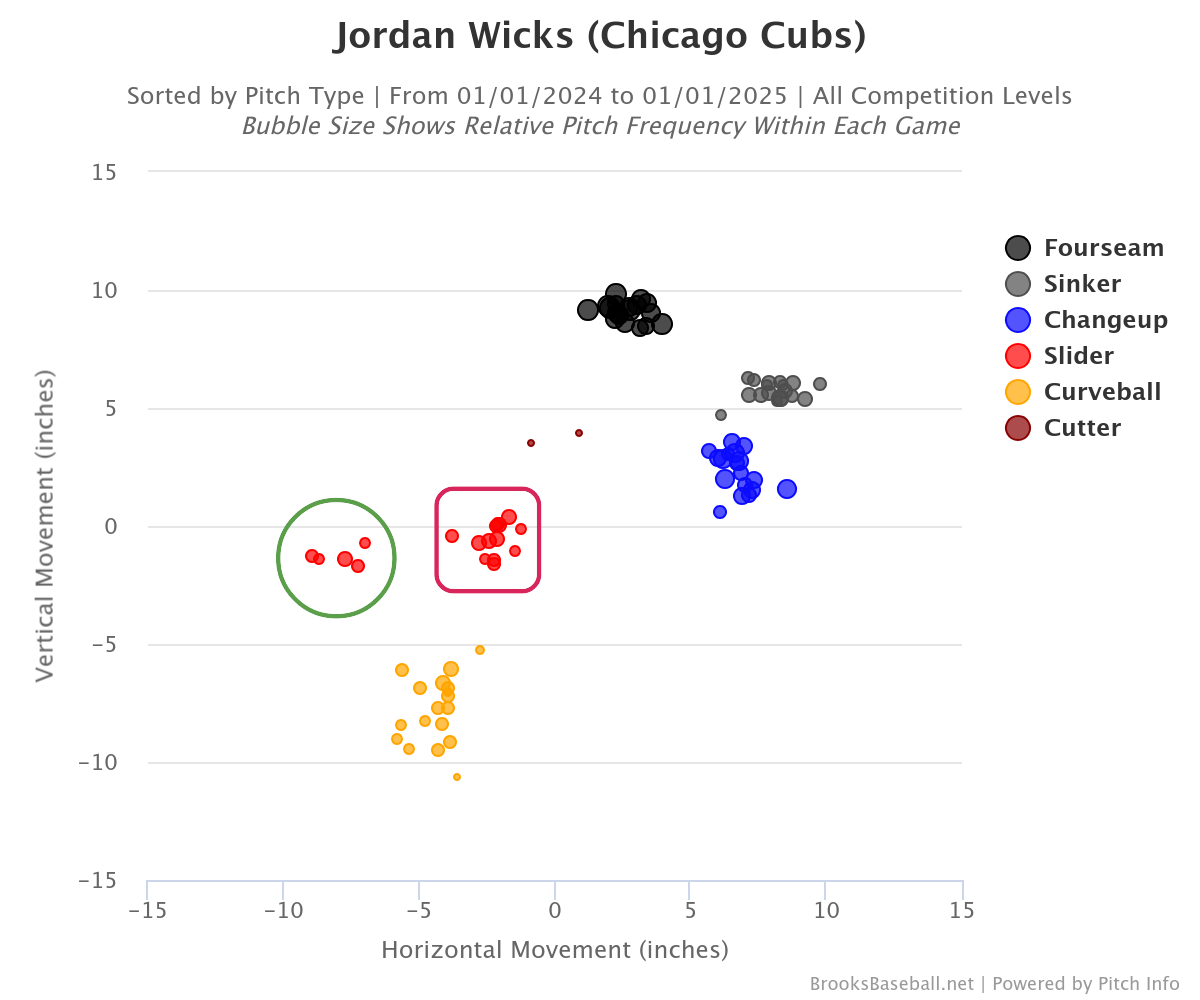
That's a good change, and one very much in line with the organization's philosophy on this, both at the time and (especially) now, a handful of months later. Motor preference is a major point of emphasis for new Cubs special assistant/pitching guru Tyler Zombro, who also works at the increasingly famous training academy, Tread Athletics—and is seen in the video in the tweet above. Zombro will surely encourage Wicks to stick with that more vertical slider, and in fact, he might suggest even less of an emphasis on depth. With the carry he got on his fastball in 2024, there's room for Wicks to throw more of a cutterish, hard slider.
Indeed, Wicks was throwing the sweepy slider around 82.5 miles per hour early on, but that ratcheted up to 85.5 or so after the shape change. He could pull that up to around 87, where he threw his few nominal cutters last year, and get a bit less drop on the pitch, and still be doing fine. In the video of Zombro, you can hear him allude to a Death Ball-style breaking ball, which is a version of the hard, overhand curve that emphasizes sharp movement and mimicry of the fastball instead of big movement or velocity differentials. With a more gyro, cutterish slider, Wicks would also create room to pivot into more of a Death Ball curve.
All of those possible upsides are good news. The bad news is, the version of the tight slider to which Wicks turned in 2024 really didn't miss any bats, or fool anyone at all.
We can use Baseball Prospectus's StuffPro and PitchPro to break this down a bit. StuffPro evaluates pitches not based on outcomes, but based on velocity, release, movement, count, and handedness; and PitchPro uses all of those inputs, plus location. Zero is average, and lower is better, because the numbers are represented as the number of expected runs produced against that pitch type in that split per 100 pitches thrown, relative to an average pitch. Here are all the pitch types Wicks threw at least 10 times to batters of a particular handedness in 2024.
| Pitch Type | v. LHH | v. RHH | ||
| StuffPro | PitchPro | StuffPro | PitchPro | |
| Four-Seamer | -0.3 | -0.8 | 0 | -0.6 |
| Sinker | -0.1 | -0.3 | 2.2 | 1.8 |
| Changeup | 0 | -0.1 | -0.3 | -0.4 |
| Slider | -0.3 | 0.3 | ||
| Sweeper | -0.8 | -0.8 | ||
| Curveball | -0.1 | 0.6 | ||
As you'd expect, Wicks's sweeper was expected to be really good against lefties. Sweepers against same-handed batters are nearly always good. If a pitcher can't consistently execute them or run into injury trouble when they try, though, the pitch doesn't have much real-world utility. Note that these data tell us Wicks has four or five usable pitches against lefties, including the four-seamer, the sinker, and the slider. He just has to execute the latter better, to make up for scrapping the sweeper.
Against righties, though, Wicks is in more of a predicament. His changeup and four-seamer work gorgeously, but the current forms of the sinker and the curveball do not work at all. Reshaping the curve into a Death Ball could be a game-changer for Wicks, but he also needs to put the sinker away against righties, altogether. Given that, it would be great if he could find more confidence with the hard, cutterish slider, to set everything else off.
It's a dilemma. Wicks has some impressive and valuable traits, but putting his puzzle pieces together to form a complete pitcher with mid-rotation value is surprisingly difficult. Reinventing his slider on the fly didn't quite work. As the Cubs gear up for spring training, it will be interesting to see whether Wicks has come up with a new way to attack the problems he faces in terms of pitch design and achieve more strikeouts, without giving up the good things he did unlock in 2024.
Are you optimistic about the Cubs right now?

Follow North Side Baseball For Chicago Cubs News & Analysis



-
 1
1


Recommended Comments
Create an account or sign in to comment
You need to be a member in order to leave a comment
Create an account
Sign up for a new account in our community. It's easy!
Register a new accountSign in
Already have an account? Sign in here.
Sign In Now