


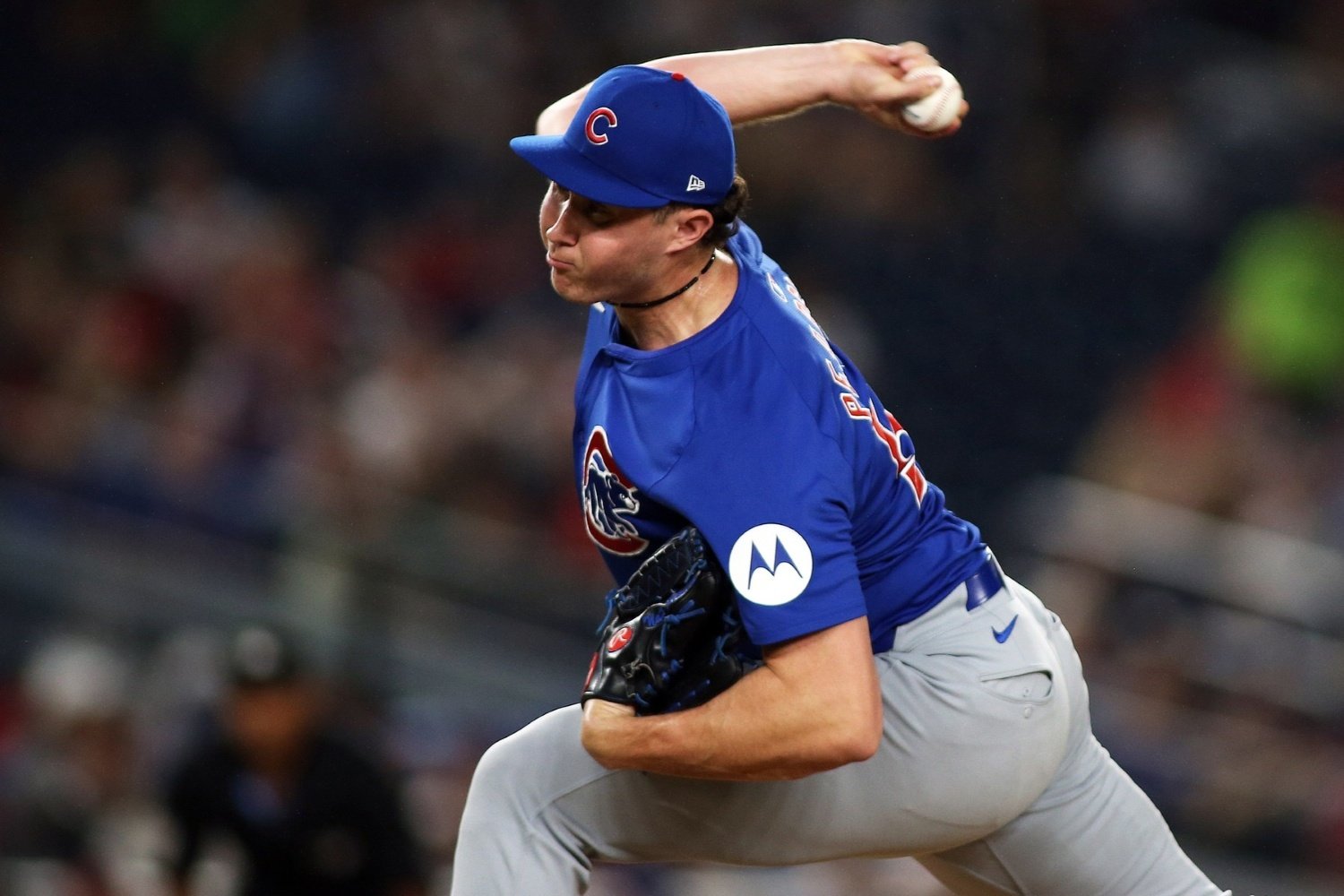
Cubs Video
Nate Pearson always wanted to make it work as a starting pitcher, which is part of why he never figured things out and established himself with the Toronto Blue Jays. When he finally moved to the bullpen full-time in 2023, he began to figure things out, and after the Cubs snatched him up last July and made a few changes to where he sets up and which pitches he throws most often, he was superb. His strikeout rate had spiked in 2024 for Toronto and then receded to an underwhelming 22.3% for the Cubs, but he also only walked 3.9% of the batters he faced in a Cubs uniform.
Because it's the trendy thing, and because Pearson does nominally have a three- or four-pitch mix, there was some talk this winter about whether the Cubs would capitalize on that improved control by moving him back to the rotation. That would be one way to infuse their starting group with some high-end velocity, which (admittedly) they do need. Pearson averaged 97.7 miles per hour on his four-seamer last year, with a 90th-percentile velocity of 99.5. Even if he lost a tick by stretching out and pacing himself, he'd be capable of dominating with that heater, especially given his plus extension. Thus, last month, Jed Hoyer told Meghan Montemurro of the Chicago Tribune that Pearson will stretch out to some extent this spring. Hoyer did say, though, that he still expects Pearson to end up in the bullpen.
I can tell you right now how far Pearson will stretch: he'll work to nine batters in a game. That's his limit, and that's where the Cubs will stop him, and that's ok.
There are a handful of things that can stop a pitcher from being viable as a traditional starter, which requires one to face the opposing lineup two or three times within a game. One, of course, is health and durability, but while Pearson has often been injured during his developmental journey, his frame says he could hold up to the job of starting as well as he can to relieving, from a health standpoint. He's a horse.
Another separator is control, but Pearson checked that box last summer, after the Cubs moved him over on the rubber. He can now fill up the zone with his fastball enough to avoid undue numbers of walks or unwieldy early pitch counts. That same slide across the rubber, coupled with an increased reliance on his slider (which works better to lefties given the horizontal and vertical angles created by his change of mound position than it did before), resolves another common issue, which is a vulnerability to platoon matchups.
.jpeg.a3bd1d996da674f70a2cc285eaba1bbb.jpeg)
So far, so good. Now, we come to the trouble spot. The final test of a starter is the ability to fool hitters that second or third time, which means having a deep enough arsenal to keep them guessing and a repeatable enough delivery to stop them from identifying a particular pitch early in its flight. Unfortunately, that's where Pearson fails. Here are his release points in 2024 while he was with Toronto:
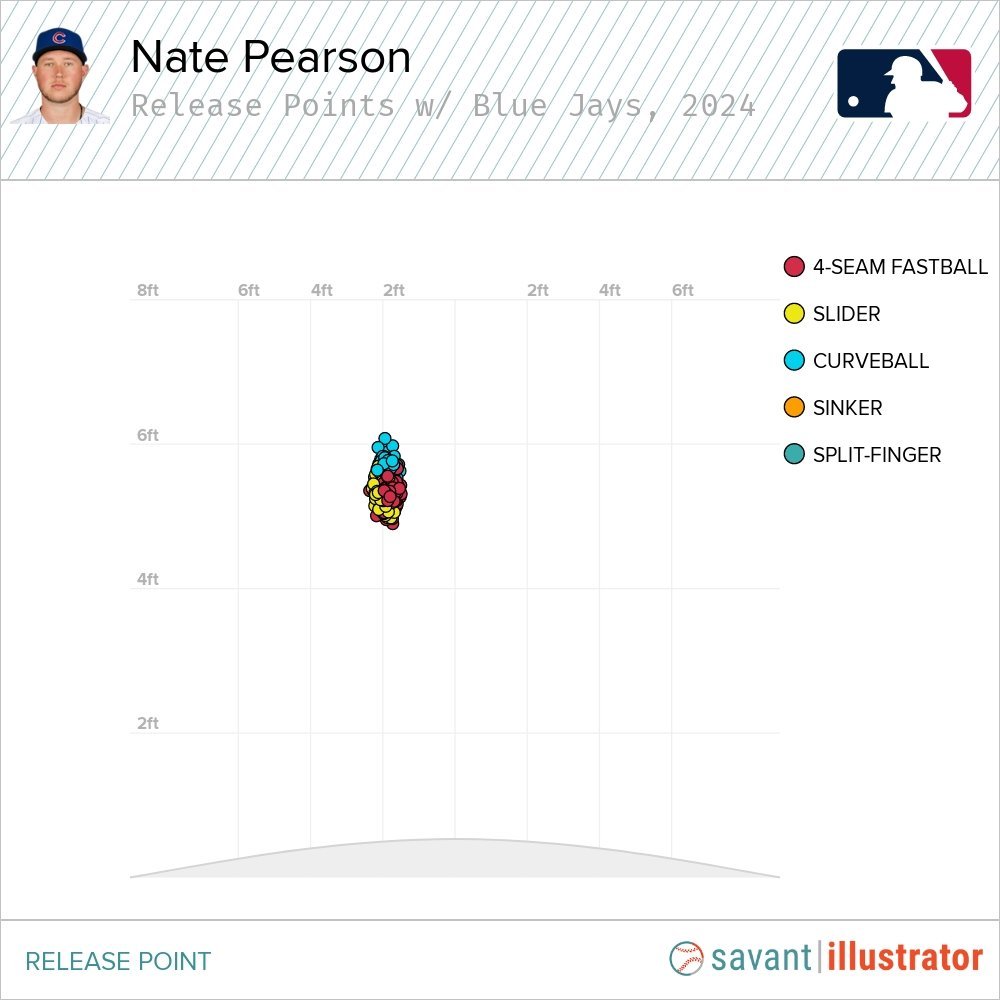
That carried some problems, especially because it created a set of horizontal angles lefties could pick up on, and because of the aforementioned control problems that stemmed from his alignment. Here's the same plot for his time with the Cubs.
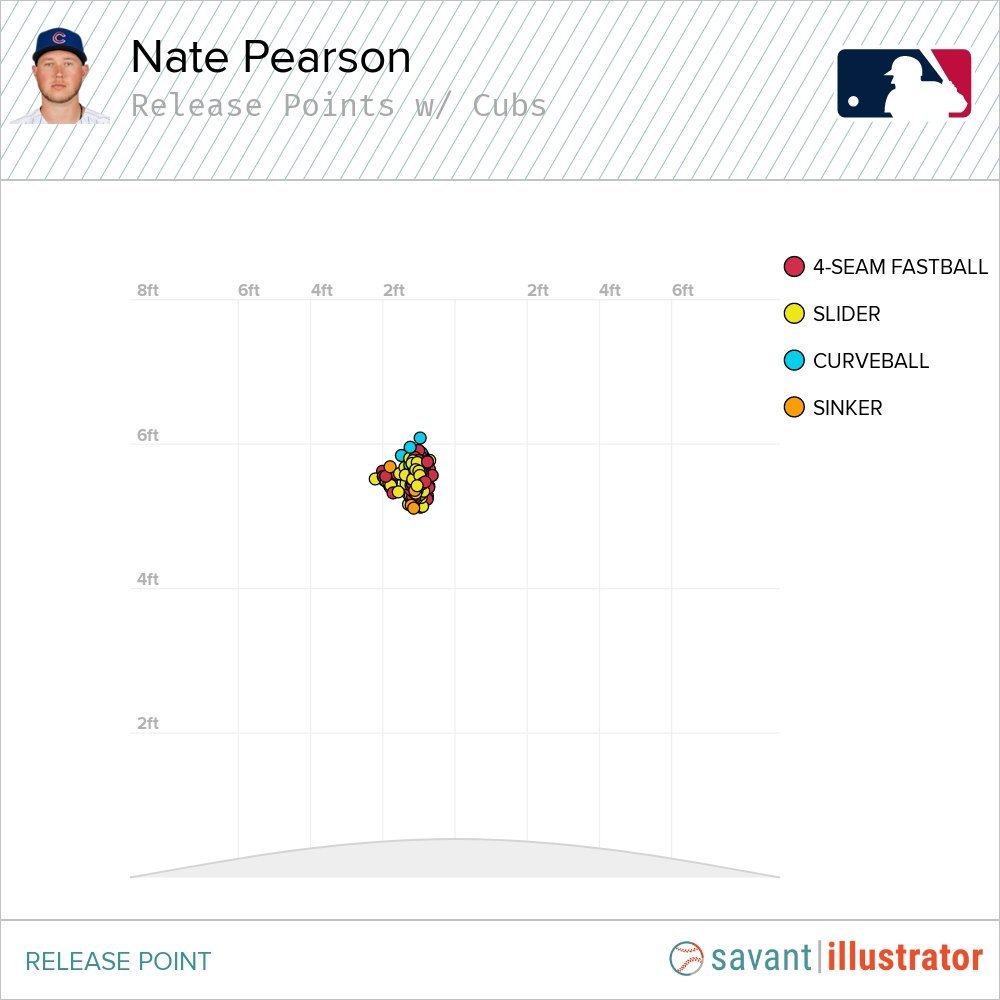
There's more funk here, but there's also less consistency. Pearson doesn't really have a changeup, and he uses his sinker only sparingly, but the four pitches do fit together in a neat, deceptive way. Baseball Prospectus's Arsenal metrics, released last month and discussed in detail with regard to Colin Rea here at North Side Baseball, do smile upon Pearson, thanks to the deceptiveness of his altered release angles and the combination of his vicious slider with a high-riding fastball.
- Pitch Type Probability: 50th Percentile
- Movement Spread: 88th
- Velocity Spread: 79th
- Surprise Factor: 62nd
So, what's the problem? Consider these two snapshots of his release points in consecutive outings in September, from the pitcher's perspective and in 3-D visualization:


He threw 33 pitches in the game against the Athletics on Sept. 18, on the left, and 22 in one against the Nationals two days later. Look how scattershot his release points were in the image from the game against Oakland. That's untenable, and that happens too often with Pearson. Here, drawn at random, is another snapshot, from his first appearance in August, against the Cardinals:

Even if you can sustain deception and have nasty raw stuff, being this wild with the actual release of the ball is a problem. We can make some allowances, perhaps, for the fact that Pearson was moving over to a new place on the mound under the Cubs' direction, but this just isn't the profile of a pitcher who can keep hitters from identifying his pitches out of the hand on a second or third trip through the lineup within a game. For that matter, he also seems to work well on relatively short rest, which is how some guys work. He's better off in a role where he can be called upon to work two innings in a close game against a tough lineup, without having to face anyone twice, and then get a few days off—and that's exactly what the Cubs bullpen needs, given that veterans Ryan Pressly, Caleb Thielbar, and Julian Merryweather are all better in one-inning bursts.
Stretching Pearson out enough to be the entire bridge from a good start to a Pressly save makes a world of sense. Trying to get a pitcher who still struggles to repeat his delivery after half a decade in the majors through five or six innings makes none. The Cubs will (and should) stretch Pearson out just enough to maximize his utility in relief, and then reap the rewards of a flexible bullpen megaweapon.





Recommended Comments
Create an account or sign in to comment
You need to be a member in order to leave a comment
Create an account
Sign up for a new account in our community. It's easy!
Register a new accountSign in
Already have an account? Sign in here.
Sign In Now