


Cubs Video
When Juan Soto signed an eye-popping 15-year, $765-million contract with the New York Mets in December, it seemed to confirm what many had already begun to assume about salaries at the top end of the free-agent market in MLB: that there's almost no ceiling, and that a superstar's floor is quickly pushing toward $400 million. It altered all the conversations around players set to hit free agency at anywhere near that talent level, including Kyle Tucker, who will hit that market this fall.
The sheer mass of that deal—the gravity of it, as an anchor in negotiations around players like these—is enormous. Length is one thing, but Soto got $51 million per year, which becomes a new touchstone for stars trying to achieve the highest salary possible. In an information environment already a bit polluted by confusion around Shohei Ohtani's heavily deferred 10-year deal from last winter, the Soto payday fell like a boulder into a pond.
Now that the ripples have smoothed, though, we can see that the entry of that boulder has not fundamentally changed the pond, and the degree to which it raised the water level is so small as to be imperceptible—unless you're hunting for it, hungry-eyed, in which case you're likely to see even what isn't there. In the run-up to Soto's free agency, there was plenty of talk about what makes him so exceptional, and why he got this much money, but too many people failed to take it all to heart.
Here's the thing: Juan Soto is not worth $51 million per year for the next 15 years. That's true however you read it:
- He's not worth a total of $765 million; and
- He's not going to be worth a steady $51 million annually over the life of the deal.
That's not at all to denigrate Soto, but it's important to understand it. What happened was this: An elite free agent at a uniquely young age hit the market at precisely the right moment. He's the best free agent of his age since Alex Rodriguez—better and more consistent than Bryce Harper, even if he hasn't won an MVP the way Harper did before getting to the market. He was coming off a season with one of the three richest teams in baseball, having just helped them to their first World Series in 15 years—which they didn't even win, leaving ownership hungry for more. He also stepped right into the gaze of the richest team in the league, funded by an extraordinarily wealthy owner in the same market.
Those were the ingredients for an irrational bidding war, and that's exactly what developed. So, even more than most desirable free agents, Soto got more than his sterling performance record and age really dictated. Whereas a superstar with a robust market in a good winter might typically expect to get one extra year and $3 million more per year than is rational, Soto got, perhaps, three extra years and $6 million more per year. Instead of getting something like $50 million as a superstar premium over the life of a deal, he got anywhere from $150 million to $250 million.
That was, yes, because of the market dynamics named there, but let's also tackle the age thing. Soto won't be overpaid at the front end of this deal. In fact, he'll be underpaid. Given his projected production (since he's unlikely to even start to decline until Year 4 of this deal); the Mets' market and its potential; and the novelty of a star joining a team for the long haul, selling jerseys and season tickets left and right, Soto will be worth a solid $100 million per year to his new club from 2025 through 2027. That's how astronomically valuable getting a guy like this at 26 (instead of, say, 29) is.
Soto will lose value starting somewhere between 2028 and 2030, but over the very long life of this deal, so will the dollar. Inflation comes into play all the time in these conversations, not just when there are technically deferrals in a deal. If you think of the even structure of the deal as a gentle deferral, then, and of Soto's first three years as being worth $300 million by themselves, it makes sense to think of his market value from age 29 on as 12 years, $450 million.
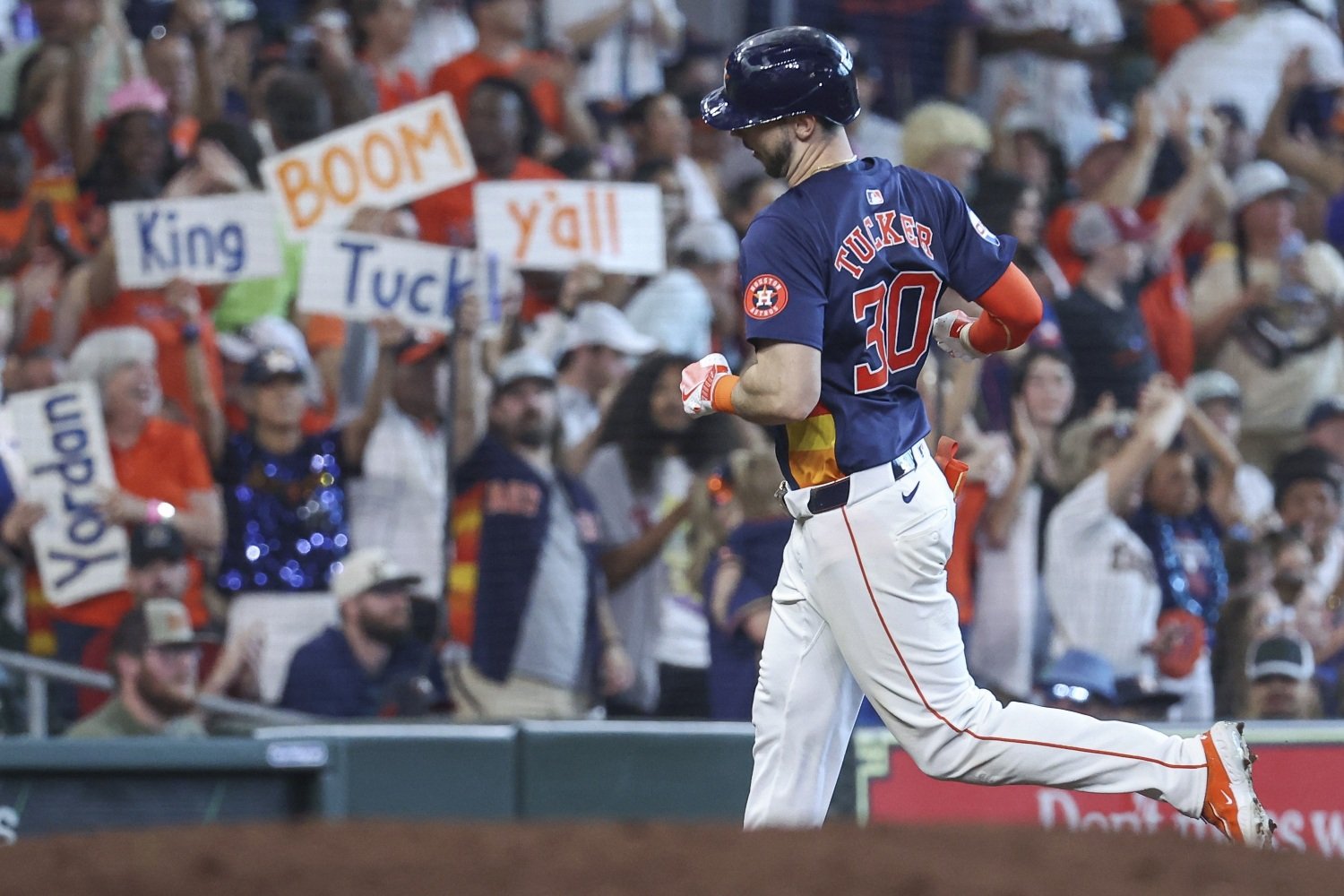
That's only $37.5 million per year. That's the right place to start talking about Kyle Tucker's market value for 2026 and beyond. If he has a very strong season this year (I roughed out one in which he hits .285/.377/.529 in a full season of plate appearances, with 30 homers), he'll hit the market with a career .277/.355/.519 career slash line. That's tremendous, but it's certainly not on par with Soto, Harper, or Prince Fielder, the only other hitters of this caliber to hit free agency before 30 since 2010. He's a balanced lefty slugger and a better defender than Soto, but we saw him slow down significantly over his final two years with Houston; he doesn't project to be a valuable fielder even over the first half of whatever new deal he signs next winter.
We suffer from a lack of direct comps for Tucker, because players generally like him (Ryan Braun, Andrew McCutchen, Giancarlo Stanton, Christian Yelich, Ronald Acuña Jr., Mookie Betts) have tended to sign extensions, usually long before they could have become free agents. He's as good as most of those guys, unless you focus on one of those players' very best seasons and acknowledge that no campaign from Tucker can match it, but they all took at least a little less (and all but Betts and Yelich took considerably less) than they were worth to avoid the risks associated with going all the way to free agency. The guys roughly like him who did go to free agency were so much younger that they can't be compared to him, because those three years of age gap make an enormous difference and they're also (if only marginally) better than Tucker.
It will sound shockingly low, because of Soto's and Ohtani's deals, but I expect the net present value of the deal Tucker signs to cover 2026 and beyond to be under $400 million. Ten years and $380 million is a good benchmark. If he goes elsewhere, he'll probably get some deferrals and the vanity of a deal worth more than $400 million. If he stays with the Cubs, it will be right around that number. The bad news for the Cubs is that there's probably no discount available. This is one place where I'm compelled to accuse the players of being a little bit irrational. Lately, superstars (and even stars, just pretending at super) don't seem to be mentally accounting for the risk of waiting and going all the way to market properly.
We saw that most vividly with the Pete Alonso situation this winter, but Anthony Rizzo and Kris Bryant were in the same boat several years ago. Neither maximized their career earnings, precisely because they assumed the best way to do so was to go to free agency (in Rizzo's case, at the end of an initial extension, but it comes to the same thing) and they were very wrong. No numbers have emerged, yet, from the negotiations between Vladimir Guerrero Jr. and the Blue Jays, and he's a bit more within his rights to roll the dice, since he's going to be another exceptionally young free agent, but I suspect he, too, erred by not taking the deal.
I doubt Tucker would sign for 10 years and $380 million (or even a bit more, to bring the total commitment from the Cubs for 2025-2035 up to $400 million) today, but he probably should. Only a truly transcendent season would push him into the stratosphere some are already imagining him to be in, and a bad or injury-marred one could cost him $75 million or so. If the Cubs don't make the offer, they'll never know, and they probably won't make the offer. Should they do so, though, Tucker should take the money. His ceiling and his floor are both lower than they seem, because despite the warm afterglow of that Soto deal, the market is not going to get as rabid about Tucker—especially now that Guerrero looks likely to be there with him.






Recommended Comments
Create an account or sign in to comment
You need to be a member in order to leave a comment
Create an account
Sign up for a new account in our community. It's easy!
Register a new accountSign in
Already have an account? Sign in here.
Sign In Now