


Cubs Video
Exploring different "what-if" scenarios is not a unique idea, but this was somewhat inspired by the Disney+ series that explores the ripple effects of small decisions or actions within the Marvel Cinematic Universe. Of course, in this series, we’ll be looking at small decisions or actions in Chicago Cubs history, and how it might have drastically changed a future outcome for the team. I don’t have as good of a voice as Jeffrey Wright, who narrates the Marvel series for Disney, so you’ll just have to deal with my writing instead.
My approach with each counterfactual will be to explore the few years right afterward, to get us all into the right frame of mind, then pose some questions about the continued ramifications of a decision. For some of these (today's included), I could write 50,000 words on the continuing effects of something, so I’ll have to cut it off somewhere. Feel free to let me know if you have any future ideas for the series, what you think of the format, or if you loved or hated it, in the comments.
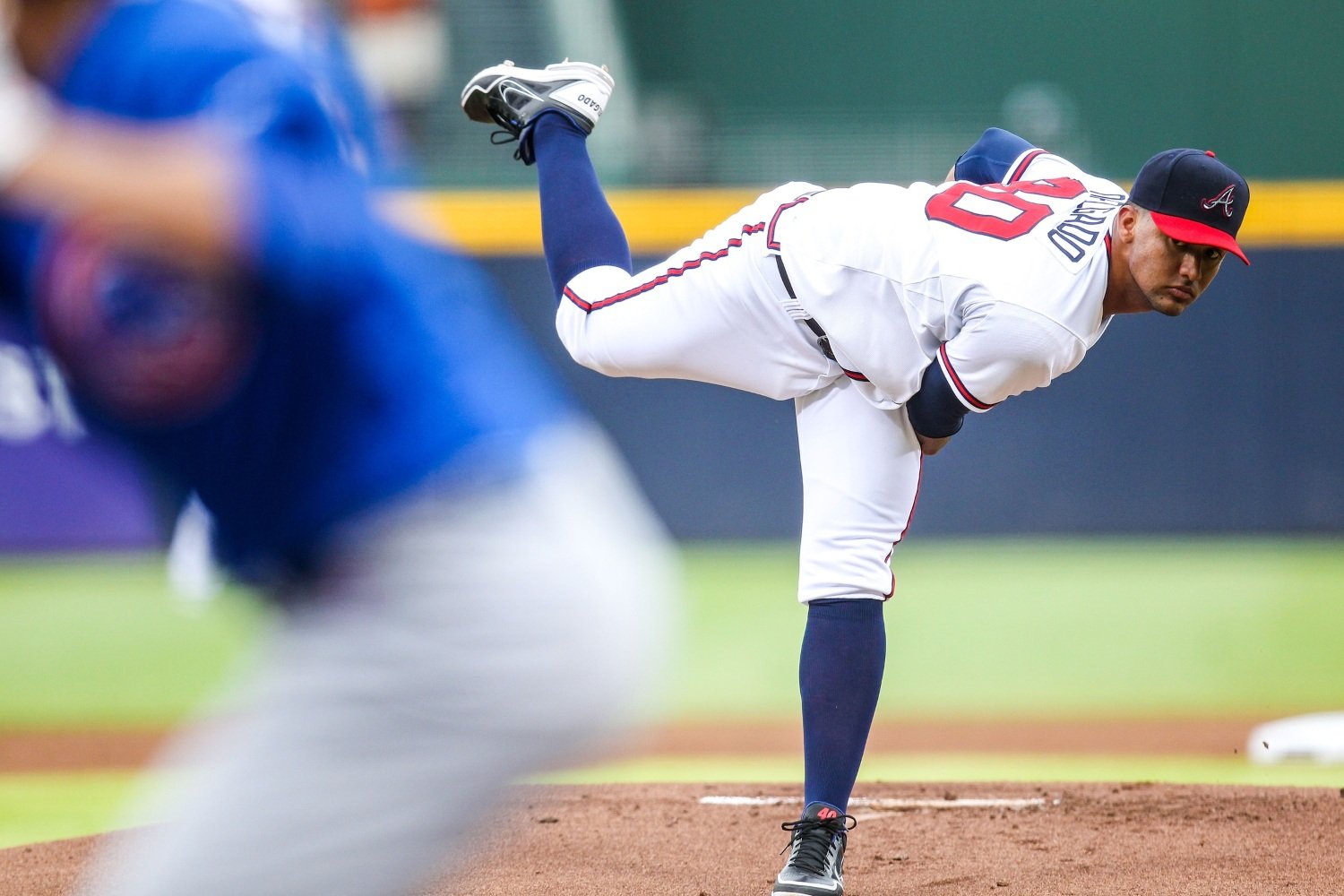
The date is Jul. 23, 2012. Ryan Dempster, having pitched to a 2.25 ERA in 104 innings to that point in that first year, is one of the hottest starting pitchers available on the trade market. Keith Law reported that Dempster was headed to the Atlanta Braves in exchange for Randall Delgado, who was a top-100 prospect in baseball before that season. Dempster blocked the trade with his 10-and-five rights, which allow any player with at least 10 years of service time and five uninterrupted years of tenure with their current club to block any trade. Check out an entire recounting of that day, and everything that was reported, at Bleacher Nation.
Dempster, for his part, later denied that was the case. Regardless, though, the damage was done. Dempster was dealt to the Texas Rangers later that month. In return, the Cubs received fringe top-100 prospect Christian Villanueva and a little-known minor-league pitcher by the name of Kyle Hendricks.
We all know what happened after that. But what if Dempster never vetoed the trade to the Braves? Let’s explore that world for a bit.
The Cubs gave Randall Delgado a long runway to succeed as a starting pitcher through the rest of 2012 and for the entirety of the 2013 season. It just wasn’t working out. After posting a 4.99 FIP and -0.1 fWAR in 116 ⅓ innings in 2013, the team slotted him into the bullpen for the 2014 season, where he finally found a decent home for himself. His fastball velocity ticked up, and so did his ability to miss bats. Still, this wasn’t the value that the team hoped they’d get for Dempster.
Heading into the 2015 season, the Cubs were desperate for starting pitching help. Jake Arrieta slotted in as the ace after an impressive 2014 season. The team signed Jon Lester and Jason Hammel to fortify the rotation, but beyond those three, the North Siders were banking on Travis Wood bouncing back and Tsuyoshi Wada continuing a strong showing, after he pitched to the tune of a 3.25 ERA in 13 starts to close the 2014 season.
Wada and Wood both pitched admirably, but failed to give the team much length. The Cubs made the playoffs with 93 wins, but were dispatched by the New York Mets in the NLCS when the pitching staff ran out of gas.
Heading into that offseason, Theo Epstein was clear about where he needed to fortify the team: the starting rotation. Lester, Arrieta, and Hammel were a decent front three, and Wada and Wood performed admirably behind them. However, there wasn’t a ton of depth there. He signed John Lackey to a short-term deal, two years and $32 million. He knew he could rely on him, and had a good relationship with him dating back to their days together in Boston.
Epstein also knew he couldn’t let Dexter Fowler go. He was unsure of Kyle Schwarber and Jorge Soler in left and right field, respectively, so he needed someone he could rely on, and he needed to lock them up ASAP. The Cubs agreed to a 3-year, $55-million deal with Fowler early in free agency, as well as a 4-year, $56-million deal with Ben Zobrist to provide veteran leadership. There was still some room in the budget for an ace, and while David Price and Zack Greinke were out of the team’s price range, there was common ground to be found with Johnny Cueto, with whom Zobrist had just won a World Series with in Kansas City. The Cubs and Cueto agreed to a six-year, $145-million deal.
The Cubs' outfield depth was tested early on with an injury to Schwarber, but plate appearances from the likes of Javier Báez, Matt Sczcur, and Chris Coghlan were good enough, given the excellence of the rest of the lineup. Cueto was rock solid for the Cubs in Year One, earning down-ballot Cy Young votes with a 2.79 ERA and 4.9 fWAR. Behind him, a great season from Lester, and a worse but still effective Arrieta, the Cubs cruised to the NL Central crown and an MLB-best 101 regular-season wins. To the playoffs they went…
From here, it’s really hard to continue to estimate the ramifications of this decision. Cueto accumulated 4.9 fWAR in 2016, which, believe it or not, was better than Hendricks’s mark of 4.2. By this logic, the Cubs would have been slightly better on that side of things. I would argue that not having Jason Heyward would have hurt more than his 1 fWAR would suggest, given the early-season injury to Schwarber and the frequent unavailability of Soler. As ineffective as he was that season, an available, major-league-caliber body helped tremendously. Obviously, too, Heyward would not have been available to give his legendary speech during Game 7 of the 2016 World Series. Would the Cubs still have won it all?
Without a doubt, beyond 2016, the Cubs would have been worse. Cueto accumulated 3.5 fWAR through the remainder of his contract with the Giants, which ended in 2021. For the purposes of this exercise, I assumed the Cubs also would have given him six years. It would have been just as much of an albatross as Heyward’s contract, who was worth 6.8 fWAR from 2017-2021, though the Cubs gave him an eight-year deal, two years more than the term for Cueto. Hendricks was worth 13 fWAR during that same time frame. As bad as we all thought the state of the Cubs’ starting rotation was during the 2018 and 2019 seasons, it would have been considerably worse. The team’s run of success, which really only lasted through one more season, probably comes to an end even sooner.
This all dates back to Ryan Dempster’s decision to veto a trade to Atlanta that, at the time, seemed like a better return than the trade with Texas. While the Cubs may have still won that World Series in 2016, we already know that they did win the World Series 2016 in this timeline. I’m comfortable with that. As they say, sometimes, it’s better to be lucky than good.





.thumb.JPG.19c99ddd60a76edf810c77d321439828.JPG)


Recommended Comments
There are no comments to display.
Create an account or sign in to comment
You need to be a member in order to leave a comment
Create an account
Sign up for a new account in our community. It's easy!
Register a new accountSign in
Already have an account? Sign in here.
Sign In Now