


Cubs Video
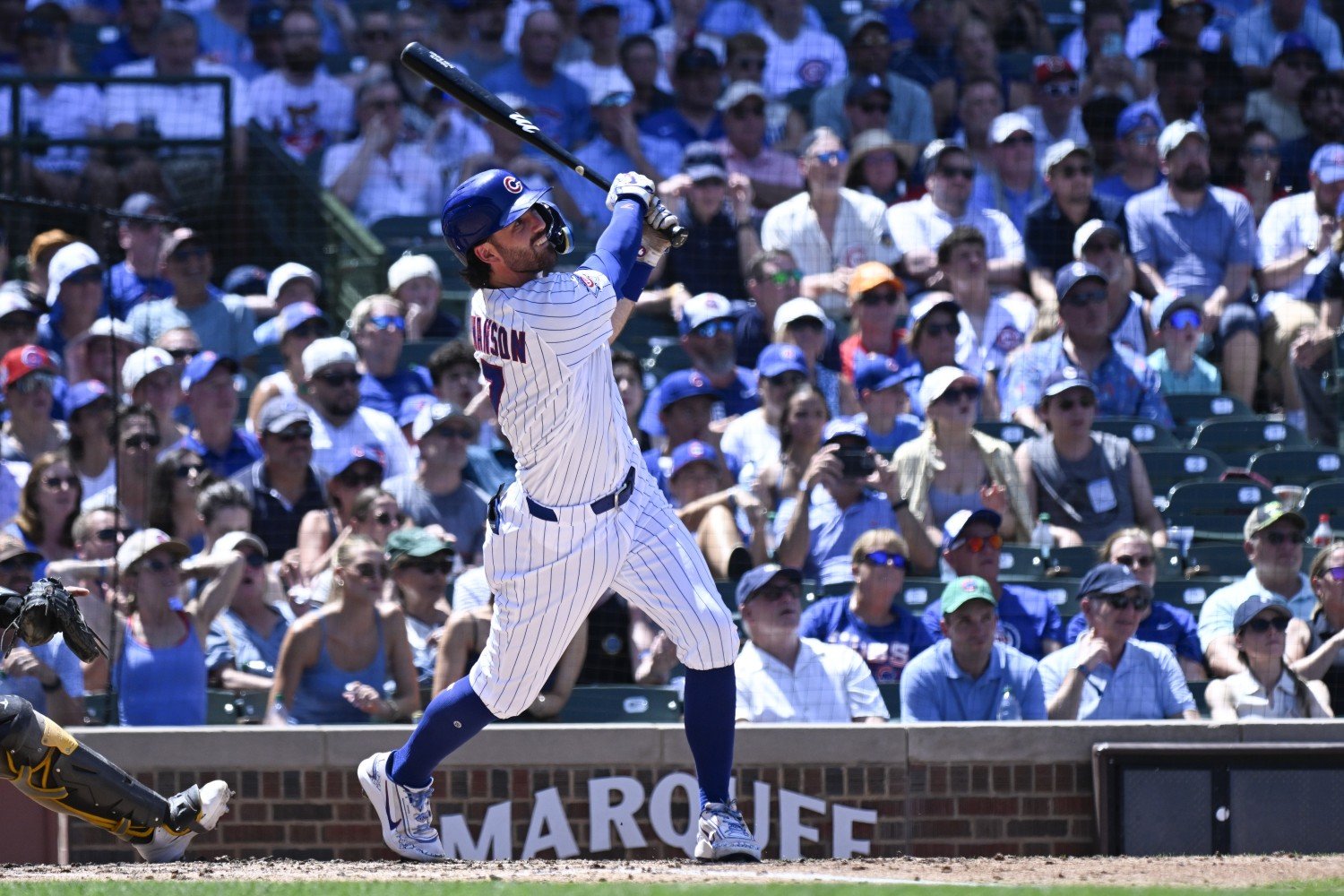
It's slightly inflated, this hot streak. It's easy to get a little carried away about it. Dansby Swanson is raking lately, to be sure, but the competition and the weather have conspired to make him look superhuman, instead of merely superb. He's hit five home runs in the last two games, taking ample advantage of the wind gusting out and the heat making everything carry at Wrigley Field. The ball is exceptionally lively lately. Walker Buehler came to town primed for some brutal regression. Last week in New York, the Mets inexplicably left their star rookie and ace on the mound to collapse, and Swanson hit a home run off Nolan McLean that was center-cut and missing about 3 MPH from McLeaan's usual fastball velocity. The last homer he hit Wednesday, which left his bat at 92.5 MPH and came against an eephus-lobbing backup catcher, was downright fraudulent. He's racked up an extraordinary number of RBIs, thanks mostly to coming up with runners on base constantly for the last fortnight.
All of that, though, to say this: Swanson is also genuinely on fire. He's as hot as he's ever been, and that's saying something. Here's a graph tracking his rolling 50-plate appearance weighted on-base average (wOBA) throughout his career:
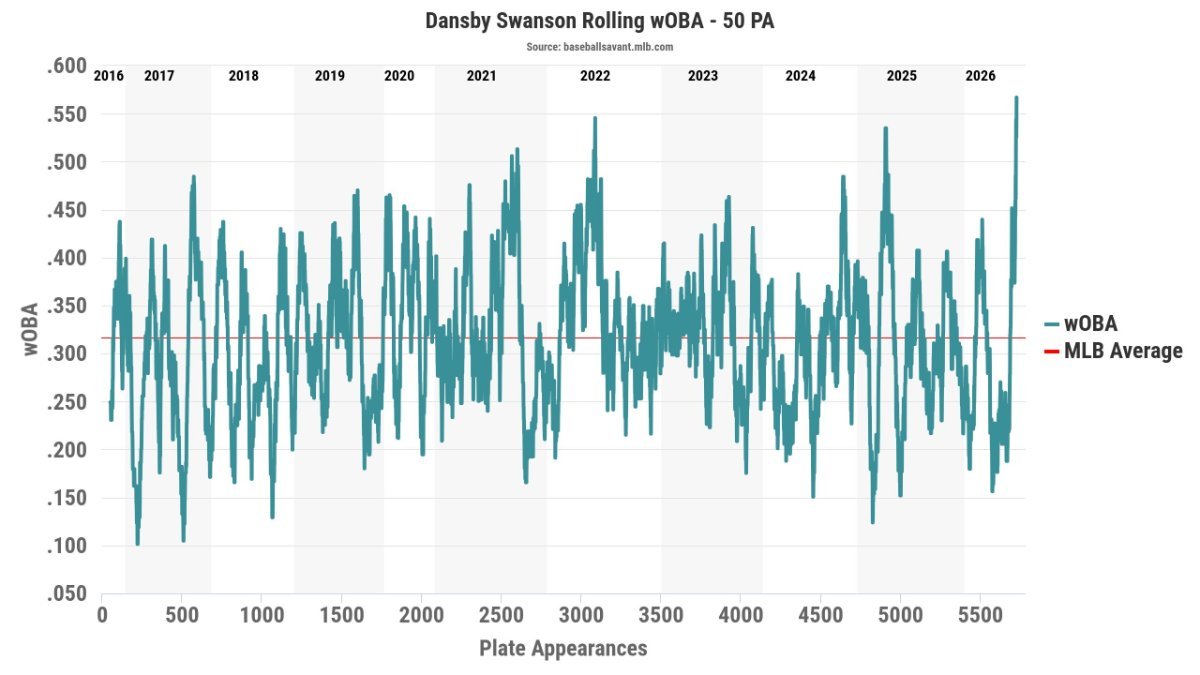
Every hitter experiences fluctuations in production over the course of a season. Not every hitter experiences ones that look like this. Swanson has always been capably of running extremely hot and cold, for a player with such an average-looking overall stat line. When he first joined the Cubs in 2023, he brielfy reduced the magnitude of his ups and downs, but by early last season, he was back to being what he will probably always be, despite his best efforts: wildly inconsistent.
Given how sharply and widely he's swung between delightful and disastrous for his whole career, it's jarring to say this, but it's irreefutable: Swanson is on an unbelievable hot streak right now, even for him. By contrast, just a few weeks ago, he was mired in a sustained funk as bad as anything he'd experienced since he still played his home games near Atlanta, Ga.
What's changed? Well, there are a lot of ways to answer that question. We could start by saying that it's a good idea to adjust his raw numbers to account for the Rockies, Blue Jays, Mets and Padres throwing a lot of bad pitchers at the Cubs, on very hitter-friendly days. The fact that he's never been "better" over a span like this before partly reflects the fact that this particular heater has coincided with some very favorable circumstances that are beyond his control.
Maybe, then, the better way to look at what's changed is to study process, rather than results. These days, though, 'process' is a term that catches several variables. Even 20 years ago, talking about process was simple: Instead of reading the baseball card, you checked a player's BABIP and their walk rate, or their out-of-zone swing rate. In fact, what the heck? Let's do that.

This is a chart of Swanson's rolling 15-game averages for weighted on-base average (wOBA), which is the same stat being tracked above and just describes overall production; out-of-zone swing rate; and the percentage of pitches he saw that were four-seam fastballs. It won't shock you to see how the three things interact. Swanson started the season in an aggressive mode, but got hot when he started forcing pitchers into the smaller zone created by the implementation of the ABS system. Pitchers' answer to that development was to stop throwing him fastballs, and he reacted so badly to that that they kept reducing heater usage, dragging him to Hell for weeks with one breaking ball after another.
Several weeks ago, though, Swanson started reducing that chase rate. Success didn't come right away, so we can say with some confidence that that's now why he's now hammering the ball without mercy. On we go, then, to a different tier of process-centered analysis. Let's talk about bat speed, and feel for the barrel, and timing.
Firstly (and I'll spare you the graph, this time, but it's true), Swanson is swinging faster lately. His average bat speed is up a little over 1.0 MPH since he started to get hot; he rarely swings this fast over any prolonged period. One narrative we might construct, then, would have him going in the tank at the end of April when he developed some hip/glute soreness that took him off the field for two days, and getting hot again when he started to feel healthy in mid-June. The thing is, he didn't lose bat speed right away when his production disappeared at the beginning of May. In fact, that number rose a bit early in his rough spell, and dipped when he started stabilizing his approach—before exploding around the middle of last month.
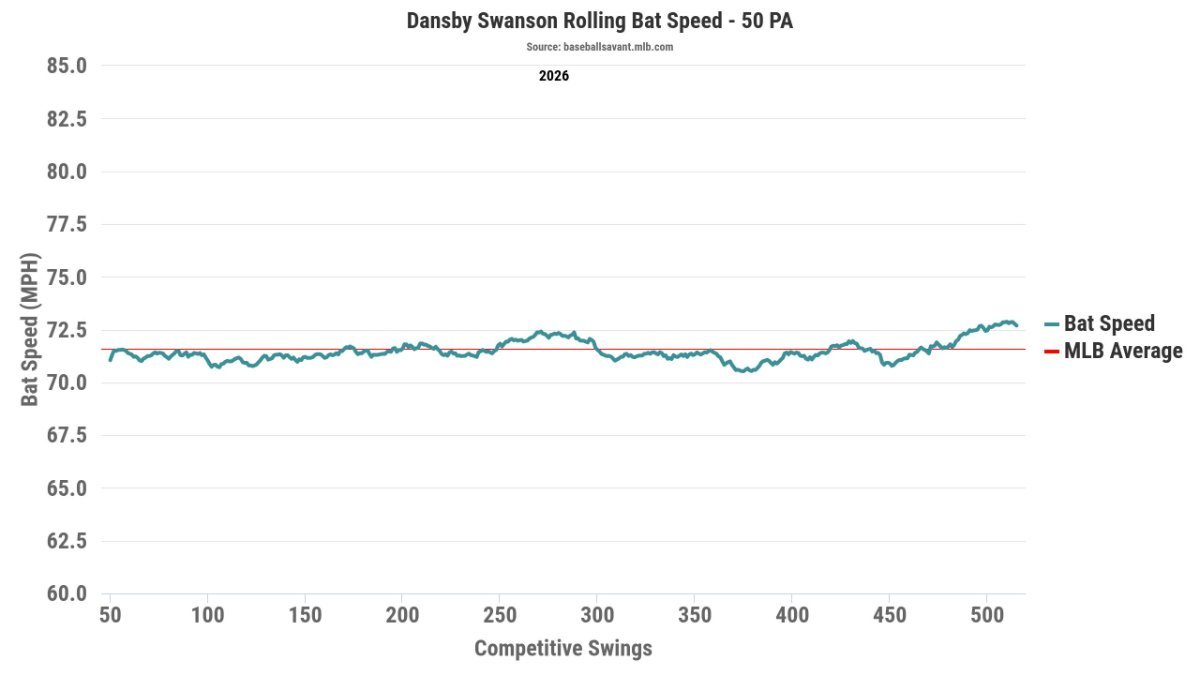
Bat speed matters, and the turbo boost in Swanson's is one component of his recent surge. Like his improving plate discipline, though, it's not enough to explain why he's suddenly searing. Let's forge on. It's time to get nitty-gritty.
As you might guess, in addition to swinging harder, Swanson is making more solid contact lately. Since June 15, he's batting .333/.371/.895; you can't do that just by swinging for the fences and catching a few friendly zephyrs. Swanson's Squared Up Percent (the percentage of the maximum possible exit velocity on a given swing, based on the speed of the incoming pitch and of the swing itself that a batter produces) has risen sharply lately, returning to and then eclipsing the level he was at before things fell apart for him for six weeks.
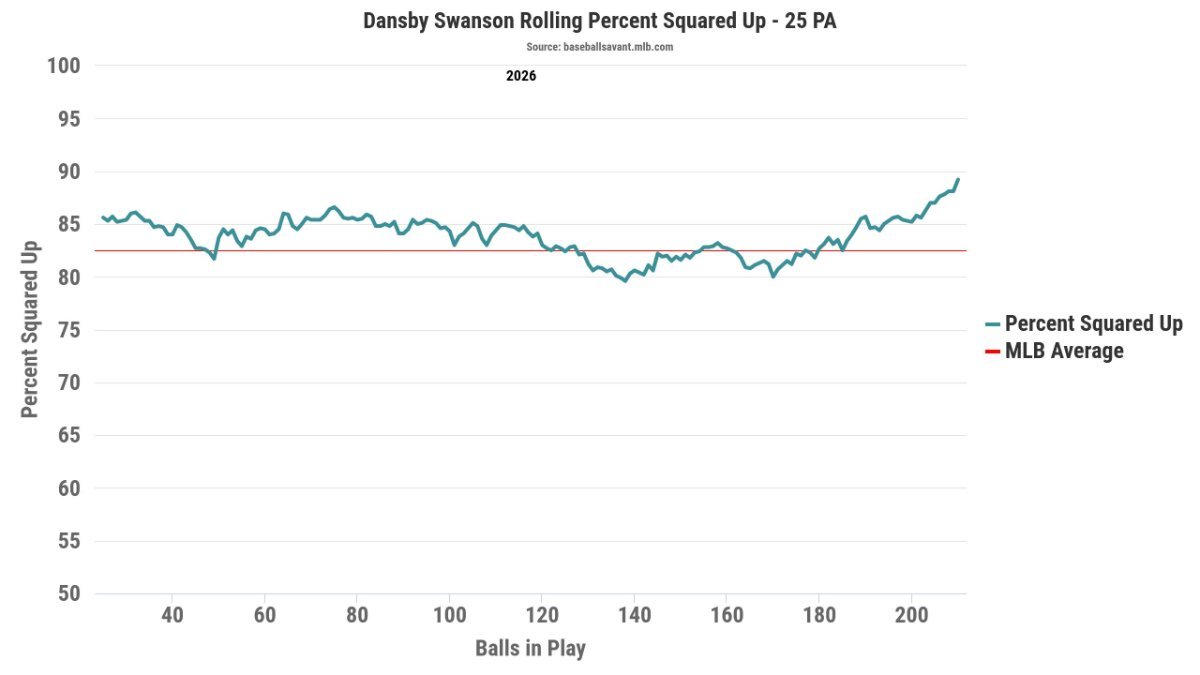
That's not an explanation, though. That's a dressed-up tautology. "Hey, you know the hot streak this guy is on? Guess what? Since it started, he's making more solid contact!" That's not insight. Let's seek some.
Statcast's new swing timing metrics hold the key to really, deeply understanding what has changed for Swanson. First, keep in mind the chart (a couple charts back, now; sorry) in which we saw the rolling fastball rate against him; it's risen again recently. Essentially, Swanson was lost in the woods for so long that pitchers stopped feeding him as steady a diet of slop and decided they could probably beat him by throwing their four-seamer over his infamously steep swing, as he tried to sit on and attack the softer, spinnier stuff that had become his daily diet. Both when they're doing that and when they do go to the secondary offerings, though, Swanson is ready for them lately.
Here's our control group. These are the distributions in each of the key swing timing metrics Statcast tracks for Swanson's swings through the end of April.
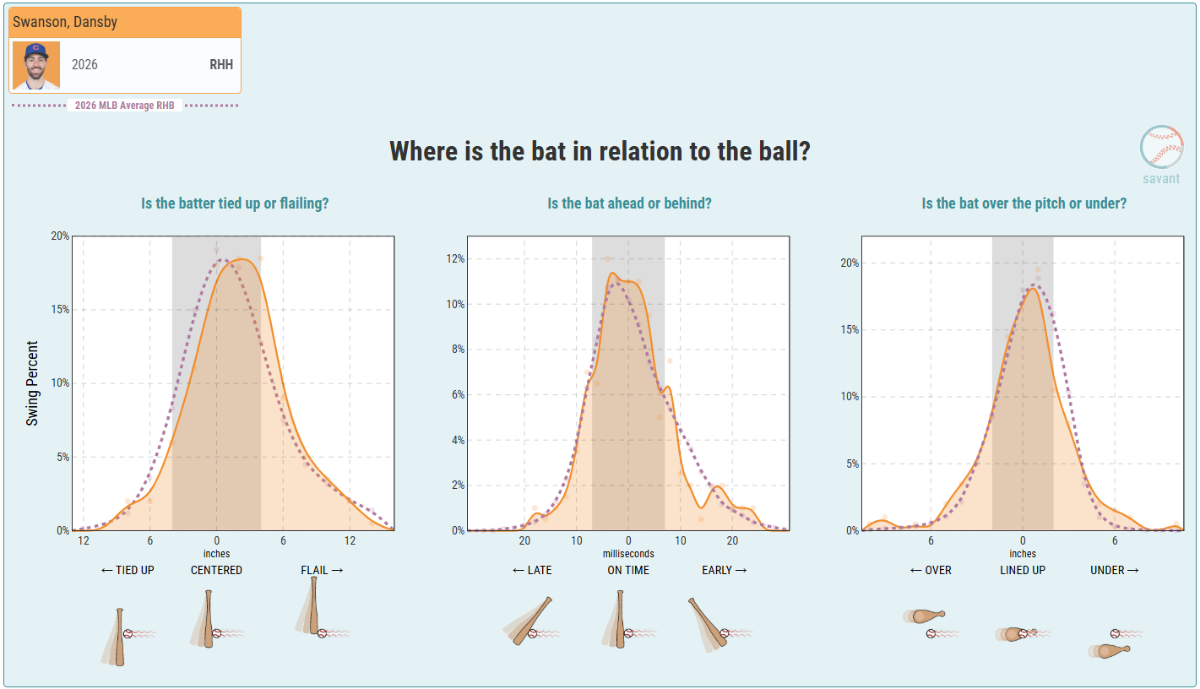
This data is still new to all of us, so let's walk through it a little. The lefthand image tells us how often Swanson centers the ball on the barrel, versus hitting it off the label (in on the hands) or out on the end of the bat. The center image tells us how often he was (more or less) on time, based on the angle of his bat relative to the path of the incoming pitch at the point of contact (or non-contact, as the case may be). The righthand image tells us how often Swanson lines up the ball on his barrel, vertically, versus swinging over or under the ball or hitting either the top or bottom third of it. As you can see, relative to an average right-handed batter, Swanson got the ball off the end of the bat considerably more often; was on time slightly more often; and missed both above and below the barrel slightly more often.
That's consistent with the profile of Swanson you're familiar with. He has a swing that leaves him running out of bat for soft stuff fairly often and whiffing fairly often, but he's fairly good at getting through the hitting zone in rhythm, and the swing is geared to do damage when he does achieve accuracy with the barrel. All of that was working (for better and for worse) in March and April. From the beginning of May (just after that glute issue cropped up) to the middle of June, however, it worked only for worse.
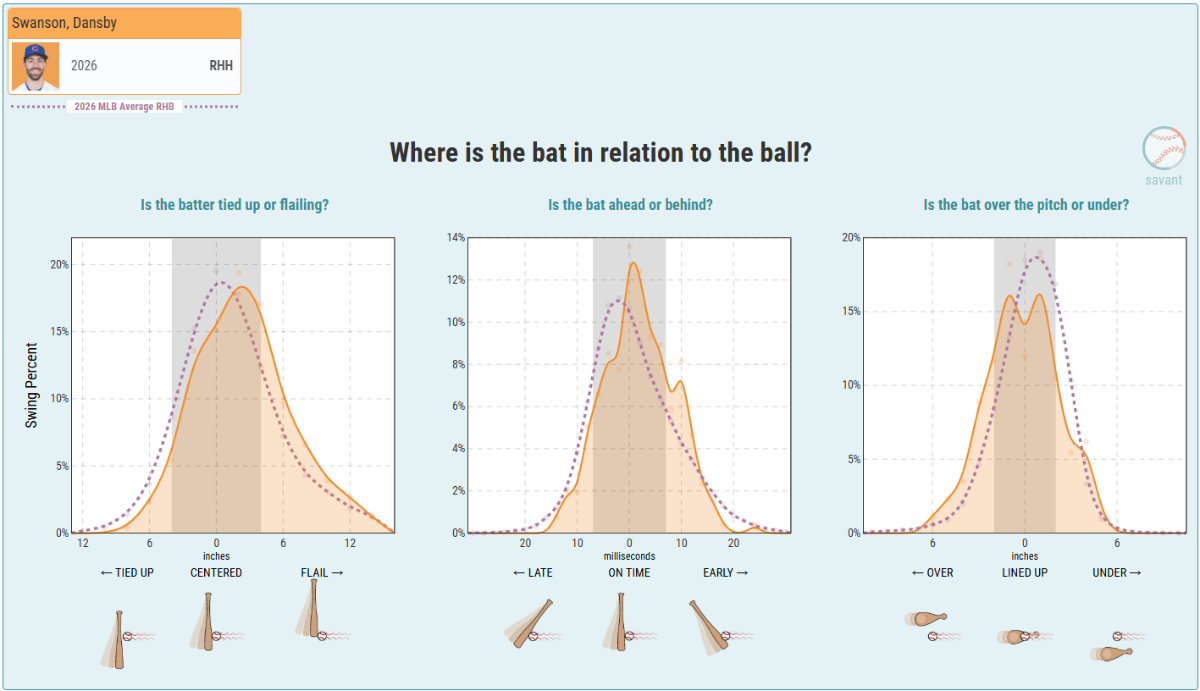
With all those extra breaking and offspeed pitches, hurlers got him out on (or beyond) the end of the bat even more. They had him early more often, taking away his ability to use the whole field. And notice the righthand image, here. That dip in the middle of the high range on the distribution is a sign that Swanson was always a little bit fooled, always a hair off in what he was trying to accomplish. He hit the outside and top half of the baseball a lot. He also hit the inside and bottom half of the ball a lot. Neither is the right way to produce solid contact, especially if you're catching it on the end of the bat.
Now, here's what those distributions look like since June 15.
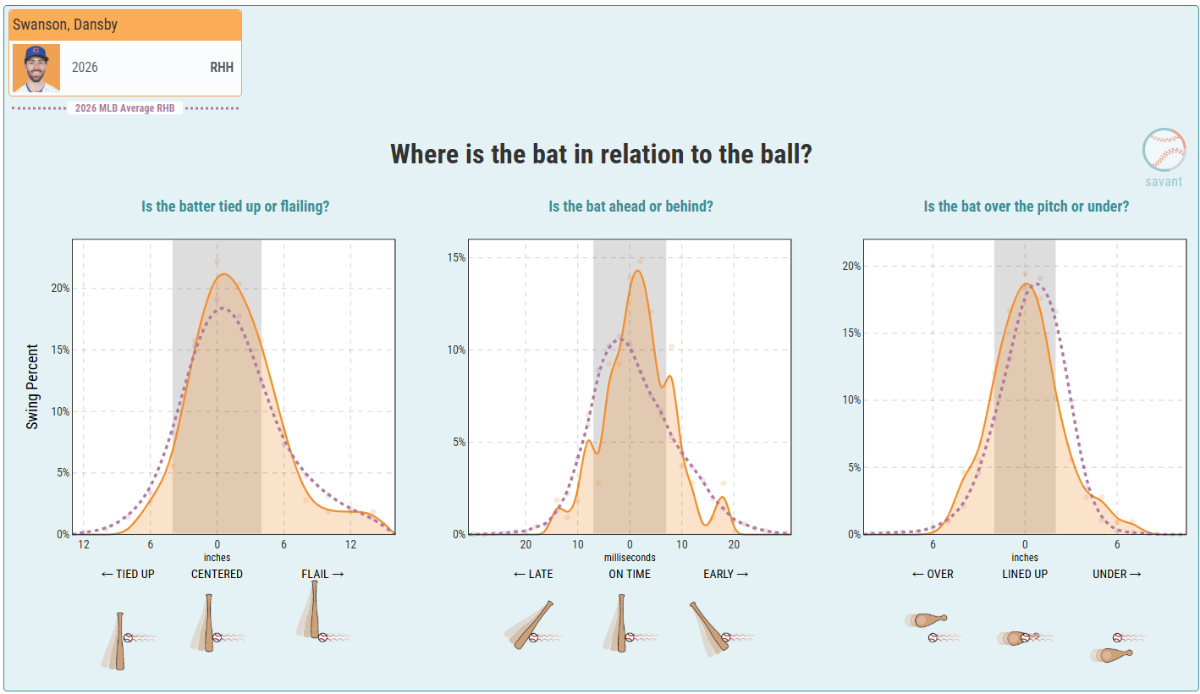
He's early in a good way (a little early, that is; just enough to pull the ball instead of spraying it) more often lately. He's also back to lining it up well on the barrel. But the biggest difference lies in how often (and how well) he centers the ball on the barrel. Over the last two weeks and change, nearly 70% of Swanson's swings put the sweet spot of his bat on a path through the ball. He's not getting it off the end nearly as often. He was under 60% accurate that way during his megaslump.
Getting more aggressive with his swing—a slightly longer stride and a slightly later but faster shift of his weight from the back left to the front—has gotten Swanson through the ball better. He's longer through the hitting zone, which is leaving more lumber on either side of the ball when he squares one up. That's why he's pulling it more and producing the long fly balls that can benefit so handsomely from the heat and the wind. Here's a middle-middle changeup on which Swanson just missed, from last month in St. Louis.
Now, here's one on which he (emphatically) did not miss, from this week against the Padres.
The extra length on the stride is important; it lets him sink into the swing more and not get stuck having to manipulate the barrel as much with his hands. The extra bat speed (which comes from the more energetic move in his lower half) is important; it lets him wait longer and get off a swing that can benefit from the subconscious but incredible hand-eye coordination that makes him a big-leaguer. He's on time, but more importantly, he's on time with a barrel he was able to load up and fire accurately. The difference between those two swings tells us much about why he's been red-hot lately.
That doesn't mean he'll stay hot, though. Swanson is simply an inconsistent player, because the bad swing above just isn't that great a departure from the good one, and it never has been. Being a great hitter in the majors is extremely difficult, and never more so than now, with the high baseline of talent and development for pitching league-wide. Small defects that can creep into your approach or your swing—flaws in your physical and mental routine that are virtually inevitable—can have big effects, and those effects are bigger on Swanson than on most players.
To answer the question of why Swanson has swung from as cold as he's been in years to as hot as he's been, ever, though, we can go a step further than simply acknowledging that he's inconsistent. He's done something material and impressive to get the sweet spot on the ball more often. That small tweak has played up in a big way for him, because he's already good at being on time. Though he's 32 (and players are always fighting off age-related decline at that point), he's showing signs of being smarter and organizing his physical and mental game better than ever, to make up for any creeping athletic shortcomings. For however long that lasts, it's sensationally valuable, especially from one of the game's best defenders at shortstop.






Recommended Comments
Create an account or sign in to comment
You need to be a member in order to leave a comment
Create an account
Sign up for a new account in our community. It's easy!
Register a new accountSign in
Already have an account? Sign in here.
Sign In Now