


Cubs Video
It didn't feel like Ian Happ's home run in Game 1 of the NLDS mattered very much. Decades ago, when sportswriters wanted a succinct way to sneer at Sammy Sosa for what they perceived as a dearth of clutch ability, they would say that all his home runs seemed to make a 9-1 game 9-2. Happ's solo shot off Brewers starter Freddy Peralta literally made a 9-1 game 9-2, and it felt like something worse than meaningless. It felt like a moral victory, at the time of year when those aren't supposed to exist.
Within the context of that game, of course, it truly didn't matter. The Brewers went on to win easily, 9-3, and the contest was even more lopsided than its final score implied. October, however, isn't about individual games. It's about series, and in the context of the series, that homer turned out to have real heft: education, emotional weight, and foreshadowing. It all paid off Thursday night, when Happ strode to the plate with two on and two out in the bottom of the first inning, in a way Anton Chekhov would be proud of.
Happ, of course, is the Cubs' longest-tenured player. He's the only guy left who has been in the organization since before they won the World Series, but when they did that, he wasn't yet a member of the big-league team. He came up the following May, and although no one knew it at the time, the dynasty he hoped he was joining was already in decline. Even as Happ had some productive seasons, his teammates stalled out or succumbed to slumps and injury. The team won a dramatic Game 5 over the Washington Nationals to reach that fall's NLCS, but it would be their last time there as a group. They were caught and passed by the Brewers for the division title in 2018. They missed the playoffs in 2019. The pandemic hit, and then the free agency of a half-dozen vital Cubs stood in the doorway brandishing its club, and the team simply came apart. Happ and Willson Contreras were the last ones left in the burned-out remnants of the palace Happ didn't get to live in back when the fruit was fresh from conquered lands and the tapestries were still thick and gorgeous.
Unlike Contreras, though, Happ stuck around, electing to embrace the possibility of a revival for which he would be the elder statesman, instead of the latecoming youngster. He signed an extension in April 2023, which not only guaranteed him payment from the Cubs through 2026 but came with a no-trade clause—a rare concession by the team, and one on which Happ insisted.
When he signed that deal, he probably hoped that he would see October with the team just six months later; it wasn't to be. The bitter disappointments of 2023 (when Happ came alive down the stretch but the team couldn't manage even the 84 wins required to qualify for the postseason) and 2024 (when they didn't, truthfully, even come especially close to making it that far) began to color Happ's legacy, just as the 2018-21 stretch discolored those of the guys who had won the World Series without him years ago.
That wasn't fair, because Happ was improving even as he entered the phase of his career wherein many hitters begin to decline. He had his first steadily productive season as a full-time player in 2022, when he was finally shifted to the right defensive home for him in left field. He was about equally good in both 2023 and 2024, delivering solidly above-average offense and plus defense. Stubbornly, though, the team kept losing (or didn't start winning enough, anyway), and Happ struggled to evolve into a good clutch hitter. That part came last for him, and when that happens, fans have already long formed their opinions of you before you start making the impression you want.
Come it did, though. He's now a .254/.353/.464 career hitter in high-leverage situations, and a .239/.327/.444 guy in late-and-close spots. It took a long time for him to become a balanced enough switch-hitter that teams couldn't exploit him by turning him around with a lefty reliever in key spots, and it took his gradual change from an all-or-nothing slugger to a more balanced, 20-homer type of guy for him to become less exploitable when the opposing hurler was hunting a strikeout. He became that kind of well-rounded, dangerous hitter, but still, it took (seemingly) forever for his signature moments to begin to come.
Entering this year, Happ had zero career walkoff hits. On April 22, though, he ripped a walkoff single to beat the Dodgers at Wrigley Field. Not even two months later, he slashed another one to beat then-Pirates relief ace David Bednar. He did come up with big hits, couched comfortably in a lineup where opponents feared three or four other guys more than him. He became Big Hit Happ, in a way. More broadly, though, he scuffled.
After a reasonably strong start, Happ slumped for much of May, June and early July. He went on the injured list for the first time in his career, with an oblique strain, and he almost certainly rushed back from it. It took a long while for him to get right. It took the All-Star break, in fact. When that break came, he was fighting (a losing battle) to keep his OPS above .700.
Since then, though, he's been nails. Happ shored up an otherwise disastrously slump-prone lineup for much of the second half, batting .266/.368/.491 in 261 plate appearances. He swatted 17 doubles and 11 home runs, and was the beacon of consistency on a team full of suddenly bewildered batsmen. Subtly, he came up as clutch as ever, keeping the lineup afloat until enough of his teammates reawakened to get them into the postseason relatively comfortably.
The playoffs were not kind to Happ, until Thursday night. He had a tremendously well-struck double against the Padres, and that homer against Peralta in Game 1, but those were his only hits in 24 trips to the plate. He needed to break out of that, and come up with the big hit for the team. He'd been able to extend the occasional rally with a walk, but facing Peralta with two outs and two on base, they didn't need him to extend the rally. They needed him to convert it.
Let's flash back, one last time, to Saturday. In the sixth inning, Peralta had started Happ with a nasty slider, then gone upstairs to jump ahead 0-2 with a fastball. Happ had laid off a curveball, which is how he earned the slightly lazy fastball that he punished to center field.

Peralta's execution wasn't good enough, but you can see what he was thinking there, and you can see the signs of how well he pitched for most of Game 1. His slider and curve were located right where he wanted them. So was the first heater. His stuff all had a great, very vertical shape, and he had good command of all of it.
Not so in the first inning Thursday night. That would be a major factor. Peralta threw six breaking balls to batters before Happ in the first inning, and most of them had much more glove-side movement than he's typically had on them of late. Here's a chart showing his pitch movement from the first inning, alone. Lately, when he's been right, those two wiggliest sliders and the not-so-deep curve have not been there; he's consistently thrown the ball with a 12-to-6 movement pattern.

Since he wasn't placing those offerings where he most wanted to, though, Peralta started Happ with changeups. He got to a 1-1 count with back-to-back cambios, retreating to the pitch with which he was most comfortable for most of this season against lefty batters. Then, he came up to the top third of the zone again, trying to take the crucial 1-2 lead in the count. This pitch was where he wanted it to be, or close thereto. He didn't miss down with it, the way he had in Game 1.

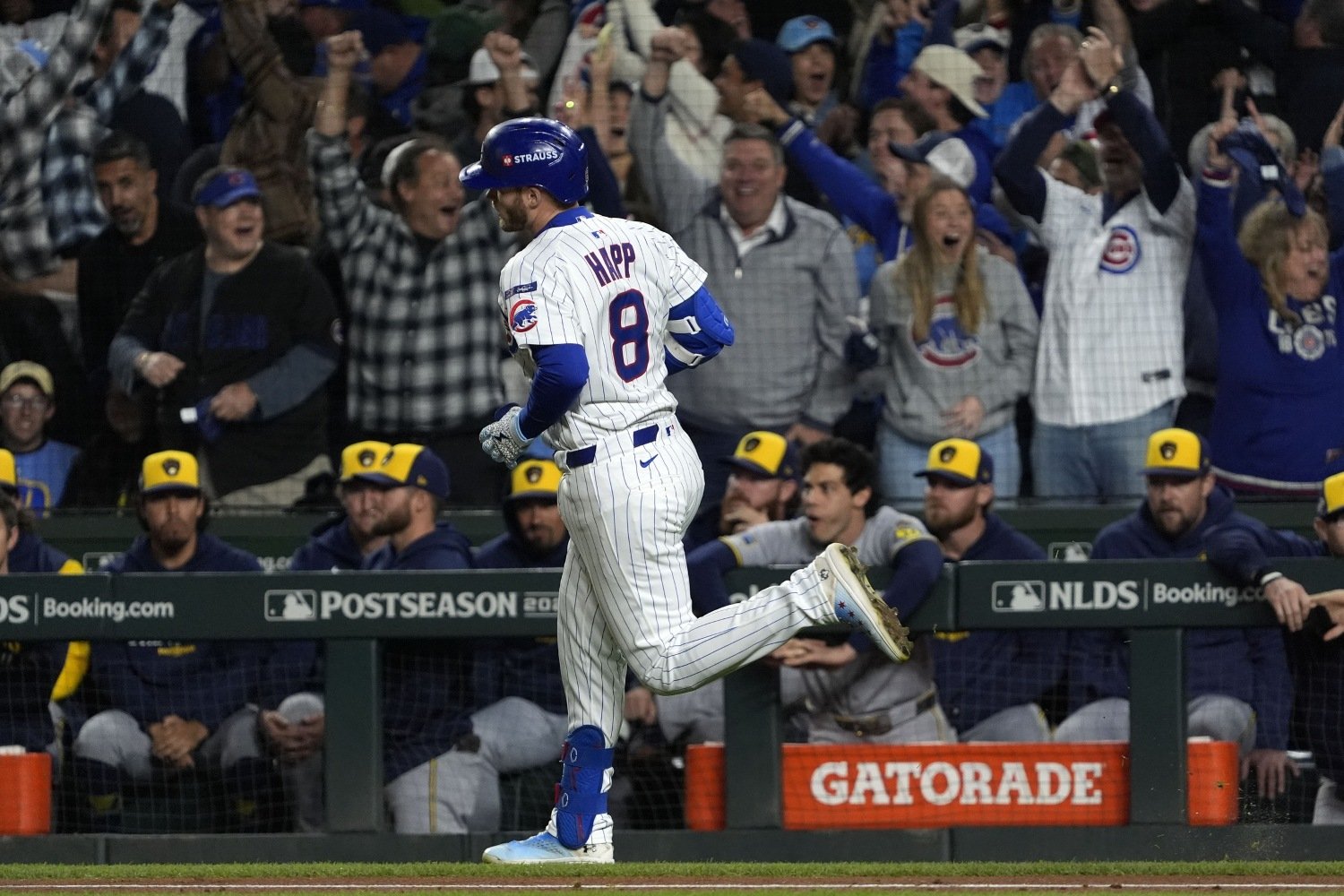
Happ, however, was ready for it. He doesn't usually hit pitches in that spot to the pull field. When he's on time for it, he usually hits a sharp line drive the other way. On that pitch, though, he sought to ambush the ball, and it worked. On a pitch above his wheelhouse and on the outer half, he sent a no-doubt dinger deep into the bleachers in right-center field. That at-bat in Game 1 had mattered; he'd carried something from then to now. Those two walkoff singles be damned, Ian Happ found his signature Cubs moment.
Who knows what will happen Saturday? The Cubs could complete a comeback that would sit like a rock in the stomachs of the Brewers and their fans for years to come; they could earn a chance to play for the National League pennant. They could also, of course, be sent home after all, valiant but doomed in their effort to undo the damage of Games 1 and 2 at Uecker Field in Milwaukee. At this moment, it doesn't matter. What happened in the first inning Thursday night is why you want your team to reach October.
The upswell of emotion when Happ connected—from the stepwise increase of the crowd's cacophony to the blossoming feeling of joy on behalf of Happ, the organization's best soldier—is what makes these series wonderful. Winning pennants and trophies is only part of the point. The bigger, better part is that warm feeling in your breast that came after the stinging high fives and the bear hugs. It's the looks on the faces of the fans in the picture at the top of this page. It's the way this game can feel like a story written by a great author, rather than just another experience in this random and often cruel world. It's the depth of connection you felt, in that moment, with No. 8 in white—and the way his combination of loyalty and dauntless work culminated in such a remarkable reward.




Recommended Comments
Create an account or sign in to comment
You need to be a member in order to leave a comment
Create an account
Sign up for a new account in our community. It's easy!
Register a new accountSign in
Already have an account? Sign in here.
Sign In Now