


Cubs Video
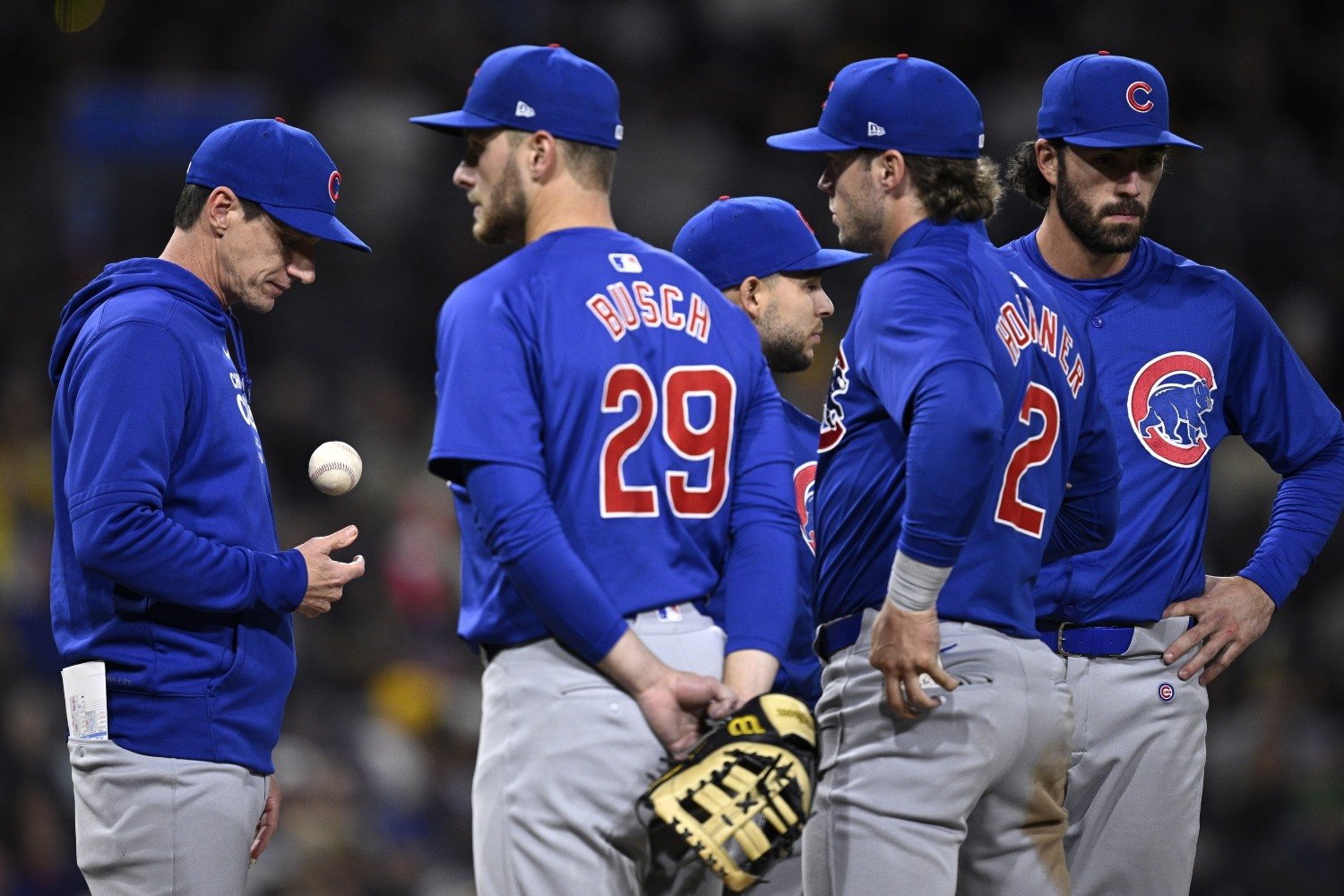
You could see it in Craig Counsell's body language. Oddly, that's sort of comforting. Amid a first week and a half that saw the Cubs win six of nine, score runs by the fistful, and establish some real optimism in a half-wary fan base, Counsell always knew Monday night was coming, and that's a testament to his managerial and tactical nous. As the bottom of the sixth began Monday, Javier Assad took the mound with an 8-0 lead, but Counsell looked restless and worried.
Never the type to cut a stern and immovable figure atop the dugout step, Counsell gave in to the opposite end of the spectrum in the sixth. He was pacing like a caged animal, but the emotion he was trying to contain by clenching his way and rolling his neck to look skyward wasn't fury or ferocity; it was worry. It was a set of movements unique to a man who knows he's in good position, but that it might not be good enough.
The Cubs have been hurtling toward a pitching implosion--the genuine article, even bigger than the one that almost cost them the last game of the Rockies series Wednesday night--almost since the moment the season began. They have several pitchers about whom there's ample reason for optimism, but they also have an extreme dearth of depth, particularly in light of Yency Almonte and José Cuas being unreliable and Jameson Taillon, Justin Steele, and Julian Merryweather being unavailable. This was a failure of the front office; they should have done more to reinforce the pitching staff this winter. It was Counsell on whom the problem landed like an anvil, though.
Merryweather's loss feels especially glaring, and the pit in Cubs fans' stomachs surely only deepened when the team provided a dim-sounding update on his status Monday. As gutty and exciting and talented as Adbert Alzolay is, it's Merryweather who held real elite upside for the team in the bullpen. He's their flamethrower and their bat-misser. It's Merryweather's absence, in the present and as far into the future as any manager can really afford to look, that gave Counsell that dyspeptic look even while his team led 8-0. He not only knew that he was (bizarrely) in trouble in that game, but knows that there might be a lot more nights like that one ahead.
It's not all that helpful to neatly apportion blame for what happened next. Certainly, Counsell himself can come in for some. Bringing in Nick Madrigal to shore up the defense once the contest tightened, while understandable (in light of the bullpen failing to miss bats for most of the season so far), seemed like a desperation move this time. It was likely, by the time Madrigal entered, that the Cubs would need to score again in order to win. As it turned out, Garrett Cooper had to come in and pinch-hit for Madrigal with the Cubs down to their last out in the ninth, and had that button never been pressed, Christopher Morel would have been up as the tying run.
Bringing in Alzolay for a five-out save was the act of a desperate man, too, and it's the kind of aggressive relief-ace usage that should be reserved for relief aces a tier better than Alzolay is. I'll admit that this is a wild theory, but I think the psychological barrier--the enormity of the task in the pitcher's head--involved in asking a closer to go five or six outs with almost no margin for error tightens them up so much that they become disastrously mistake-prone, and therefore, that teams should only do it in the most urgent circumstances, with the most bulletproof star relievers. Neither Game 10 of the regular season nor Alzolay meet those criteria for me.
Again, though, Counsell was put into a no-win situation, first by a neglectful front office, then by buzzard's luck--to wit, Shota Imanaga's stellar start Sunday being cut short by a rain delay, forcing him to ask an extra inning or two of an already tired bullpen--and finally by players who failed in their most essential responsibilities, even with huge margins for error.
While Counsell was apace in the dugout, Assad and Miguel Amaya were miles too cute with Fernando Tatis Jr. to lead off the sixth, going to a second straight slider low and away on 3-2. In that situation (leading off an inning, up by eight), asking a player to chase a breaking ball outside the zone is not only a low-percentage play, but a rude declaration that you don't believe that player has any feel for the game at all. Tatis has that feel. The situation called for a fastball, to whatever sector of the zone Assad was most confident about locating that pitch by that stage in the game. Instead, two young players made an error in game planning, and a floodgate was opened.
Perhaps the free pass frustrated Assad. Perhaps he was shaken by the near-homer Jake Cronenworth hit almost as soon as he stepped into the batter's box as the next batter, just foul down the right-field line. Perhaps he was just gassed, as he reached 100 pitches. In all likelihood, (Counsell didn't really want Assad out there, but he was down behind the stairs in the dugout, pacing and trying to figure out who the hell might get him 12 more outs, when he had three guys (Mark Leiter Jr., Almonte, and Daniel Palencia) down for the night based on their usage Saturday and Sunday. He was trying to steal an extra out or two with his starter, even if it cost him a run or two.)
Whatever the reason, though, Assad's body language got utterly atrocious in the blink of an eye. He got antsy about Tatis at first, suddenly seemed to be rushed by the 18-second pitch clock, and showed visible frustration with the umpire when a pitch outside the zone wasn't called a strike. He was already pitching like it was 8-7, not 8-0.
Cuas is a different problem. Counsell clearly hoped that the Cronenworth homer that chased Assad would pop the tiny tension bubble that had bloomed on the field before it, and that Cuas could come in and be breezy, with a clean inning and a six-run lead. Alas, right now, Cuas is beyond even that kind of ease. It would be a surprise if he isn't optioned to the minors Tuesday, as the Cubs try to patch together a pitching staff that can survive the rest of this West Coast trip.
Luke Little and Héctor Neris were little better, though. It was just a night filled with chickens coming home to roost. In a way, it's good. Each of those pitchers are going to have nights like that; none of them are good enough to be trusted the way you can trust a Josh Hader or a Devin Williams. Crowding a clunker from each into a single game led to a nightmare of a loss, but it's only one loss. Had each of them had a similar implosion in sequence over a week or two, the Cubs could be under .500 right now, or they could lose an extra game or two on the balance of this trip.
As it is, while the ugliness of that defeat will linger a while, and while it laid bare some very real issues the team needs to address, it's just one loss. Ben Brown will start Tuesday, and while you'd rather have a player with more experience and a greater chance of going six or seven innings pitching after that kind of game, Brown looked terrific last time he pitched. Leiter, Almonte, and Drew Smyly will probably be the first three out of the pen behind him, in some order, each freshened by a much-needed day of rest. The team will make at least one roster move, too, to shake up the bullpen. The team can leave that game behind. It's just important to remember that that failure didn't come out of nowhere.
Which team do you dislike the most in the NL Central?

Follow North Side Baseball For Chicago Cubs News & Analysis



-
 1
1


Recommended Comments
Create an account or sign in to comment
You need to be a member in order to leave a comment
Create an account
Sign up for a new account in our community. It's easy!
Register a new accountSign in
Already have an account? Sign in here.
Sign In Now