


Cubs Video
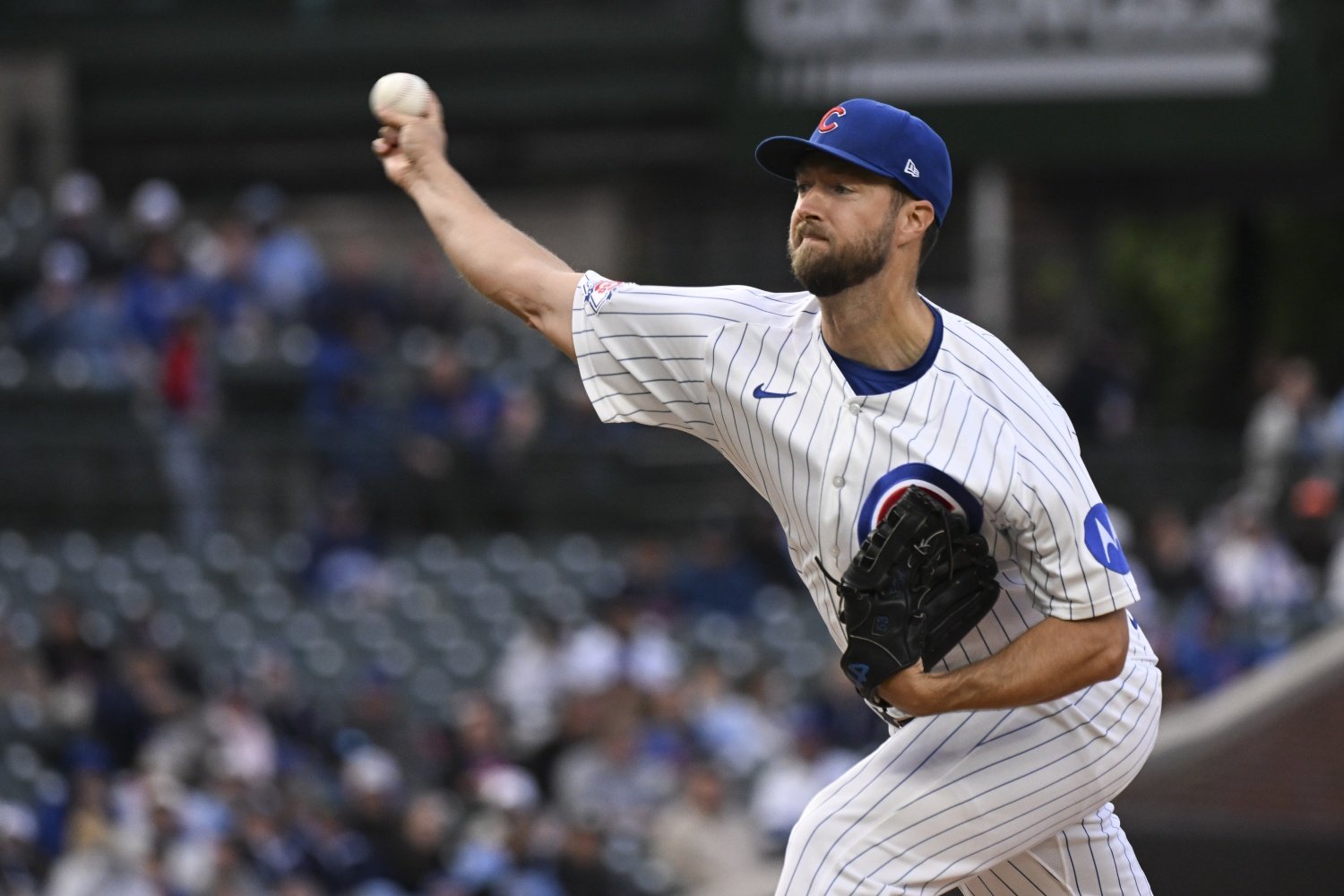
If Colin Rea pitches six innings Tuesday night in the northwest suburbs of Atlanta, he'll reach 650 for his career. That's not exactly a significant milestone, in the historical context of the big leagues. It's remarkable, however, because Rea is less than two months shy of his 36th birthday, and almost exactly half of his career frames have come in the last two years.
On May 13, 2024, Rea threw an unremarkable quality start: 6 innings, 3 earned runs, 1 walk, 5 strikeouts against the Pirates. To that point in his career, 'unremarkable' had been a pretty good encapsulation of Rea. He'd finally gotten some traction in the majors the previous year, with the Brewers, but before that, injuries had slowed his long ascent to the majors—so much so that he spent time pitching in Japan before coming back and finding a new toehold Stateside. He finished the night with 323 1/3 innings pitched in the majors, over the nearly 13 full years since he was drafted in June 2011, and a 4.56 ERA.
Since then, though, Rea has spent almost all his time in the starting rotation of either Milwaukee or the Cubs. No, that wasn't quite the plan, in either place, but one way or another, Rea keeps being needed—and he keeps meeting the need. Over the last two years, 'quality' has been the word that best defines him, and there's nothing unremarkable about his career, anymore. In addition to doubling his career volume in his mid-30s, he's posted a 4.21 ERA in the last 320-plus frames.
Born Jul. 1, 1990, Rea is the oldest possible person who could be listed at age 35 for this season at Baseball Reference; the baseball age convention is to give the player's age on June 30 of the season in question. If he were born one day earlier, he'd be listed as 36, instead. Nonetheless, he has more innings pitched since the start of his age-33 season (365, since 2024) than he had before that. More importantly, he's become so established that it's relatively easy to see him pitching another 350 innings or more—something that would have been almost unthinkable when he turned 33, in the middle of a 2023 season in which he was an up-and-down swing man for the Brewers.
Among pitchers whose age-33 season came in 2005 or later, 34 have pitched at least 700 innings from that point to the end of their career. Mostly, though, those are long-time stars and potential Hall of Famers. Max Scherzer, Justin Verlander, Zack Greinke and Roy Halladay are on the list. So are slightly lesser workhorses like Adam Wainwright, Tim Hudson and Mark Buehrle. There are several guys who pitched that much because that's just what you did back then—soak up innings at the back of a rotation throughout your mid-30s: Aaron Harang, Kyle Lohse, Ryan Dempster, Jeremy Guthrie.
Only six of those hurlers actually pitched more after the start of their age-33 campaign than they did before it. Two guys (Jose Contreras and Hiroki Kuroda) pitched more in MLB after 33 than before, but they'd had long careers in Cuba and Japan, respectively, before coming to the United States. The main six—the six pitchers of this century whom we might call real comps for Rea, if he can turn in another couple of seasons like his last three—are:
Two of these guys (Hill and Morton) are heroes of the player development revolution; they became stars late in careers that started out seemingly doomed by injury trouble or extreme hittability. Unlike them, though, Rea has no high-spin curveball story, and no multi-year, eight-figure contracts await him. Bassitt was in the same draft class as Rea, but is 16 months his senior, which means he's listed as two years older than Rea. Like Rea, he was a late-round pick, but unlike Rea, he gained a modicum of prospect buzz and reached the bigs on a normal trajectory; he was waylaid almost solely by injuries.
Morton and Lowe each pitched fairly big numbers of innings before turning 33; they just stuck around long enough to be more voluminous in their old age than in their younger days. Bassitt and Mikolas had each thrown more than 500 innings before their age-33 seasons, so even though Bassitt shares that draft history with Rea and Mikolas went overseas like Rea did, each was much more established much earlier than Rea was. Remember, at the beginning of his age-33 campaign, Rea had only amassed 279 innings in the bigs.
That really only leaves Ryan Vogelsong as a true match for what Rea went through, and what he might hope to achieve. Vogelsong is a fascinating case, too. He had some injuries—you really can't end up on this kind of list without some—but that wasn't his main problem. His main problem was that he was bad. After being a fifth-round pick in 1998, Vogelsong pretty quickly proved he was too good for the minors, but he wasn't good enough for the majors in any of his first seven seasons there. At almost the same age Rea did, though, he went to Japan, and he came back as something a whole lot like what Rea is now.
Vogelsong came back from NPB to the team who had initially drafted him: the Giants. With them, from ages 33-37, he had a 3.89 ERA and pitched almost 800 innings. He was even useful (and occasionally heroic) in the postseason, en route to the team's 2012 and 2014 World Series rings. Baseball Prospectus still runs a regular feature called the Vogelsong Awards, honoring players who weren't in their annual preview book but end up having a significant impact in the majors.
Rea hasn't ever been quite as good as Vogelsong was in 2011 and 2012, but he's already showing more staying power than Vogelsong did. At age 35, Vogelsong went over a cliff. His velocity dipped from 91-92 MPH to 89-90, and the rest of his stuff couldn't make up for the loss. Rea, by contrast, is sitting just under 94 MPH in average velocity, virtually exactly where he was last year and harder than he'd ever thrown before that. He's also using seven different pitches, including a slider and a splitter that each miss bats at above-average rates.
In a perfect world, the Cubs would have Rea working in long relief. We know that for sure, because they came into the season planning on that. It was never all that likely to stay that way for long, though, and now, it looks like Rea will be in their rotation all season. He should be. He's earned it. And if he keeps doing this much longer, he'll be the best virtually anonymous late-blooming pitcher in recent memory. It's not enough to earn him a chapter in the next book about tech in baseball or to make his grandkids ultra-rich, but Rea is a shining example of persistence, resiliency, and having your best years just when everyone else is hanging them up.
Do you approve of the job Craig Counsell is doing as Cubs manager?

Follow North Side Baseball For Chicago Cubs News & Analysis



-
 1
1


Recommended Comments
Create an account or sign in to comment
You need to be a member in order to leave a comment
Create an account
Sign up for a new account in our community. It's easy!
Register a new accountSign in
Already have an account? Sign in here.
Sign In Now