


Cubs Video
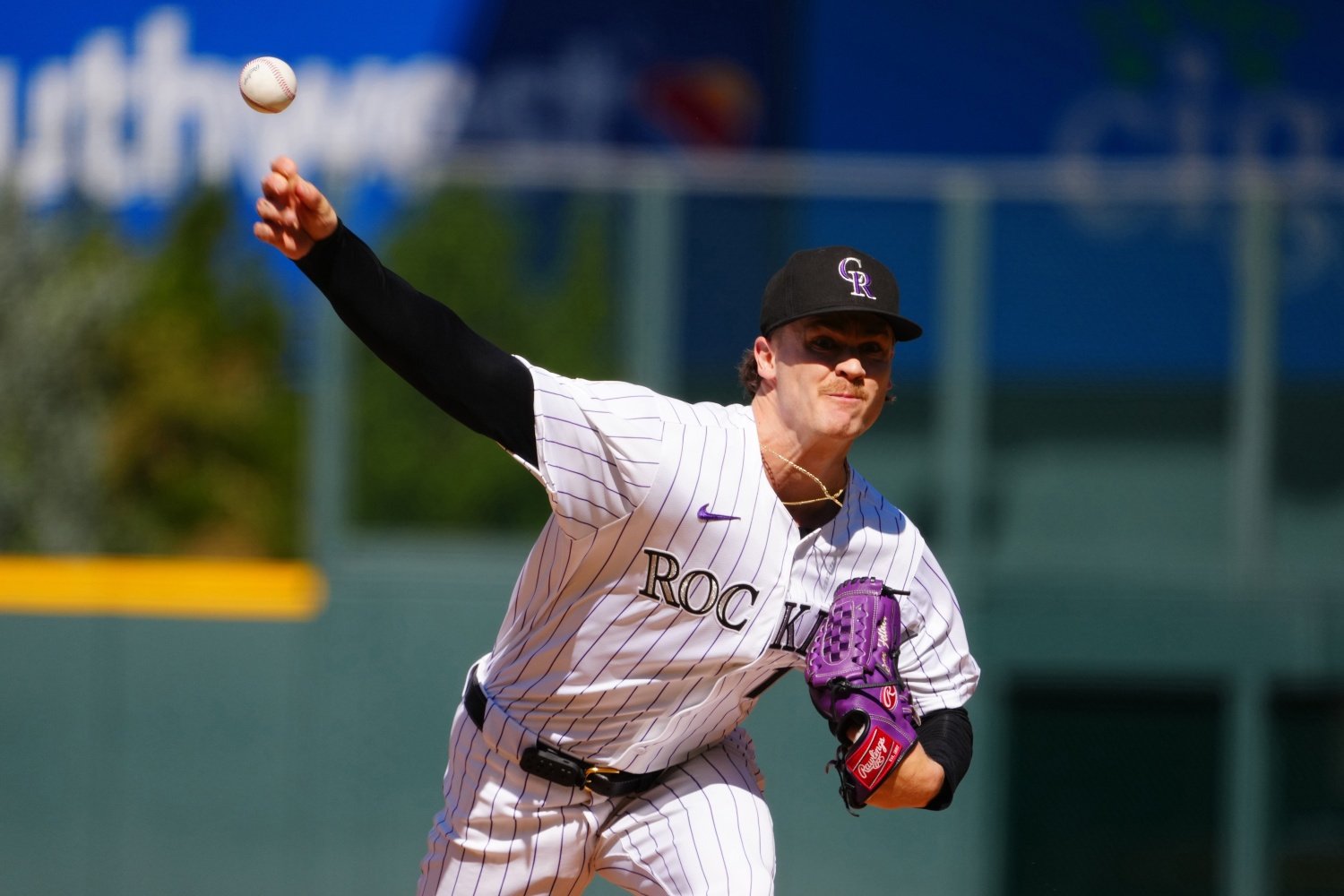
When I ran down a list of possible players the Cubs could target to bolster their starting rotation in the wake of a Jesús Luzardo trade falling apart last week, the name of Rockies righthander Ryan Feltner drew raised eyebrows. He's much, much less of a brand name than hurlers like Luis Castillo, Dylan Cease, Walker Buehler, Sean Manaea, Corbin Burnes, or Shane McClanahan, even if most fans understood already that some of those hurlers were crossed off the Cubs' wishlist for financial reasons. He didn't seem like a great fit with the rest of the group.
Thus, I'm here to answer your implied question, with gusto: Yes, Ryan Feltner. Yes, really.
The former fourth-round pick is eligible for arbitration this winter, the first of what will be four such seasons because he qualifies as a Super Two guy. He's not a hot name on the market, but he should be available, because the Rockies are more than one pitcher or four years from contending in the heated NL West. They are, to put it into terms that suit the season, the equivalent to the Bears in the NFC North: a disastrously mismanaged team with some talent (but not anywhere near enough of it), utterly unable to keep up with fierce competition in their division. They need to continue leaning into a rebuild.
Feltner, 28, had a 4.49 ERA and an unimpressive 19.9% strikeout rate in 2024, which was his first full season in the Rockies rotation. Automatically, though, you have to give his stock a bit of helium, for each of several small reasons. First, of course, he calls Coors Field home, which can have all kinds of knock-on effects on pitcher development. Second, and related, he pitches for the Rockies, who are bad at pitcher development in ways that go beyond the impact of their park and its elevation. Third, what would have been his first full season in the majors was cut in half by a line drive off the bat of Nick Castellanos, which hit him in the head and fractured his skull, shelving him for three months in 2023.
Those are the obvious things. The less obvious and even more important things are these:
- Feltner has a six-pitch mix and throws 95 miles per hour, with some natural cut on his four-seamer. His is precisely the kind of repertoire the Cubs like, and the sweeper he added in 2024 is the best weapon in his arsenal—which means that evaluations of him prior to its inclusion need to be discounted and we need to rapidly update our sense of who and what he is.
- In 2024 (almost 2025!), it's perfectly possible to evaluate how a pitcher's fundamental pitch characteristics are affected by a place like Coors Field—and we can see that, in Feltner's case, it's a real and dramatic impact.
Baseball Prospectus has a suite of metrics for pitch-by-pitch evaluation, akin to the more prevalent Stuff+ you can find on FanGraphs. The BP flavor of the models doesn't just rate pitches and then scale the scores to 100, though. They express the expected run value of each pitch type, per 100 pitches thrown. There's StuffPro, which gives a per-100 run value to each pitch type based on release point, movement characteristics, handedness and count; and PitchPro, which does the same but includes location as an input. Negative numbers are good things, because that means the pitch should tend to prevent runs. Positive numbers are bad; they mean more runs on the board.
Here are Feltner's StuffPro and PitchPro for each of his pitch types, at home and away, for 2024:
| Pitch Classification | Home/Away | Pitches | PitchPro | StuffPro |
| CH | away | 189 | 0.1 | -0.3 |
| CU | away | 124 | -0.5 | -0.3 |
| FA | away | 467 | 0.2 | 0.3 |
| SI | away | 215 | 0.7 | 0.5 |
| SL | away | 294 | -0.6 | -0.2 |
| SW | away | 64 | -2.1 | -1.4 |
| CH | home | 182 | 0.1 | 0 |
| CU | home | 134 | -0.2 | -0.3 |
| FA | home | 462 | 0.4 | 0.8 |
| SI | home | 143 | 0.9 | 1.4 |
| SL | home | 226 | 0.4 | 0.1 |
| SW | home | 71 | -0.8 | -1.1 |
His slider is just a bit better than average on the road, but it's just on the wrong side of average at home. His two fastballs both play considerably better away from Coors Field, and his changeup and curve are incrementally better when he's not there, too. Weighting his StuffPro and PitchPro grades by pitch usage in each location, you can see how much more effective his arsenal is if he's not at Coors Field than if he is.
| Away Pit. | 1353 | Away PitchPro | -0.081 | Away StuffPro | 0.005 | |
| Home Pit. | 1218 | Home PitchPro | 0.278 | Home StuffPro | 0.389 |
On the basis of his pitches' actual, physical characteristics (and locations) alone, Feltner was about five runs worse at home than on the road in 2024. That's before accounting for the fact that contact is more damaging at Coors than elsewhere. It also doesn't account for the defense behind him, which was roughly average in 2024.
In other words, bring Feltner to Wrigley Field in 2025 and put him in front of one of the league's best defenses, and he might be a good 12 runs better than he was in 2024—before accounting for any changes to his pitch mix or strides in pitch design the team could make, taking advantage of being better at pitcher development than the hapless Rockies. That 4.49 ERA comes down to 3.83 on that alone.
The tweaks are easy, too. That sweeper that stands out as such a strong offering already showed up more as the season went along; the Cubs could easily double his usage of it. They could, very plausibly, redesign his changeup, which moves more like a splitter; they might well help him achieve more consistent depth on it. He could be a much better pitcher against lefty batters with a slight improvement to that change.
Feltner would not be an especially easy acquisition. He would probably cost the Cubs one of Owen Caissie or James Triantos, as many assumed Luzardo would have, and they'd need to send Colorado an arm, too—maybe someone like Michael Arias or Caleb Kilian, but maybe someone as high-profile as Jordan Wicks. The opportunities Feltner presents are unique, though. Any similarly talented and accomplished pitcher with four years of team control left would be either totally unavailable, or considerably more expensive. Feltner's market value is dinged by his home park, and his practical trade value is limited by the fact that the Rockies probably don't quite realize what they have. It's a riskier move than acquiring someone like Castillo, but the price is much, much better, because the money he wouldn't cost could be put toward big splashes in free agency to close out this crucial offseason for the Cubs.





Recommended Comments
Create an account or sign in to comment
You need to be a member in order to leave a comment
Create an account
Sign up for a new account in our community. It's easy!
Register a new accountSign in
Already have an account? Sign in here.
Sign In Now