


Cubs Video
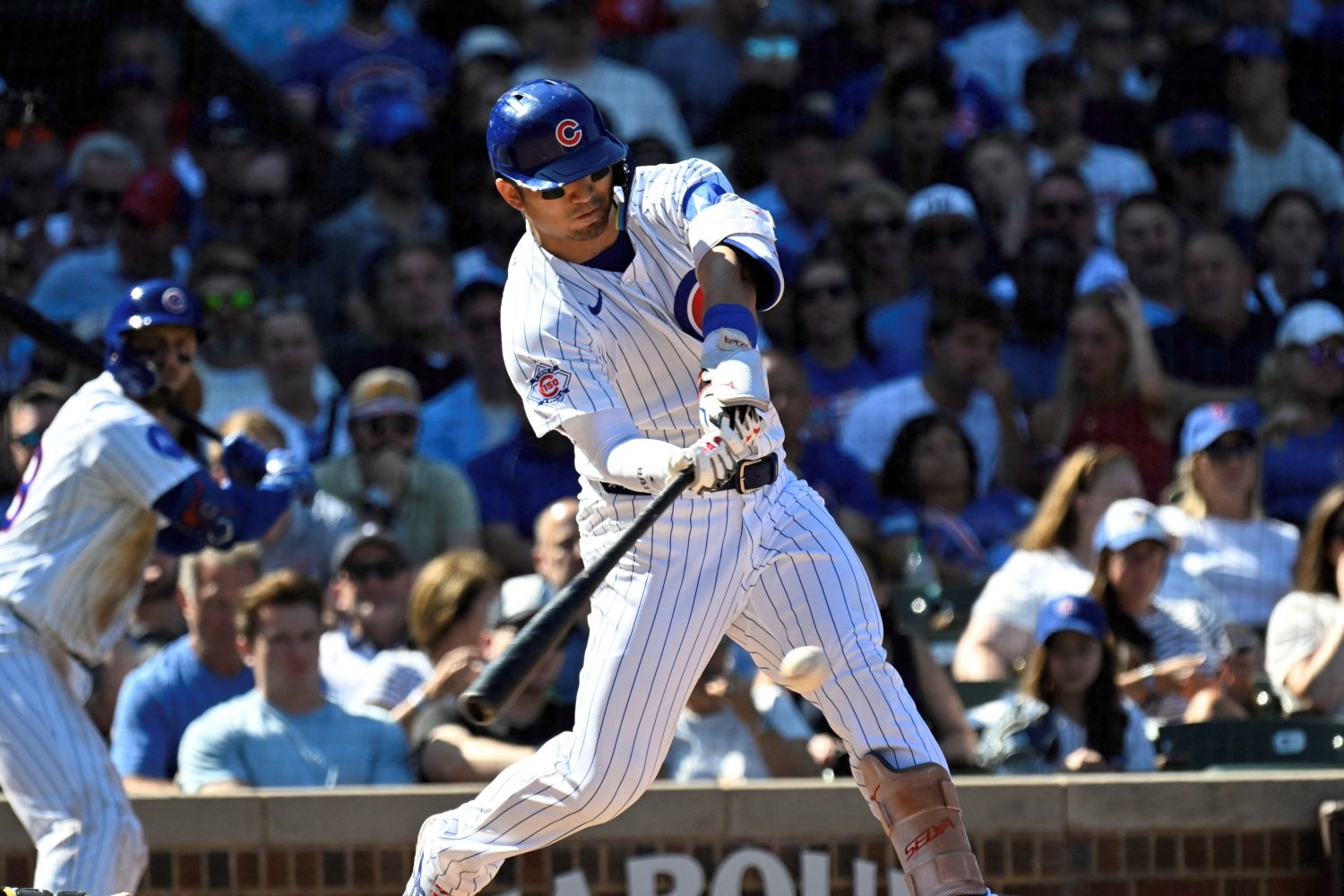
The batted-ball data says Seiya Suzuki should be having a worse season. He's down almost 3 miles per hour in average exit velocity. He's hitting the ball on the ground more often, and he's hitting it hard less often. He still takes excellent at-bats—his walk rate is up to a very strong 13.2%, with a career-high 77 total free passes, and his strikeout rate is very slightly down—but if he were doing everything the same (and if luck were treating him exactly as it has for the previous few years), we'd expect to see much less production from Suzuki this year than in 2024 or 2025.
If you're reading this, though, you probably already know that that's not how things are actually going. Suzuki is hitting a tremendous .269/.369/.477, right in line with his output in 2023 and 2024 and a tick better than his more power-focused 2025 numbers. Baseball Prospectus's DRC+, which estimates a players deserved contribution based on production and process, has him at 122 this year (where 100 is average and higher is better); that's the best mark of his career. That advanced metric, then, doesn't think he's merely gotten lucky. According to Baseball Savant (powered by Statcast), however, his expected weighted on-base average (xwOBA) is just .341, the lowest he's posted since 2022 and a far cry from his .369 actual wOBA. Which is it, then? Has he gotten lucky when he's put the ball in play, or made material changes to produce similar results despite worse contact quality?
There are multiple ways to answer that, and even if you pin down one of those answers, it can be a bit double-edged. Still, let's dig into one. Opponents have struggled to defend Suzuki more than any other hitter in baseball, according to Baseball Savant. He's gotten 8 runs of value from fielders not getting to balls as well as they do against average batters. He has a .324 BABIP this year, which is virtually identical to his .328 career mark, but remember, he's hit the ball less hard (and hit it hard less often) this year than in the past, so these two data points fit together neatly. Despite less impressive contact, Suzuki is enjoying very similar results, because fielders aren't getting to the balls he hits and converting them into outs as well as defensive metrics would expect.
In the past, we would call this a pretty straightforward case of a player getting lucky. Bloop singles are the very emblem of good luck at the plate, and without a doubt, Suzuki has more of those this year.
Ah, but not all bloop singles are created equal. Some of them are pure luck, but most of them contain at least some amount of earned value. You made contact, rather than whiffing. Maybe you've also demonstrated sufficient power or directional hitting ability to have forced the defense to position itself in a way that made them less likely to catch the ball you hit. And maybe you also have a swing that's hard to read, or which produces some batted balls that are much harder to catch than they appear.
Though Suzuki isn't whiffing less often on a per-swing basis than in the past, he is striking out less often than in the past, so he gets a little bit of credit for hits like the one above, based on that. Fouling the ball off more often and chasing outside the zone slightly less often (along with a bit more proactivity early in counts) has produced more balls in play, and even mishit balls in play have more expected value than whiffs.
Mishit balls are exactly what's happening more for Suzuki this year, too. Importantly, he hasn't lost any bat speed. Instead, he's just squaring the ball up less well and less often. Here's a comparison of his 2024, 2025 and 2026 seasons via the FanGraphs Squared Up Explorer tool. This charts the efficiency of his contact (the percentage of the possible exit velocity produced by a given swing, given the speed of the swing and of the incoming pitch) against the launch angle of his batted balls. The bubble sizes show the frequency of balls fitting that pairing of efficiency and launch. The pink highlighted band shows the ideal range for launch angle if one wants to hit a home run.

When Suzuki first entered the league, he was one of the best hitters in baseball at producing exit velocity and squaring the ball up. You can see how far outside the black curve showing the league average Suzuki's curves arced for 2024 (in blue) and 2025 (in yellow) sit. In 2024, however, his best contact came on low line drives. (That was also true in 2022 and 2023; we just don't have complete data for those years.) Last season, Suzuki focused a bit more on elevating with his most squared-up swings, which is how he topped 30 home runs for the first time since coming to the United States. That cost him a bit of contact efficiency, but it increased his production efficiency.
This year, however, his squared-up rate is way, way down. His bat speed is almost identical to what it was in the past, but he's hitting it less hard because he's hitting it less squarely. His best contact is back to coming on low liners, and he's hitting a lot of his fly balls extremely inefficiently. For the most part, that's bad news.
Sometimes, though, that tendency yields unexpected value for the batter, and it's not all about luck. Suzuki's bat speed being intact means he can still split a gap with the best of them when he connects cleanly, so defenses have to respect his power and play deep against him in the outfield. Thus, when he hits balls like the one above, they're more likely to fall in than they would be for other players, based purely on where defenders begin the play. Even after one accounts for where the fielders were, though, there's an effect left over: it's hard to react accurately to a full swing from an established slugger that produces an otherwise harmless little flare or fly.
It's one thing when a player gets under a ball like this. That ball will carry another 25 feet or so and be an easy catch for the center fielder. What seems to be throwing off defenders, this season, is that on many of the swings on which he's underneath the ball like this, Suzuki is also missing the center of the barrel. In this case, as you can see if you freeze the video when he makes contact, the ball is well off the barrel, toward the handle. His swing wouldn't tell you he was jammed, but the result in terms of where on the bat he met the ball is the same as if he had been.

You've probably heard outfielders say this before: it's hard to read a full swing that produces less than a full-strength hit. Again, then, Suzuki is making some of his own luck. That's because his swing has changed, in a subtle but essential way.
Suzuki has more tilt in his swing this year. On average, as he's about to make contact, his barrel is slightly more downhill from his hands than in the past. That's helpful, because it tends to produce more solid contact—but it can also generate more foul balls when your timing isn't quite right, rather than a pop-up or a whiff. It even occasionally yields a hit on a ball that seems to have no business being one, because that tilt allows one to fillet the ball the other way.
As part of that swing change, though, Suzuki has also oriented himself to lifting and pulling the ball even more than he did last year. That's a mild surprise, right? Way back at the beginning of this, we observed that he's actually hitting a few more grounders this season. He's not getting more balls in the air, and his pull/spray profile hasn't changed, but the orientation of his bat as it moves through the zone has. His average attack angle is steeper; his average attack direction has turned toward the pull field.
Take a look at his timing profile on swings that produce balls in play this year, compared to the last two.

Two key things stand out (although, again, they're subtle).
- Suzuki's timing (in terms of the horizontal orientation of the barrel at contact, expressed here in the middle panel) tends more toward being early this year. That goes hand-in-hand with the greater pull orientation we just talked about. What we're really seeing is that he still mostly tries to meet the ball squarely, but sometimes gets around the ball quite a bit. That's not because he's swinging early more often than in 2025, per se; it's because he's putting more of the balls on which he's early in play.
- He's hitting more balls that are classified as having tied him up (the left-hand panel). The differences look very small in these visuals, but they're a bit bigger than they appear. More often, this season, Suzuki is hitting ball somewhere other than the center of his barrel, and that variable controls exit velocity more than the other timing elements in these data, so it makes sense that he's seen a decline in exit velocity this year. Specifically, he's getting it slightly up toward the handle more, as we saw in the clip above.
What if we isolate balls in play on which Suzuki was classified as being early, by this reckoning? Here's the same set of charts with that filter in place.

Ah! Suzuki is more likely to have barreled up the ball when he's early this year: not over or under it even by a little, not as likely to hit it off the end of the bat as in the past. This is firm evidence of what was implied (but not confirmed) by the simple attack angle and attack direction data: Suzuki's geared himself to pull the ball this year, more than ever.
Disaggregating his batted-ball data down to buckets based on both directionality and trajectory tells the story pretty clearly. Suzuki's exit velocity on ground balls up the middle is way down this year; it's down almost as much on grounders the other way. He's found no value by hitting those grounders back through the box, but interestingly, he's had a ton of success with so-called "back-side grounders". He's shot several grounders through that side of the infield this season, in addition to the liners over first basemen's heads.
You have to feel for defenses. Here's Suzuki's infield slice chart—where he hit his grounders—in 2025:

Here's the same for 2026:

Even more than in the past, he's an extreme pull hitter on the ground. You have to shade your infielders that way, too, because unlike on other grounders, Suzuki's exit velocity on pulled grounders is right in line with the last two years—and he's not hitting them down as sharply. Instead, he's hitting more one-hop rockets that require some bunching on the left side and the second baseman to curl toward the base to cover the middle of the diamond. That leaves the right side wide-open.
The pattern is the same with line drives. Suzuki is hitting them (almost) as hard as ever when he pulls them, and they're even lower, top-spin liners, harder to defend. To center and right, however, he's hitting his liners much less hard than in the past. That should hurt him, but in reality, he's finding tons of value on those batted balls, because defenses can't populate the areas of the field where those balls go.
On fly balls, little has changed for him, really. All his lost exit velocity is on grounders and liners, and a bit on opposite-field flies. The slightly altered orientation of his swing means that when he pulls fly balls or hits them to center, they usually still have as much juice as they used to. When they don't, he's benefiting from the fact that they usually do, as we saw on those high fly-ball singles against the Nationals and Mariners.
There are a few more instances in which Suzuki has cut down his swing to go the other way. Here, you can see his bat speed histograms for 2025 and 2026 layered over each other. The 2026 bars are green; the 2025 ones are blue. Where the green bars are higher, then, he's swinging more in that bat-speed band than he did last season. As you can see, despite being capable of swinging just as hard as ever, Suzuki has more swings below 70 MPH this year, by a noticeable margin. That's where some of those singles the other way and to center come from, too.

All told, it's been a deeply impressive season for Suzuki, who has quietly been excellent and would be more loudly celebrated if not for the superb campaigns of Pete Crow-Armstrong and Alex Bregman. Heading into his mid-30s, the slugger looks as physically capable as ever, but smarter, too—enough so that, even as he stands on the edge of what is usually a bat-speed cliff, he might have found ways to thrive for years to come. If he's getting lucky, he's doing a very good job of covering it. This looks more like a player making their own luck, through wile and guile as well as tremendous talent.





Recommended Comments
Create an account or sign in to comment
You need to be a member in order to leave a comment
Create an account
Sign up for a new account in our community. It's easy!
Register a new accountSign in
Already have an account? Sign in here.
Sign In Now