


Cubs Video
As a starting group, they were 25th in strikeouts per nine (7.78) but posted the sixth-best BB/9 rate (2.55). Their collective groundball rate (44.7 percent) was the third-best mark in the league, while they surrendered hard contact at the lowest frequency (30.3 percent) among starting groups. Unexciting? Probably. Effective? It’d be hard to argue against it.
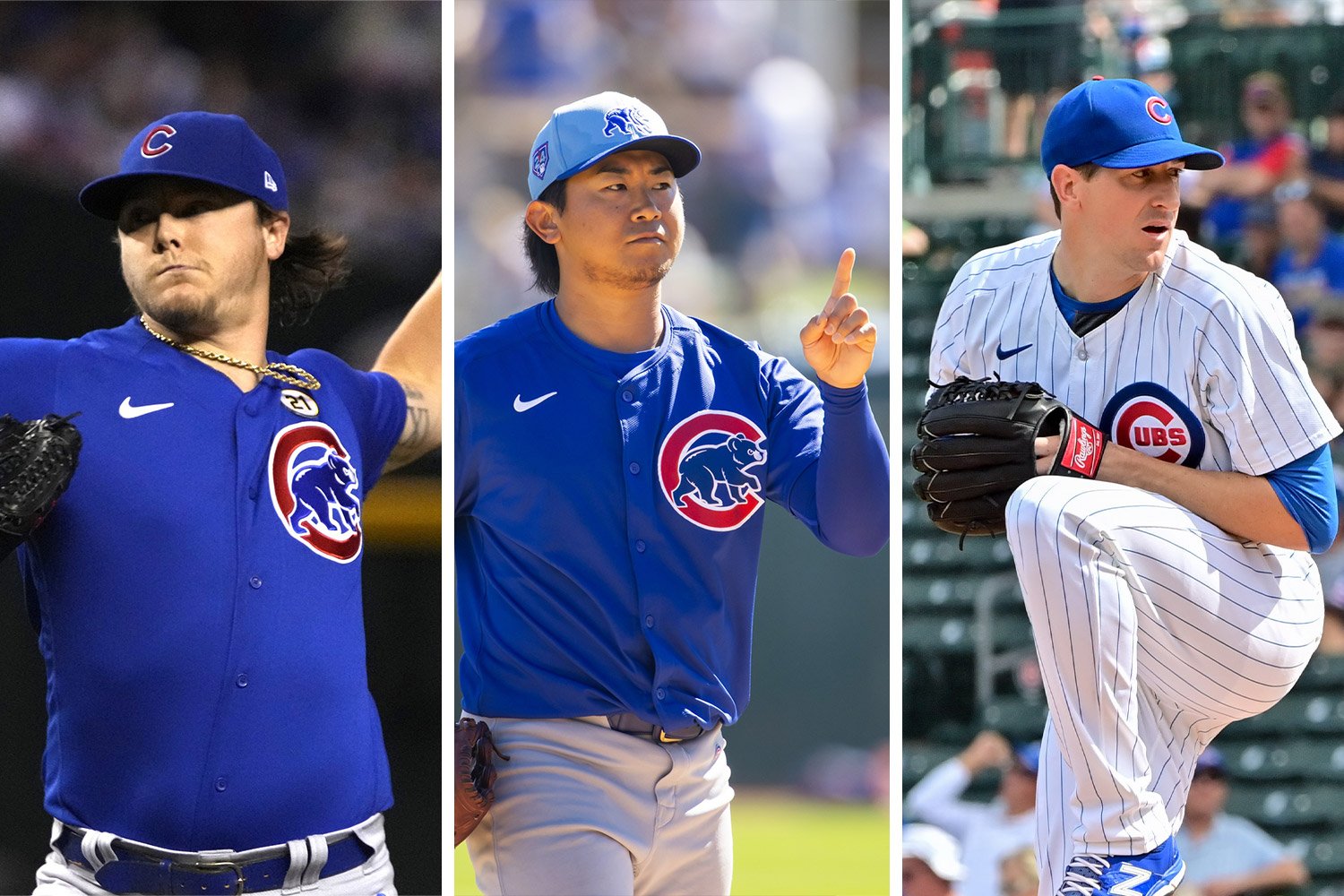
The impending 2024 year doesn’t look much different, either. Despite a little buzz about potential trade or free-agent acquisitions heading into the winter, holdovers will comprise most of the starting five. Justin Steele, Kyle Hendricks, and Jameson Taillon all return. Shōta Imanaga represents the only new face among the locks for the rotation. While he brings more movement, we’re still looking at a front-end fairly low on velocity.
And that – at least for the foreseeable future – will remain by design. While the organization may have some younger arms more adept at the velocity game within the next year or so, the remainder of the roster remains constructed so that they’ll continue to rely on in-play and out(s) as their formula in the rotation.
The Locks: Justin Steele, Kyle Hendricks, Jameson Tailon, Shōta Imanaga
2023 Stats:
Steele: 30 GS, 173.1 IP, 16 W, 9.14 K/9, 1.87 BB/9, 1.17 WHIP, 3.06 ERA, 3.02 FIP, 4.9 fWAR
Hendricks: 33 GS, 137.0 IP, 6 W, 6.11 K/9, 1.77 BB/9, 1.20 WHIP, 3.74 ERA, 3.81 FIP, 2.8 fWAR
Taillon: 31 GS, 154.1 IP, 8 W, 8.16 K/9, 2.39 BB/9, 1.28 WHIP, 4.84 ERA, 4.61 FIP, 1.6 fWAR
Imanaga (Japan): 24 G, 159.0 IP, 7 W, 10.6 K/9, 1.4 BB/9, 1.02 WHIP, 2.66 ERA (Baseball-Reference)
2024 Projections (ZiPS):
Steele: 27 GS, 153 IP, 10 W, 8.16 K/9, 2.64 BB/9, 1.25 WHIP, 3.64 ERA, 3.90 FIP, 2.6 fWAR
Hendricks: 25 GS, 132 IP, 6.99 K/9, 2.17 BB/9, 1.30 WHIP, 4.41 ERA, 4.52 FIP, 1.6 fWAR
Taillon: 25 GS, 137 IP, 7 W, 7.83 K/9, 2.44 BB/9, 1.26 WHIP, 4.41 ERA, 4.43 FIP, 1.7 fWAR
Imanaga: 25 GS, 137 IP, 8 W, 9.59 K/9, 2.63 BB/9, 1.20 WHIP, 3.55 ERA, 3.55 FIP, 3.0 fWAR
Scouting Report:
91.8, 87.7, 93.8. Those are the average fastball velocities of Steele, Hendricks, and Taillon. Numbers aren’t quite in on Imanaga yet, but he’s likely to sit about 92-93 if his trends from Japan carry over. Not to belabor the point, but we know exactly what kind of arm makes up the majority of the starting group. The good news is that the team kept their elite defensive middle infield intact, re-signed Cody Bellinger, and had stability behind the plate and the outfield corners. While living with little margin-for-error isn’t an ideal way to fly, at least the remainder of the squad is built in such a way as to support the pitching staff properly.
Steele represents the ace of the staff. He’s coming off a year in which he finished fifth in the NL Cy Young voting, even with an uneven finish. Steele finished sixth in GB% (49.4) and featured the second-best hard contact rate (27.8) among qualifying starters. His K/9 ranked 22nd, while his BB/9 sat 7th. With an offseason to refine his fastball/slider combo (accounting for just over 96 percent of pitches thrown), we shouldn’t expect anything less from him in ’24.
Hendricks rebounded from his 16 starts in 2022 to the same form we expected. While his strikeouts were down even from his modest career norms, his walk rate and batted ball numbers all fell in line with his yearly averages. He remains a cerebral force in the starting five. Interestingly, we can say essentially much the same of Taillon. While he labored through the first half of the season – mainly due to mechanic struggles – most of his peripherals fell in line with the career averages; only the ballooned ERA (4.84) stands as an outlier from what we’ve typically come to expect. More on him in a moment.
Imanaga is a deviation from this group because he has high whiff potential. For the other three starters, it’s really about location (save Steele, who gets enough movement to generate strikeouts at a higher rate than Hendricks or Taillon, even if not quite elite). With Imanaga, you’re getting the combination of stuff and command we haven’t seen in the starting group in the last few years. Seeing how it translates to facing MLB hitters with a larger workload will be interesting.
Other Options:
We’ll discuss the depth options to occupy the fifth spot and beyond later this week. For now, here is a list of names: Jordan Wicks, Drew Smyly, Javier Assad, Hayden Wesneski, Ben Brown, and Cade Horton. There is probably more intrigue on the back end than the front, given the upside within the volume. Those names represent some of the upper-tier arms within the system, so an opportunity to start this season could provide insight into future iterations of the rotation. Some of those names will feature heavily in relief, as well. Ultimately – and, again, we’ll dive further into this group in a second part – the team has done a solid job at building up starting depth thanks heavily to their still-recently revamped pitching infrastructure.
The Big Question: Which Taillon are the Cubs getting in ’24?
There are questions about Steele replicating his 2023 success. There are questions about Imanaga’s transition to Major League Baseball. There are questions about the ability of some of the depth arms to perform in a starting role. But perhaps the most immediate question facing the starting group is which version of Jameson Taillon they’ll see in 2024.
The first-half flavor of Taillon posted a 6.15 ERA, walked almost three hitters per nine, and gave up heavy line drive contact. The Cubs lost a dozen of his first 14 starts. In the second half, though, he improved the ERA to 3.70, walked only 2.07 per nine, and dropped his WHIP from 1.40 to 1.17. While he gave up harder contact overall, he boosted his groundball rate by about five percent.
It’s pretty evident at this point that Taillon was working through some mechanical stuff early on in the year, especially with an adjustment to a new organization & staff. Given that the second half of the year showcased Taillon as the type of pitcher he’s been throughout his career – a reliable starter, though not quite upper tier – one imagines that some of those unquantifiable elements (comfort, etc.) will allow him to return as a stabilizing presence in the upcoming year.





Recommended Comments
Create an account or sign in to comment
You need to be a member in order to leave a comment
Create an account
Sign up for a new account in our community. It's easy!
Register a new accountSign in
Already have an account? Sign in here.
Sign In Now