


Cubs Video
For the Chicago Cubs, 2024 was the Year of Shota. Despite missing the playoffs, the enigmatic Shota Imanaga took the city by storm with his electric personality and his excellent pitching. Imanaga, a veteran of the Nippon Baseball League (Japan's top baseball division), was willing to come to the States and overhaul his pitching style. By limiting the offerings and leaning into throwing his fastball more often and under the hands, the lefty has become one of the more trustworthy options the Cubs have. Shota's transformation was a clear-cut success for the franchise last year.
Enter stage right, Colin Rea.
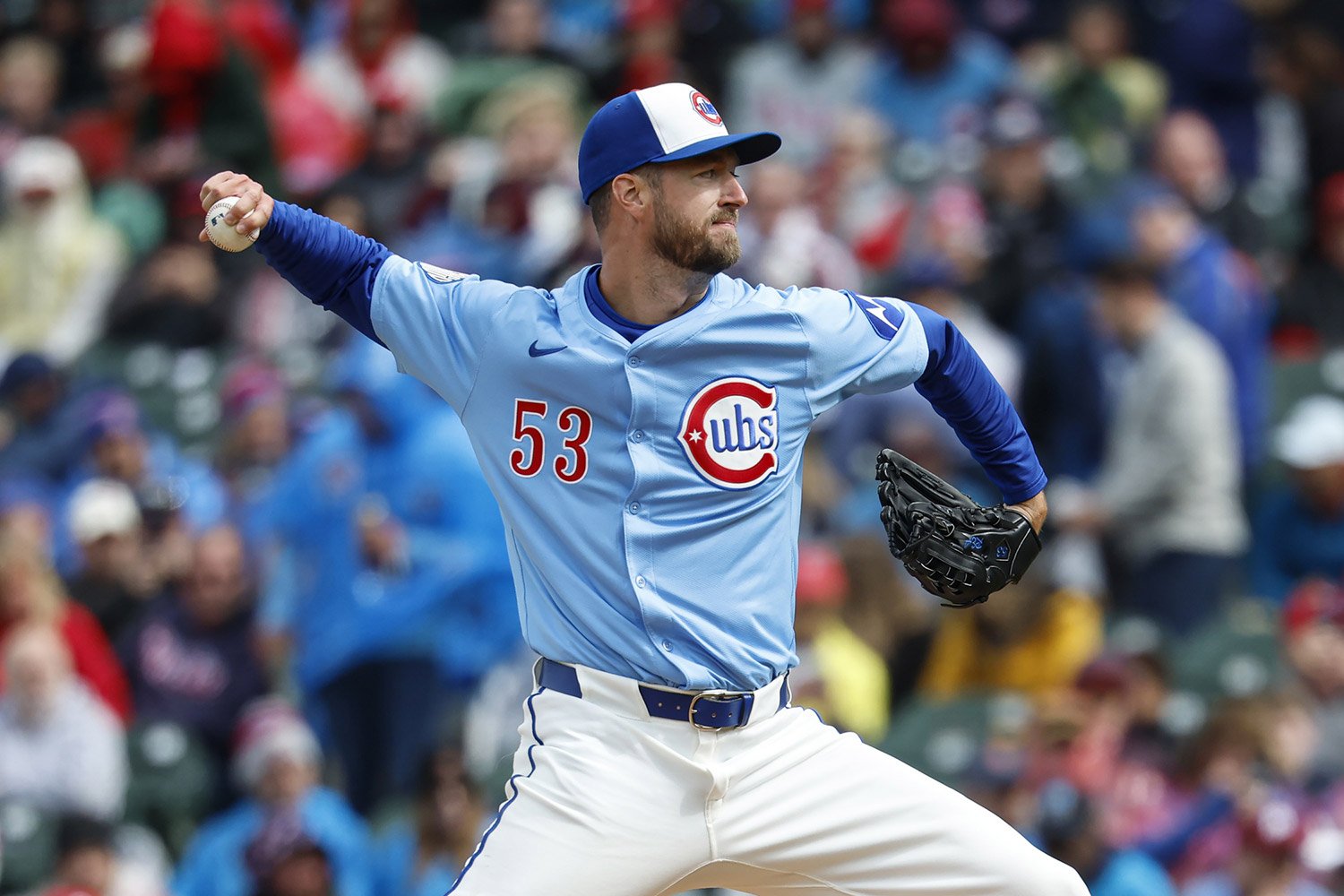
Rea, a 34-year-old veteran arm, came to the Cubs in the offseason through a one-year contract. The former Brewer has had an interesting career, spending time in the NPB himself in between MLB stops. Not to discredit much of what the right-hander has accomplished since his return Stateside, but over the last few years, his best quality was simply being available. Sporting lackluster Statcast, stuff+ and peripherals, Rea was versatile, capable of shuttling between roles in the rotation and bullpen, and ended up pitching the second most innings for the 2023 and 2024 Brewers (both seasons which ended with division titles for the Wisconsin-based side). He wasn't dominant, but he could always go when the team needed him. In today's day and age of pitcher injuries, this has intrinsic value beyond a Statcast page.
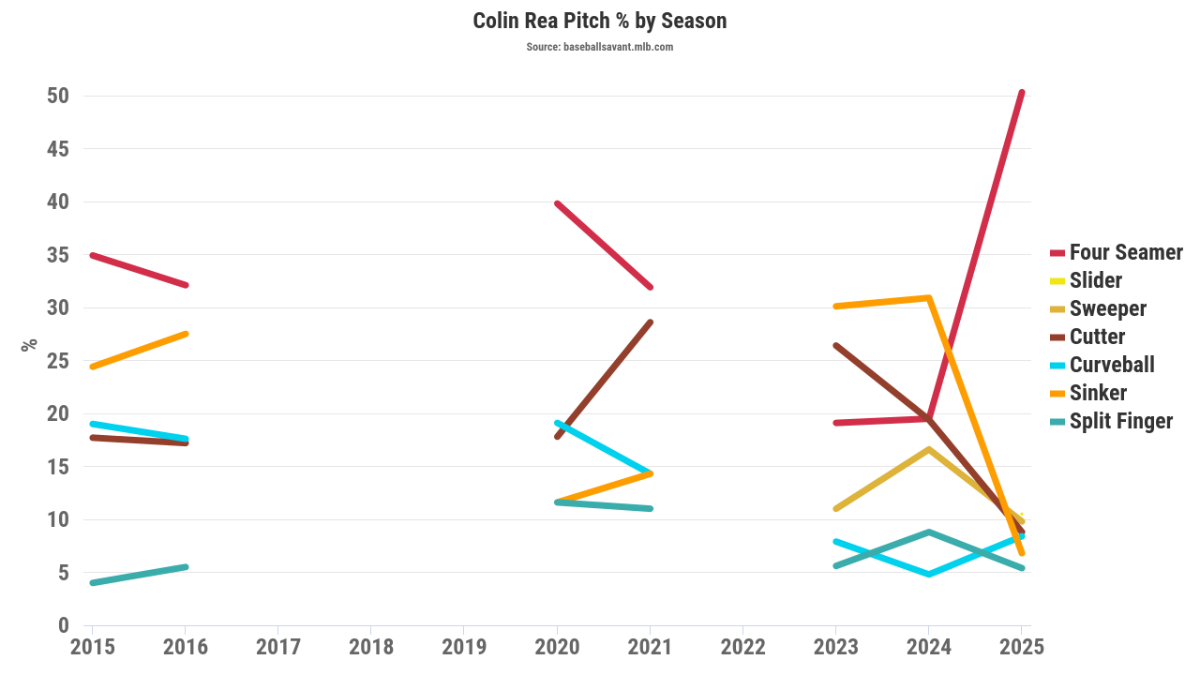
Since the first time he took the mound for the Northside, however, it's been clear the Cubs had been under-the-hood tinkering with the arsenal and have helped transform him into a pitcher who goes beyond his durability. Rea has essentially scrapped his signature sinker in favor of a fastball (that has increased in velocity around 1.5 mph). His fastball also sports more arm-side run. He's split his sweeper usage, which he threw 16% of the time in 2024, to feature both the sweeper (now only used 9.8%) and a distinct slider (which he throws a little over 10% of the time). This has currently valued the pitcher to the top of the Cubs' fWAR pitching leaderboard.
The blueprint may create a version of a right-handed Shota Imanaga, so looking at him can be a way to understand these changes. Despite throwing a fastball that sits below 92mph, the lefty has not shied away from featuring the pitch 49% of the time. One of the things that helps benefit Shota is his 37-degree arm angle - an awkwardly low arm-slot which helps create deception for his pitch, which has a lot of vertical "rise" (in reality, this is truly a lack of drop). He tends to throw the fastball up-and-over the outside portion of the plate to help create tunneling with his split finger, which he uses on the same edge of the plate. It forces hitters into difficult decisions: Is this a fastball? Or is it a split finger? This is highlighted in the chart below.

Returning to their newer two additions, the Chicago Cubs have significantly dropped Colin Rea's arm slot. Rea has seen his arm angle drop nearly five degrees from where it was with the Brewers, now sporting an arm angle of 30 degrees. This is essentially a side-arm delivery. The drop of angle has helped to create extra arm-side run on his fastball, which he now throws nearly 50% of the time.


His fastball is also used on the upper third of he plate (though not as high as Shota), particularly on the outer-third of the plate. His sweeper, which he has split into two distinct pitches, is also located on that outer-third. The sweeper creates more horizontal movement, while his slider has more vertical drop. Because all three pitches are placed on the same third of the plate, this also can create a tunnel and force hitters to decide where to swing; is this going to be a fastball up? Is this the sweeper that will break away from me? Or the slider, which will break down? Indecision can create slower decision-making, which can help miss barrels, and help create whiffs - both are things Rea is doing at career highs right now.

In my opinion, the fastball has been an important pitch for Rea. Moving away from the sinker gives Rea a few advantages. First, it changes the location of where a hitter's eyes are looking. Rea had a habit of throwing the sinker in the same region where his sweeper went, low and away. Throwing the fastball from a lower arm slot in a higher area creates extra deception and forces a new level for the hitter to look. It's deception. Secondly, it moves the pitch away from the hitter's launch areas. Sinkers can be great in creating a lot of ground balls as hitters swing over the pitch. The issue, however, is that when they float up, they drop directly into the bat path. Launch angle is designed to take advantage of low pitches, meaning sinkers can find barrels. It's not shocking, then, to look at how Rea has managed to miss more barrels by switching to a high-fastball-heavy approach. I think we're seeing a max-effort on this pitch to improve the velocity (Rea has struggled for length on the season, which would help explain that), but it's been useful.
If this is starting to feel familiar, it should, because these are many of the same ways that Shota Imanaga attacks hitters. Another place we can see a parallel is how often the two pound the zone. Shota is a strike thrower, throwing around 54.7% of his pitches in the zone this season, according to MLB.com's Statcast. Colin Rea has upped his strike throwing this season, jumping from 51.6% of the time to 54.4% of his pitches in the strike zone. The biggest change is his first-pitch strike%, which has jumped to 77.6%. What this does is give both pitchers an advantage: count leverage. To understand this best, I'd implore you to watch Foolish Baseball's breakdown of the subject. Still, the takeaway from his video is this: throwing strikes matters because the difference between when a hitter is ahead in the count and when they're behind is stark. Throwing strikes matters. Colin Rea and Shota Imanaga take this to heart and use their ability to fill up the zone to give them the leverage they need.
If you're getting excited that Colin Rea will represent the Chicago Cubs in the All-Star game like Shota did in 2024, I will pump the brakes a bit before the Rea-hype-train becomes a runaway. Despite the uptick in fastball velocity, Stuff+ hates the pitch as it currently grades out as a pretty-awful-85 on their scale. Now, it could be that the Cubs have found an outlier pitch that Stuff+ cannot fully grasp (there are outliers with all statistics), but it's more likely that the pitch is not designed to be a winner in a vacuum; instead, it plays off his sweeper/slider. This is a drastic departure from Imanaga, as it should be noted that Shota's fastball has been a Stuff+ darling. On its own, it's probably not a great offering.
Another issue will be how he handles the uptick in fly balls. As the weather warms up, Rea will likely have to deal with a new issue; he's no longer inducing ground balls at the same rate. This checks out, he's throwing a fastball up, not a sinker down. This means he's going to get bit by the home run more. So far, on the season, he's surrendered none; this won't keep up.
It's also likely that teams have not adjusted to the new Rea yet, either. We should expect the league to update the scouting report on the righty moving forward to look for more four-seam fastballs, that he's using a new slider, and that the arm angle has significantly dropped. Part of his early-season success is likely an aspect of surprise; this wasn't expected. As teams see him more and more, they will get more familiar with his new offerings.
I'll allow everyone to dream a little, however. While I doubt that Rea will ultimately lead the team in fWAR on the pitching side, I think these changes will create a better starting pitcher. The arm angle has created deception. Unlike the fastball, the slider is getting good grades from Stuff+ models; he has significantly increased his ability to miss barrels and induce swings-and-misses; on the whole, he's a better pitcher than he was before. So while we shouldn't expect Colin Rea to be Shota Imanaga, we can look to Imanaga to understand how the Cubs are improving Colin Rea. There's a concerted effort by the pitcher and the team to maximize his offerings, maximize his motion, and create a viable starting pitcher. So while I wouldn't expect Rea to be an ace, I think he's moving to entrench himself in the Cubs' rotation for the remainder of the 2025 season as a valuable member.






Recommended Comments
There are no comments to display.
Create an account or sign in to comment
You need to be a member in order to leave a comment
Create an account
Sign up for a new account in our community. It's easy!
Register a new accountSign in
Already have an account? Sign in here.
Sign In Now