


Cubs Video
One of Jed Hoyer's consistently stated goals since taking over the leadership of the Cubs' baseball operations department has been to emphasize drafting and player development. Hiring Dan Kantrovitz was an investment in starting to get the Draft right, after years of not truly doing so. The Cubs don't want to win with high-priced stars, except as complementary additions and capstones for great rosters. Their plan is to win with young players whose value exceeds their pay, and generally, that means drafting well, being aggressive and intelligent in the international free-agent space, and trading for prospects whom they can bring along well.
That's the most obvious way to build a streamlined organization capable of winning consistently across a number of years. It's also excruciatingly slow. For an executive who takes over knowing a rebuild is a foot, that's no problem. Time is a commodity they hold in abundance. They can trade, for instance, an incumbent ace for a passel of teenage prospects. They can spin off an entire semi-contending team's core for prospects who can come along at an unhurried pace.
It starts out that way, at least. Eventually, though, even fairly patient (disinterested, a cynic might say) owners demand that a commitment to acquiring and developing young talent leads to wins on the field, and it's not that easy. Anyone can, with their resources all pointed in that direction, accumulate young, cost-controlled players on whom the prospect ranking apparatus looks favorably. The challenge lies both in developing those talented people into the caliber of productive players they're capable of being, and aligning your talent well enough to convert potential and production into wins. It's this final challenge that has, so far, frustrated Hoyer's regime.
Whether he feels that the clock is ticking on his tenure because of impatience for better results from the Ricketts family, or whether he just intrinsically craves the success that has eluded him, Hoyer is now overseeing a change in front-office tactics that carries major implications. Over the last two years, we've seen a sudden shift, away from the mere collecting of talented players (as at the 2022 trade deadline, for instance, when he traded valued bullpen contributor Scott Effross to land Hayden Wesneski) and toward the creation of a window of contention. Specifically, look what he's doing with his 2022 and 2023 Draft classes.
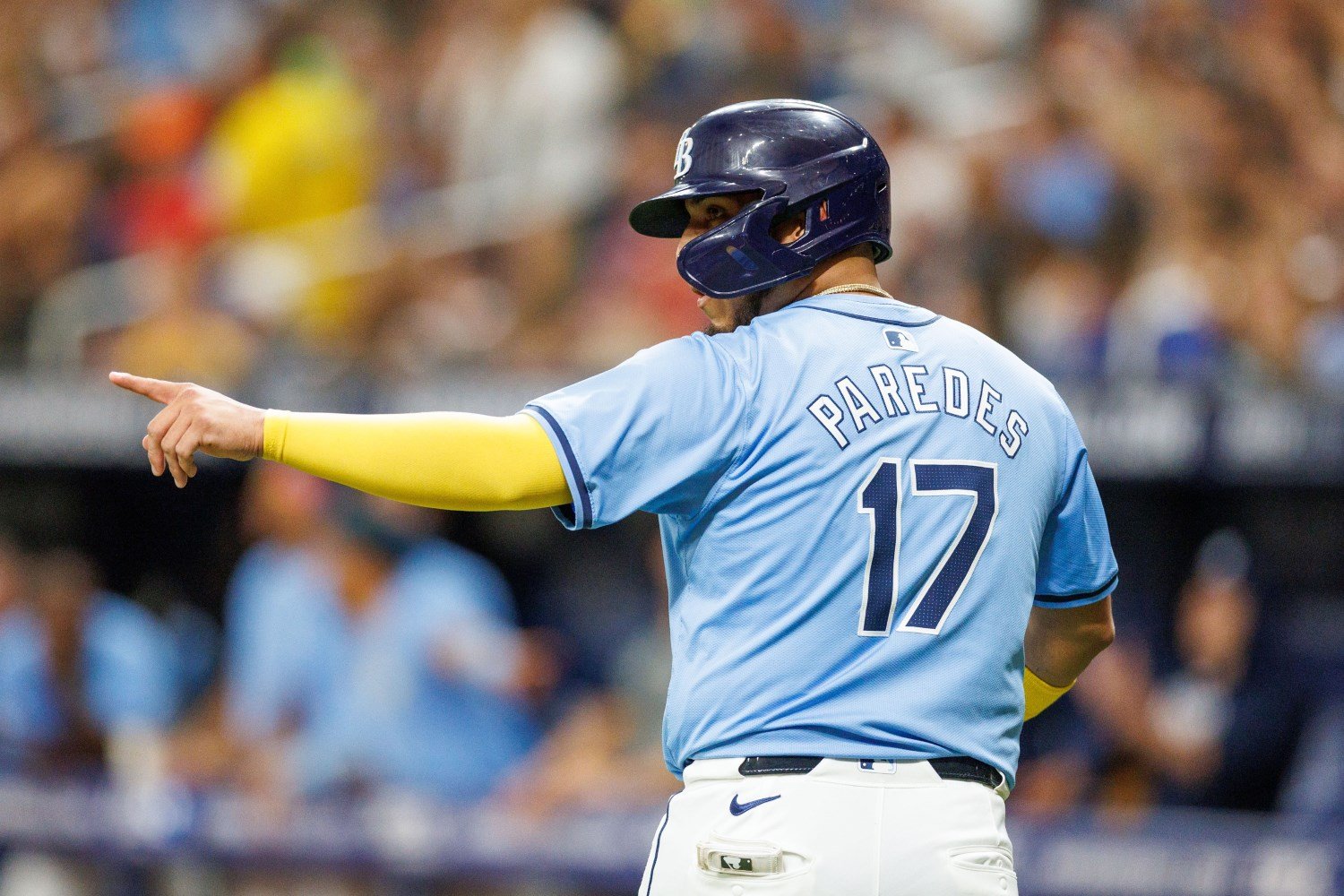
Over the winter, Hoyer traded Jackson Ferris and Zyhir Hope to the Dodgers, in exchange for Michael Busch and Yency Almonte. Ferris was the high-dollar second-round pick for whom the Cubs spent a bonus amount commensurate with a first-rounder in 2022, while Hope was one of the team's more intriguing late-round selections in 2023. Then, on Saturday, Hoyer traded Yohendrick Pinango and Josh Rivera for Nate Pearson, of the Blue Jays. Rivera was last year's third-round pick. On Sunday, Hoyer moved Ty Johnson, in the Christopher Morel-for-Isaac Paredes swap. Johnson was a blossoming 15th-round pick from 2023, himself. In almost exactly a year, Hoyer has traded three members of last year's class, and in none of those cases was it because the organization has soured on them. On the contrary, all three players' stock was right around the same place it was on draft day.
This isn't a new gambit. In fact, it's gaining in popularity. The Minnesota Twins rapidly set about trading from the top of their 2021 draft class. They've now dealt away all of their first five picks, and many of those were gone within a year of being taken. The Milwaukee Brewers got ahold of Bryan Hudson over the winter, by giving the Dodgers their 20th-round pick from last year's draft. Being willing to quickly flip prospects is a good way to pry away certain players a team might be reluctant to deal, because that very team might have had interest in the player you took in the draft, and you're now offering them to the club having already paid the signing bonus.
Novelty isn't what makes this notable. Rather, it's what Hoyer is communicating. By trading so freely from a pool of players acquired so recently, he's showing that he understands the timeline at hand to have changed. The Cubs aren't meant to be in the business of building up to something, anymore, and certain pieces who previously would have been retained so as to wait and see how they came along are now being quickly changed into trade chips. The appeal of Ferris, Hope, Johnson and (to a lesser extent) Rivera is not subtle, but the value each might have had in talks with the teams to whom they were sent is a bit more so.
For logistical reasons, the Dodgers needed to move on from Busch, because they couldn't give him the big-league playing time he was ready for. For emotional reasons, the Blue Jays were willing to give up on Pearson, because he'd been in the organization a long time and there had been so many setbacks and sidetracks. For financial reasons, the Rays felt they needed to trade Paredes, who will be modestly expensive in arbitration over the next several years. Pearson is the oldest of that group, though, and still hasn't turned 28. He throws 100 miles per hour. Paredes is an All-Star. Busch was a highly touted prospect and is now having a season that would ordinarily make him a Rookie of the Year candidate.
Those teams were willing to give up those players, in part, because recent draftees are priority targets for many organizations. The Cubs were willing to expend those players to get these, with varying degrees of team control but all very much positioned to make immediate contributions, because they feel they need to win as soon as possible. That doesn't mean "as soon as possible, given the vagaries and delays inherent to creating a homegrown juggernaut." It means as soon as possible.
Will that urgency follow Hoyer and guide him over the next day and a half? Probably so, but not necessarily in the obvious way. The Cubs still must (and probably will) sell off some parts and look beyond this lost season. It's just that whatever moves they make will almost certainly be aimed at helping them in 2025-2027, rather than in the seasons beyond that. Will the same urgency compel the franchise to be more aggressive in free agency this winter? That feels much more doubtful. If they're nimble and dedicated enough, though, maybe they really can build a young, sustainable winner under Hoyer--by getting him to more consistently step away from his hyperopic approach and use some of his long-term pieces to align talent better for the medium-term future and the present. In the meantime, don't get too attached to any recent draftees, save Cade Horton and Matt Shaw.





Recommended Comments
There are no comments to display.
Create an account or sign in to comment
You need to be a member in order to leave a comment
Create an account
Sign up for a new account in our community. It's easy!
Register a new accountSign in
Already have an account? Sign in here.
Sign In Now