


Cubs Video
After multiple reports throughout the last week that the Cubs were pushing to complete a trade for Marlins lefty Jesús Luzardo, Chicago baseball insider Bruce Levine gave word Wednesday evening that that deal is dead. It's a frustrating ending to an intriguing line of inquiry, but there were some who disliked the idea of Luzardo as the frontline upgrade the Cubs rotation needed, anyway. Now, they'll have the opportunity to pivot and pursue different options, including some with considerably more certainty attached—though all of those would also be more expensive.
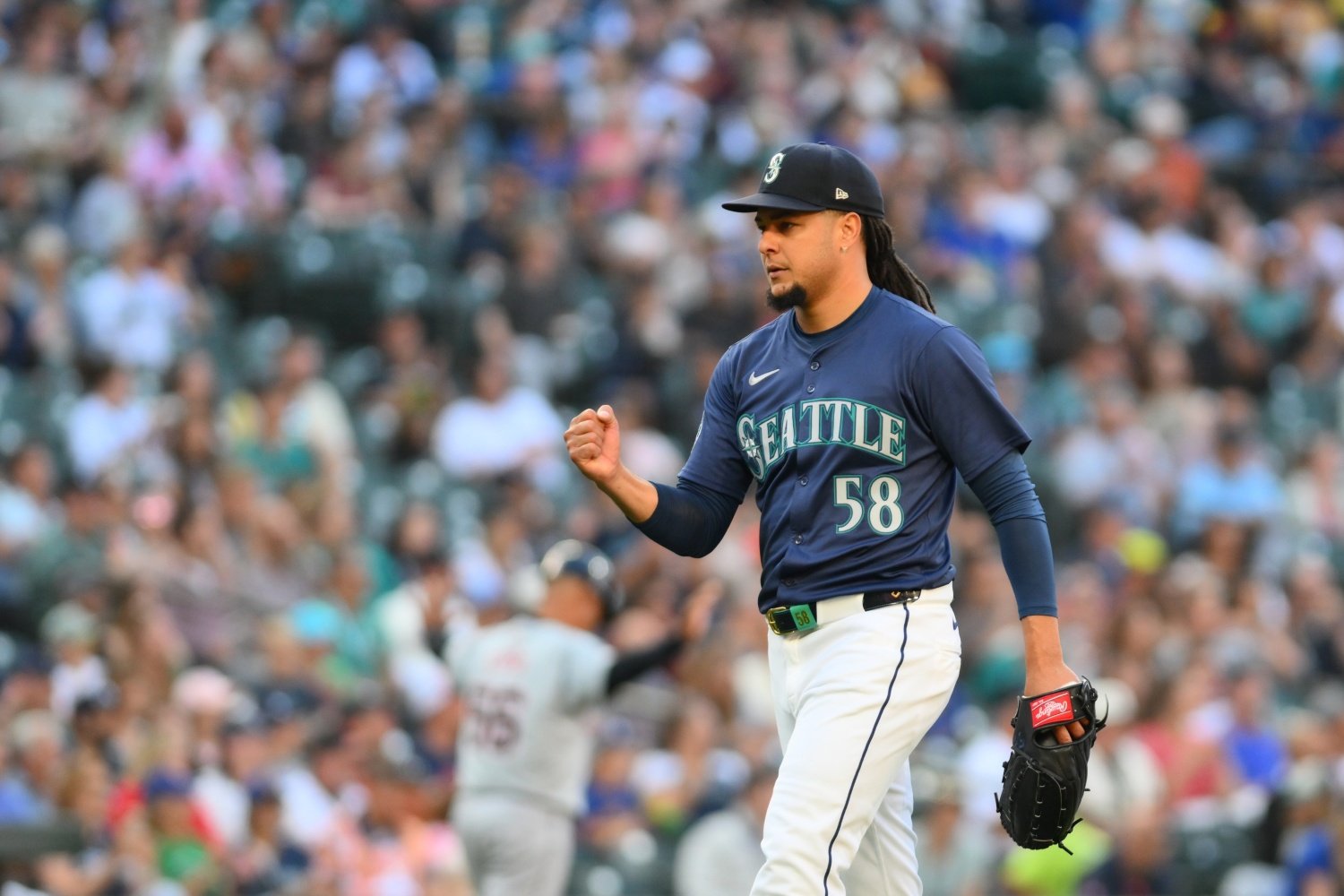
With Luzardo off the board, the Mariners emerge as a likely trade partner again. Luis Castillo costs much more money than Luzardo would have, but he's under control one more season, and his stuff (though slightly diminished in 2024) is still very good. He throws 96, with a four-seamer, a sinker, a slider, and a changeup, and the Cubs' project after acquiring him would be to repair the sinker and the change, which went a little haywire for him this past season. Those are the pitches that rely on pronation at release, so they're related problems, and this issue was a bit of a sticking point for multiple Mariners hurlers recently; the Cubs might feel that it would be an easy fix to unwind it.
Castillo is not clearly superior to Justin Steele and Shota Imanaga, but he's as good a bet for an average-or-better 170 innings as almost any pitcher in baseball. His contract would mitigate the acquisition cost somewhat, too, which is why we've heard his name more than those of controllable hurlers Logan Gilbert, George Kirby, Bryce Miller, and Bryan Woo. As I've already written, if the chance to get Miller arises, Hoyer should gleefully pay through the nose for him, but the other three names have all come up more often, and their prospect price tags in any deal feel a bit inflated. When it comes to Seattle, it's Castillo or bust.
While we're eliminating options like Gilbert, Kirby, Miller, and Woo, we might as well also cross off some other oft-mentioned names. The Cubs are not and will not be in on Corbin Burnes, save in the wildly improbable case that he really does end up being interested in a short-term, high-AAV deal, rather than a megadeal elsewhere. They're not going to be in on Sean Manaea or Nick Pivetta, who received qualifying offers and aren't clear enough upgrades to consider giving up two draft picks and substantial amateur free-agent spending power for them. There have been loose connections between them and Dylan Cease, and some Padres fans even harbored a theory that the Cubs were looking to acquire Luzardo with an eye to flipping him for Cease. Cease is the best pitcher they have any chance to acquire, but he'd come at a major cost, and with both Cease and Kyle Tucker headed to free agency after 2025, you'd start to feel that this team was overcommitting to a single campaign, given that they still wouldn't be favorites in a playoff series against the Dodgers (or perhaps the Mets, Phillies, or Atlanta) even with Cease in the fold.
Who else, then? It's time to think a bit creatively. The easier version would be to sign either Jack Flaherty or Walker Buehler, two free agents without qualifying offers attached to them and with enough upside to imagine them working at the front end of a rotation. Both pitchers will make handsome salaries, but Flaherty's would be more in line with Jameson Taillon than with Max Fried, and Buehler might be open to a one-year, prove-it deal. They'd be upgrades, on the same order as Luzardo, and they'd only cost money. There's still some risk that their markets end up more robust than the Cubs' comfort zone allows, though.
On the trade market, there are some creative angles to play that get downright tantalizing—but which also come with lots of danger. The Pirates are, reportedly, open to trade discussions about either Mitch Keller (signed to a long-term, reasonable deal, but with a Taillon-like ceiling) or Jared Jones (with lots of remaining team control and a Sistine Chapel-style ceiling, but also with some injury risk attached). That seems a great fit, given that what Pittsburgh most needs is young, cost-controlled offensive juice, but would the two sides be comfortable striking such a high-stakes intradivisional trade? I can only note that they've talked about similar moves in the past, and that Hoyer and Ben Cherington know each other very well from their time together in Boston.
Feel like rescuing a pitcher from Coors Field ruination? Ryan Feltner has four years of team control and a very interesting five-pitch mix, and Owen Caissie could do dazzling things in Colorado's thin air, but talking the Rockies into the reality that they're not contenders is always tricky. Feeling lucky and up for a challenge? The Twins are still very much trying to contend, but they have to cut some money from their payroll, and might be open to deals (with various structures) for Joe Ryan, Bailey Ober, or Pablo López. They might even let you pay handsomely for the right to undertake the project of moving Griffin Jax back to the rotation. The trick there is that the Cubs would have to find a package that helped the 2025 Twins compete, without hurting their own hopes. A deal centered around Minnesota native Michael Busch and either Ryan or Ober, with the Cubs then lurching back into the bidding for Pete Alonso or Christian Walker? It feels very improbable, but you could envision it. (I'm voting against this one, because if the team trades Busch after trading Cody Bellinger, a lot of you will yell at me. But it's interesting.)
There's a reason why the Cubs tried hard to land Luzardo. The alternatives above all have exciting potential, but their cost or implausibility make them less desirable than the relatively straightforward Luzardo acquisition could have been.
Medicals were the impetus for the non-transaction, sources said, but to be clear: that doesn't mean that Luzardo is secretly broken already. Nor does it mean a particular Cubs prospect was found to be hurt. Often, deals that fall apart at the medical review stage do so for probabilistic reasons, rather than absolute ones. When one side sees something they don't like on a medical report or a scan, they increase their internal estimate of that player's injury risk, and naturally, that leads to them asking for more or wanting to give up less. If the other team doesn't share their risk assessment on the basis of the new information, it can create a divide that becomes hard to bridge, but that doesn't mean anyone involved is guaranteed to hit the surgeon's slab within a month or anything.
For that reason, it's still vaguely possible the two sides circle back to one another. It'd be a bad bet, though, so the Cubs have to turn now to energetic examinations of the options—likely and otherwise—outlined above. They could end up aiming lower in the rotation, and higher in the bullpen or in the final bat they add, instead, but of course, that would come with its own set of new complications and considerations.





Recommended Comments
Create an account or sign in to comment
You need to be a member in order to leave a comment
Create an account
Sign up for a new account in our community. It's easy!
Register a new accountSign in
Already have an account? Sign in here.
Sign In Now