


Cubs Video
One of the first noteworthy, non-procedural moves of the fledgling MLB offseason was a trade between Atlanta and the Angels, the day after the World Series concluded. Jorge Soler, who can't stop being shipped across the country lately, landed in Orange County, with inconsistent starting pitcher Griffin Canning going the other way. Part of the motivation for the move was, plainly, financial, but it's also the first of what figure to be several trades by the Angels this winter, each focused on upgrading the team and making good on their promise to both increase the payroll and contend for an AL West title next season.
Soler, according to GM Perry Minasian, will play some outfield for the Halos, which was a curious pronouncement. To whatever extent it's true, he'll be finding that time amid and around the expected starters, Mike Trout, Jo Adell, and Taylor Ward. The Angels also have some young outfielders they're likely to want to work in, and they've talked about easing Trout out of center field to help him remain a bit healthier. It feels as though, while they could use another outfielder (especially one who can play center field), they also just created a bit of a logjam for themselves. That works out, as far as I'm concerned, because the Angels have one outfielder who has long sat near the top of my preferred targets list, should the opportunity pop up. It might be time to pull the trigger on a deal for Ward.
Soon to turn 31 years old and just two years from free agency, Taylor Ward is hardly a well-kept secret, for close baseball watchers. He's had an above-average OPS+ for each of the last four seasons, and hit 25 homers in over 660 plate appearances in 2024. Because the Angels are so relentlessly bad, though, and because he paled in comparison to Trout and Shohei Ohtani at the heights of their powers, it's been easy for him to fly somewhat beneath the radar. I don't even think the Angels properly understand what they have; that's why the Cubs should try to swoop in.
Here's the thing: the Angels love swing speed. Part of the reason why they were willing to trade for Soler at the very outset of the offseason is their belief in swing speed. Here's where all their qualifying hitters fell last season, mapping swing speed against the percentage of their swings on which they made solid, squared-up contact:
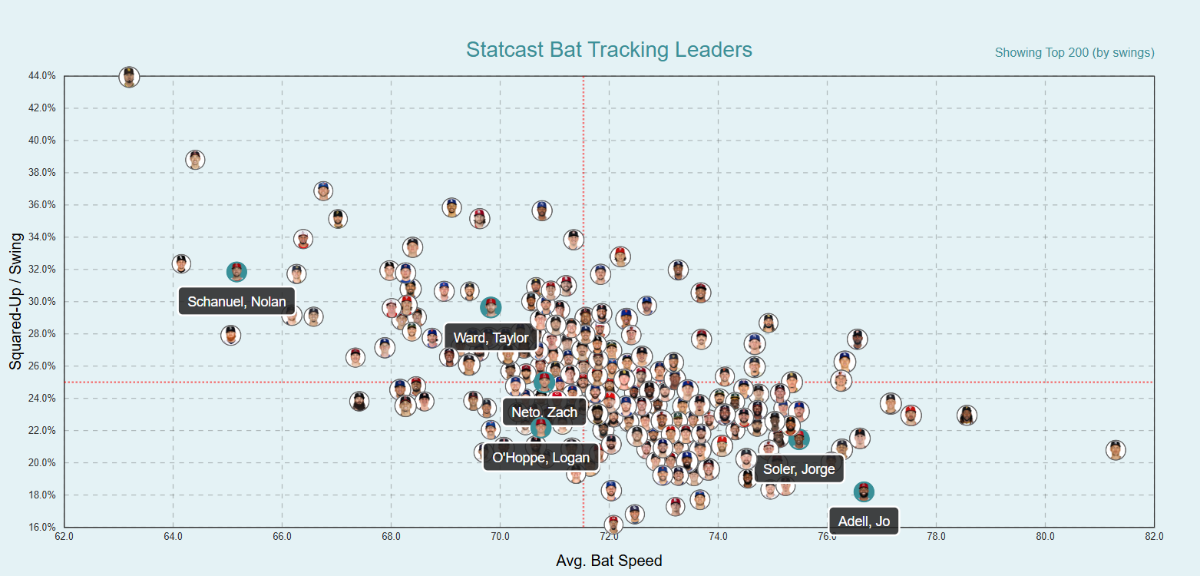
Some of their part-time players and guys who missed time because of injuries don't appear here, but would make it more obvious how much they prioritize this skill: Miguel Sanó, Trout, Mickey Moniak, Keston Hiura, Brandon Drury, Matt Thaiss, and others were specialists in swinging fast.
Ward's great strength does not lie in generating a superabundance of bat speed, but in hitting the ball squarely on a consistent basis. In fact, when you weigh his power on balls hit in the air and the frequency of those batted balls, you find him ranked 13th of 365 batters who had at least 200 plate appearances last year—in what I'm calling Skills-Adjusted Exit Velocity. In short, this metric takes a player's average exit velocity on batted balls in power-friendly launch angle ranges and adjusts it for the percentage of a player's at-bats that end in a batted ball on that trajectory. Ward's company atop that leaderboard is exquisite. Yet, he didn't enjoy success as great as most of them. Here, I've highlighted Ward and the five other players who share not only his knack for the well-struck line drive but his blend of near-average in-zone contact rates and better-than-average plate discipline:

To recap: Ward doesn't expand his zone much. When he swings within the zone, he doesn't have an especially high whiff rate. Most encouragingly, he makes a lot of hard contact, especially in high-value launch angle bands. So, why isn't he producing more real runs? Why isn't his dot on the plot above closer to those of Fernando Tatis Jr. or (very near Tatis) Freddie Freeman, Corey Seager, or Marcell Ozuna? It's because of the other key characteristic Ward shares with Bobby Witt Jr., Vladimir Guerrero Jr., Mookie Betts, Austin Riley, and Tatis: they all use the big part of the field. The bad news for Ward is, he uses it more than any of them—in any meaningful sense, too much.

Ward just doesn't turn on the ball and lift it to his pull field the way most hitters like him now strive to do. His is a much more old-fashioned, gap-centric approach. He pulls the majority of his ground balls, as virtually every hitter does, but he hits most of his air balls to dead center or right-center. He's similar, in terms of the distribution of those batted balls, to Alec Bohm, Tommy Pham, Bryan De La Cruz, and (funnily enough) Miguel Amaya. Those are dangerous, dynamic hitters, in various ways. Pham is the easiest comp, in that he's similarly patient at the plate, but he doesn't generate high-quality contact as often as Ward does. Bohm does, but he's much more aggressive at the plate. That means an exceptional strikeout rate, but a very low walk rate, compared to Ward's. If he could pair that approach with a bit more of a pull tendency, he'd really take off at the plate.
But really, the adjustment in approach is optional. Ward would gain substantially just by getting out of Angel Stadium and into Wrigley Field. When he does pull the ball in the air, it's often scalded. Here's one liner that skipped just in front of the warning track in Anaheim—but which would have been a homer at Wrigley, and nowhere else in MLB, according to Statcast.
It's not especially hard to imagine Ward's .246/.323/.426 line from 2024 jumping right back up to the airy .281/.360/.473 he posted in 2022. He's that caliber of hitter, suffering from a mixture of a home park that doesn't suit his skills and a team environment that doesn't suit anyone, period. The Angels value some other things more highly, and might be willing to move Ward, who's set to make an estimated $9.2 million via arbitration. The question is how the Cubs should go about paying for him, and simultaneously making sure they have room for him in the lineup every day.
Ward plays an acceptable left field, and could presumably play right, too. He has a strong arm and gets good jumps. Obviously, with Cody Bellinger back, the team doesn't strictly need another corner outfielder. Ward could work gorgeously in rotation, though, spelling Bellinger and Ian Happ against certain lefties, forcing Bellinger over to center against certain righties, and even giving Seiya Suzuki needed days off at DH. He did come up as a third baseman, but is terrible there. If he's to play on the dirt at all, it would need to be by way of working in spring to become an adequate first baseman. That seems well within Ward's capabilities, though.
Trading for Ward wouldn't create undue problems, given how much he could bolster their lineup. The Cubs would still have to give the Angels something useful, though. Could that be Alexander Canario? He's out of options, but has six years of team control remaining, and Canario's swing speed is almost off the charts. It is, in fact, much akin to those of Soler and Adell. If not Canario, maybe the Cubs could offer the Angels Nico Hoerner (to give the perennially injury-plagued Halos infield more depth) and a young arm, plus a little cash to even things out.
Since the start of 2022, Ward has a 119 wRC+, almost identical to those of Nolan Arenado, Will Smith, Justin Turner, and Xander Bogaerts. Give him a change of scenery and venue, and he could step up from there into the same production bracket as (for instance) Suzuki. He might not be the easiest positional fit, but it's worth exploring the possibility. The Angels are behind the curve right now, they don't value what Ward does well as much as they should, and the Cubs could have an opening. It's one worth seizing upon.





Recommended Comments
There are no comments to display.
Create an account or sign in to comment
You need to be a member in order to leave a comment
Create an account
Sign up for a new account in our community. It's easy!
Register a new accountSign in
Already have an account? Sign in here.
Sign In Now