


Cubs Video
For about 15 years, there's been a player development revolution underway in the major leagues. Independent facilities have brought new ideas to bear on the game. New and ever-improving technology has given teams and players different ways to experiment with changes to movements or approaches, and better, faster feedback on what works. A more open-minded approach to skill acquisition and better communication on the part of teams have made for more success stories in unlikely places. Lots of players who would never have found their way from promise to production in the past have done so.
In this new era, some of the arcs that carry a player from lost to found are familiar, coherent and satisfying. They've become the most common, because then tend to be simplest. This One Weird Trick Unlocked [Player Name] should, by now, be a recognizable pattern for you. Some players needed to catch the ball farther out front to produce the power that was always lurking in their swing. Some hurlers needed a new grip to get to the breaking ball that would make them a star; others just needed to start throwing the breaking ball they had a whole lot more often. When there's just one thing standing between a talented player and greatness, the story of them discovering what that one thing is and removing the obstacle is tidy and rewarding.
For a lot of players, though, there's more than one thing in their way, and in those cases, the stories of their ascent are much messier. It sometimes looks like they've gotten to the end of their tale of metamorphosis, but then a major setback forces them to begin it anew. There are layers that lay atop one another unevenly; there are trend arrows pointing in opposite directions. Obviously, the stories where only one big thing needed to change have better odds of ending happily. The more things you need to change, the greater the chances that you never quite get where you're hoping to go.
Ryan Zeferjahn is not a One Weird Trick guy. The Cubs had to know that, even when they acquired him in the midst of a stretch where he looked like he'd found his one weird trick. Zeferjahn has always had an electric arm and a good enough breaking ball to make a dominant back-end relief future possible, and a couple of months before he was dealt to Chicago, he moved over on the rubber a bit, which seemed to help him attack the zone more consistently with his two main pitches: the four-seamer and the sweeper.
On the strength of that adjustment, Zeferjahn took off. Over his final 22 appearances in an Angels uniform, he threw 24 innings, struck out 43 of the 96 batters he faced and posted a 1.13 ERA. That was what prompted the Cubs to surrender Moisés Ballesteros and Mason McGwire—a fairly significant haul—to land Zeferjahn and his long-term team control on deadline day. There had been a real turn for the better, even if it was clear there was still work to do.
In the first few weeks of his Cubs tenure, however, Zeferjahn struggled. As has often been the case during his career, he battled wildness, and sometimes (when he finally found the plate) the ball would straighten out on him and get hit hard. He'd given up 10 hits in those last 22 games with Anaheim; he allowed 13 in his first 11 with Chicago. His strikeout rate also cratered; he only fanned 10 of the 47 batters he faced through his rocky outing on September 1 against the Brewers.
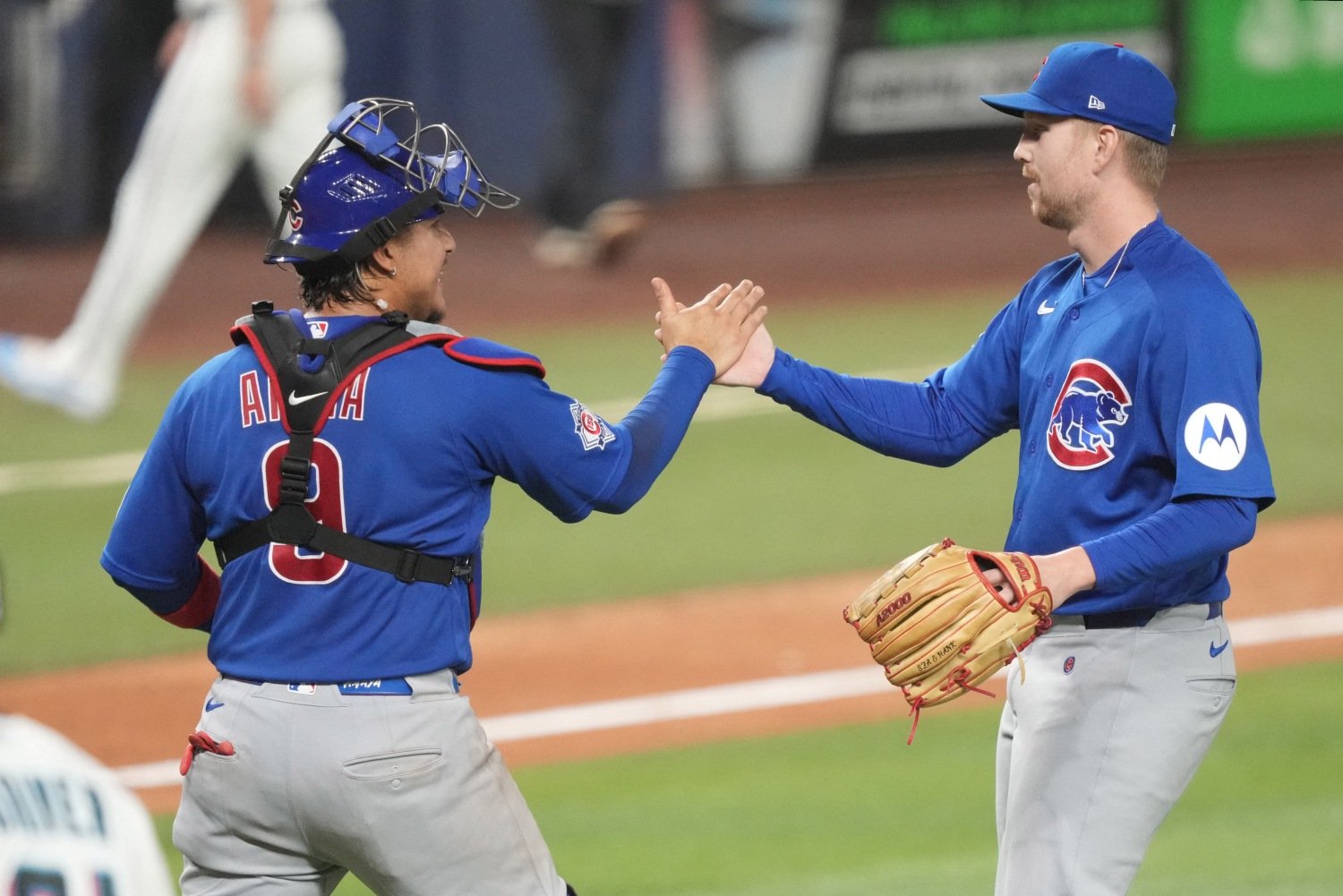
In a follow-up appearance later in the Brewers series and on Saturday against the Marlins, however, Zeferjahn returned to form—perhaps just momentarily, or perhaps more enduringly. He only fanned two of the nine batters he faced during those two assignments, but he got eight outs and allowed zero hits. He induced some ground balls. Both appearances came in high-leverage situations, so he not only pitched well, but did so under pressure.
That's happening for two reasons, and the reasons are related. Together, they comprise the next step of his evolution into the caliber of reliever the Cubs now need him to be—the one he's capable of being, but has rarely been so far in his big-league career. He's not a One Weird Trick guy, because he's always dealt with more than one big deficiency. The first deficiency has always been control; he walks too many batters. The second has always been fastball shape.
At first glance, Zeferjahn doesn't look like a guy who should have a fastball shape problem. He throws the kind of four-seamer the Cubs adore: a cut-ride offering. That means that it cuts more than a batter expects, based on its speed and release point and his arm angle, but also has more carry or ride than a batter expects. Teams use various models to estimate by how much a pitcher's movement on any given pitch deviates from what the hitter's eye anticipates, but to use one public-facing calculation via Alex Chamberlain's invaluable Pitch Leaderboard, Zeferjahn's four-seamer cuts a whopping 4.6 inches more than expected.
It only has about 1.1 inches more carry than expected, though, which is where you can start to sense the problem. When Zeferjahn worked from the first-base side of the rubber, the angle he offered batters did make it hard for them to handle the heater with that slight but meaningful amount of unexpected rising action. Working from there, though, he struggled to throw strikes, not only with that fastball but (especially) with his sweeper—and not only to throw strikes, but to put the ball close enough to the plate to tempt batters to chase non-strikes.
Once he moved to the middle of the rubber, Zeferjahn ran into a different problem: the fastball started running into the center of barrels. It doesn't hop over those barrels, and from the center of the rubber, it doesn't run off of them, either. Once he stops posing a challenge to a batter with the horizontal angle he creates, it quickly becomes clear how little deception he has on that heater.
The Cubs' answer to that dual problem has been, itself, a dual affair. First, they've steadily lowered his arm angle, via better posture and extension. To see what I mean, compare these shots of him at release on two pitches at Wrigley Field—one as a visiting Angels player in early April, and one this week against the Brewers.

If you're not a total pitching dork, the differences here are subtle—perhaps so much so that you can miss them altogether. Let's try it this way.
.png.3f2a7efe4ccdc0894291e8e6019abdee.png)
I've added a horizontal line through the middle of Zeferjahn's torso; a straight line from the MLB logo on the back of his jersey's collar to the corresponding one on the back of his pants; and the best approximate curve I could create using each of his shoulders and his hand as nodes. As you can see:
- Zeferjahn is leaning slightly more to the left in the left-hand image. This is what pitching mechanics gurus call spine tilt. In general, less tilt is good; it means less wasted movement.
- On the right, his spine has moved more from extension to flexion (that forward lean; yes, it's confusing that flexion is the opposite of extension when talking about body movments but greater flexion means more extension when reading a Baseball Savant page; deal with it). He's over his front leg a bit more now.
- His arm angle is lower. Part of the difference comes from that slight decrease in spine tilt, such that his body is more upright and his shoulders more level. Not all of it comes from that, though. Zeferjahn has made a real change to the way his arm works.
The result is a lower release point and (assuming no change in movement, which isn't a safe assumption, but we'll get to that in a minute) more deception. Throw a fastball with exactly the same vertical movement from the delivery on the right as from the delivery on the left, and the one on the right will be more likely to induce a weak fly ball or a whiff.
You don't have to trust your eyes or my illustrations on this; the data shows it. Specifically, Zeferjahn's arm angle is significantly down in his three appearances this month.

Throwing from a lower angle isn't a cure-all, though. If it were, everyone would do it, and even those pleasing One Weird Trick stories would wear smooth. For one thing, that adjustment almost always does produce a change in your movement profile; throwing from a lower angle means you're likely to introduce a bit more sidespin and a bit less backspin. More importantly, though, it can have big implications for your command. In Zeferjahn's case, the lower slot doesn't appear to gel well with his four-seamer in terms of execution, even though he hasn't lost carry since adjusting his slot.
Thus, the player and team have also made another adjustment. Zeferjahn only threw 10 pitches against the Brewers Thursday, but four of them were sinkers, and only one was a four-seamer. Against the Marlins on Saturday, he threw 19 pitches, including 12 sinkers and just three four-seamers. Zeferjahn has always had a sinker, but suddenly, it's at the heart of his arsenal. It's just two appearances, but there's some evidence that he's unlocked his next suite of weird tricks: a different delivery and a different primary fastball.
All short relievers see volatility in their performance, and it's unreasonable to expect Zeferjahn to be the exception. His profile only heaps extra volatility onto the mound of it most relievers bring. He didn't have a single epiphany. His story is far from over, and it's much more confusing and convoluted than those of guys who have that quasi-magical breakthrough. At the moment, the Cubs and their new power arm have happened upon something that works; that doesn't mean it will continue to work.
Because they have control of Zeferjahn for the balance of the decade, Chicago can (in one sense) afford to ride the wave with him. This process is iterative for them, and for him. He made one change; it worked for a while. That change ceased to work, and the one he introduced to get back on track didn't immediately work, either. Now, a third change that complements the second seems to have him in the groove again. Unfortunately, it's not even hard to foresee the trouble he might run into with this new profile. His sinker runs about 15 inches to the arm side. His sweeper goes about 15 inches the other way. Even working from the middle of the rubber, it takes very good command to make such a wide east-west separation work when pitching to a plate only 17 inches wide.
Will Zeferjahn's latest changes be the right ones to unlock some consistency for him? Maybe. If not, there's still ample hope. Zeferjahn could keep the sinker but go back to a tighter slider to complement it. He could slide back to the first-base side of the rubber, while keeping the new primary heater and the improved mechanics. The more powerful posture of his new mechanics has added a tick to his fastballs. If he can sustain that, he could even go back to the four-seamer and do better than we saw him do last month, because elite velocity provides a margin for error that isn't present even one tier below that register. There's time for experimentation and for exploration. Development continues well past a player's debut, these days.
In another way, though, the Cubs can't afford a wobble or a series of trials fraught with errors. In a very real sense, they need results, and they need them now. Zeferjahn isn't just a long-term investment. He's the closest thing this club has to a playoff-caliber relief ace. When he pitches the way he's capable of pitching, the Cubs can win close games like Thursday's and Saturday's. When he pitches poorly (or doesn't even inspire enough confidence for Craig Counsell to turn to him), the Cubs' bullpen is insufficient to that task.
The Cubs are racing the clock, but it's not purely about being as fast as possible. The team doesn't need to optimize Zeferjahn as soon as possible. They just need him to be on the high side of what seem to be (for now, at least) unavoidable oscillations in value at the moment when they need him most, which will come in about three and a half weeks. It's like timing a space shuttle launch or a flyby. The planets have to align. That's asking a lot, but it befits Zeferjahn's journey to this point. That journey hasn't been a straight line; it's always required getting some things lined up. The Cubs' postseason fortunes are just one more thing that has to be timed just right to make the most of Zeferjahn's talent.





Recommended Comments
Create an account or sign in to comment
You need to be a member in order to leave a comment
Create an account
Sign up for a new account in our community. It's easy!
Register a new accountSign in
Already have an account? Sign in here.
Sign In Now