


Cubs Video
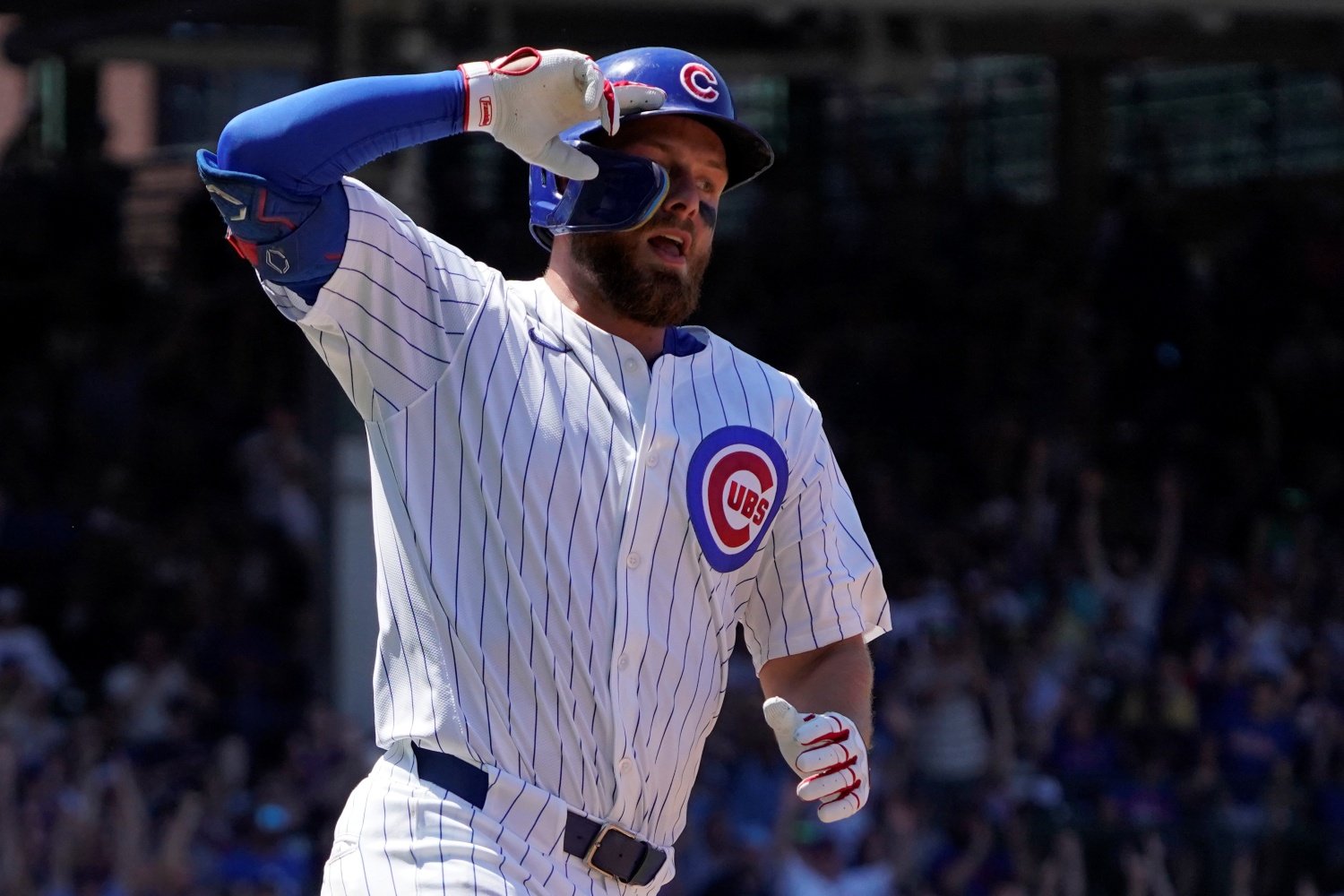
It's happened relatively quietly, amid the arrival of Kyle Tucker and the conspicuous rise of Pete Crow-Armstrong, but it would appear the Chicago Cubs have found their next franchise first baseman in Michael Busch. Probably. Maybe. It depends. We'll discuss the qualifier later.
First base is not an easy position at which to excel. You need above-average power to even be considered among the better names—but not just power. Violent power. I hesitate to use "light-tower power," but it's perhaps the most appropriate description for the type we expect out of the spot. Being a burly, intense-looking person doesn't hurt. And even if you capture what the position requires on the offensive and aesthetic areas of the spectrum, there's a decent chance the stingy defensive metrics don't like the work you're turning in, anyway, given the phonebooth in which you're operating relative to other positions (a conversation we're tabling right now in favor of an offensive focus).
In any case, Busch has been one of the most valuable players at the position since the start of last year. Going back to 2024, only five of his counterparts feature a higher fWAR than Busch's 3.9 figure, and only five are ahead of him in the wRC+ game (where Busch has posted a cumulative 128). The names ahead of him: Vladimir Guerrero Jr., Freddie Freeman, Bryce Harper, and Pete Alonso, with Matt Olson and Ryan O'Hearn swapping out for each respective category. So, you know, the good ones.
That's interesting, because when you consider the archetype of the position, it's not one that Busch conveys in physicality or in more ground-level output. At 6 feet and 210 pounds, Busch checks in as one of the smaller players the position has to offer. And then there's this:

Sure, yeah, Busch is able to put the barrel on the baseball better than most players at the position. But when one starts messing around with those categories, you start to lose him. He's 13th in average exit velocity (14th in max), 11th in average home run distance, and 20th in balls hit over 95 MPH. So if we're going by the archetype of the first baseman, it's not a box into which Busch neatly fits.
Yet, here he is, sitting among the game's very best at the position in some of those more comprehensive metrics and refining the areas of his game in which he struggled last season. That's the important thing, too. Busch's improving defense and occasional power was always going to prop him up in the broader picture of the position; it's not like the talent pool runs too deep on a year-over-year basis. But Busch has been able to focus on those shortcomings, to catapult his production toward something more consistent, primarily in the plate discipline department.
The most noticeable area for improvement last year was a strikeout rate that approached 30% (28.6). Only Rhys Hoskins had a higher K% among positional regulars last year, while Busch's CSW% (called and swinging strike rate) also sat as the fifth-highest (27.4%) as he navigated the zone in his first full season. This year, he's cut the K% to 21.7 (13th "highest") and has the ninth-best CSW% (25.1) among 27 qualifying first basemen. He's cut down the chase, brought up the in-zone swings, and produced more contact. He's also swinging at fastballs more than any other type of pitch, which lends itself to the six-percentage-point increase we're seeing in Hard-Hit% (46.0 as of this writing). As a result, you get this type of percentile chart:

There's obviously room for further improvement in certain areas, but it's also a lot of deep red. Busch is, objectively, a very good hitter. Given where he stands within the positional context, you could call him an elite first baseman, and probably face minimal pushback. The upper echelon stands above him, but it's not like he's sitting miles behind the others.
But! Can we consider him a franchise first baseman in the way that the likes of Freeman or Harper or Guerrero are?
This question rests on the fact that Busch is still getting heavily shielded against pitchers of the same handedness. He has only 38 plate appearances versus left-handed pitchers, and 229 against righties. Obviously, the only answer to that is: no. Unless and until he shows the ability to hit lefties, and thus earns every day playing time, he's not a franchise anything. That label only goes on the guys who are cemented into your lineup.
Despite the lackluster performance that the team is getting out of short-side platoon partner Justin Turner, Craig Counsell has made a concerted effort to get a right-handed hitter going against southpaws. It hasn't worked in the box score, but it's worked heavily in Busch's favor in matters of his own production. Plus, the league leader in plate appearances against lefties is Josh Naylor, with 94. The average plate appearance figure among qualifying first basemen is roughly 80. In the grand scheme of a season, it's not some tremendously high volume of chances Busch is missing; it might be 100 over a full campaign.
As long as we're talking about the idea of a "franchise" first sacker, let's invoke Anthony Rizzo's name as part of this discussion. Busch is at roughly 830 PA, while turning in a line of .260/.351/.475, a 0.46 BB/K ratio, and a 133 wRC+ across 1.5 seasons with the Cubs. Rizzo's first two seasons (around 1,000 PA) went .259/.333/.441, a 0.52 BB/K ratio, and a 111 wRC+. There's some deeper context (age, for instance), and Busch lacks the charisma of a player like Rizzo, who easily latched onto the "franchise" qualifier, but the trajectory appears set for him to become exactly that for the Chicago Cubs.
It doesn't make sense. He's small. He's quiet. He doesn't hit the ball as hard or as far. He doesn't get run vs. left-handed pitchers. And yet, everything Michael Busch has done in 1.5 years on the North Side has him set to help us forget about the first base bridge that existed between himself and Rizzo. You can be less than a franchise player, but still an extremely good one.





Recommended Comments
There are no comments to display.
Create an account or sign in to comment
You need to be a member in order to leave a comment
Create an account
Sign up for a new account in our community. It's easy!
Register a new accountSign in
Already have an account? Sign in here.
Sign In Now