


Cubs Video
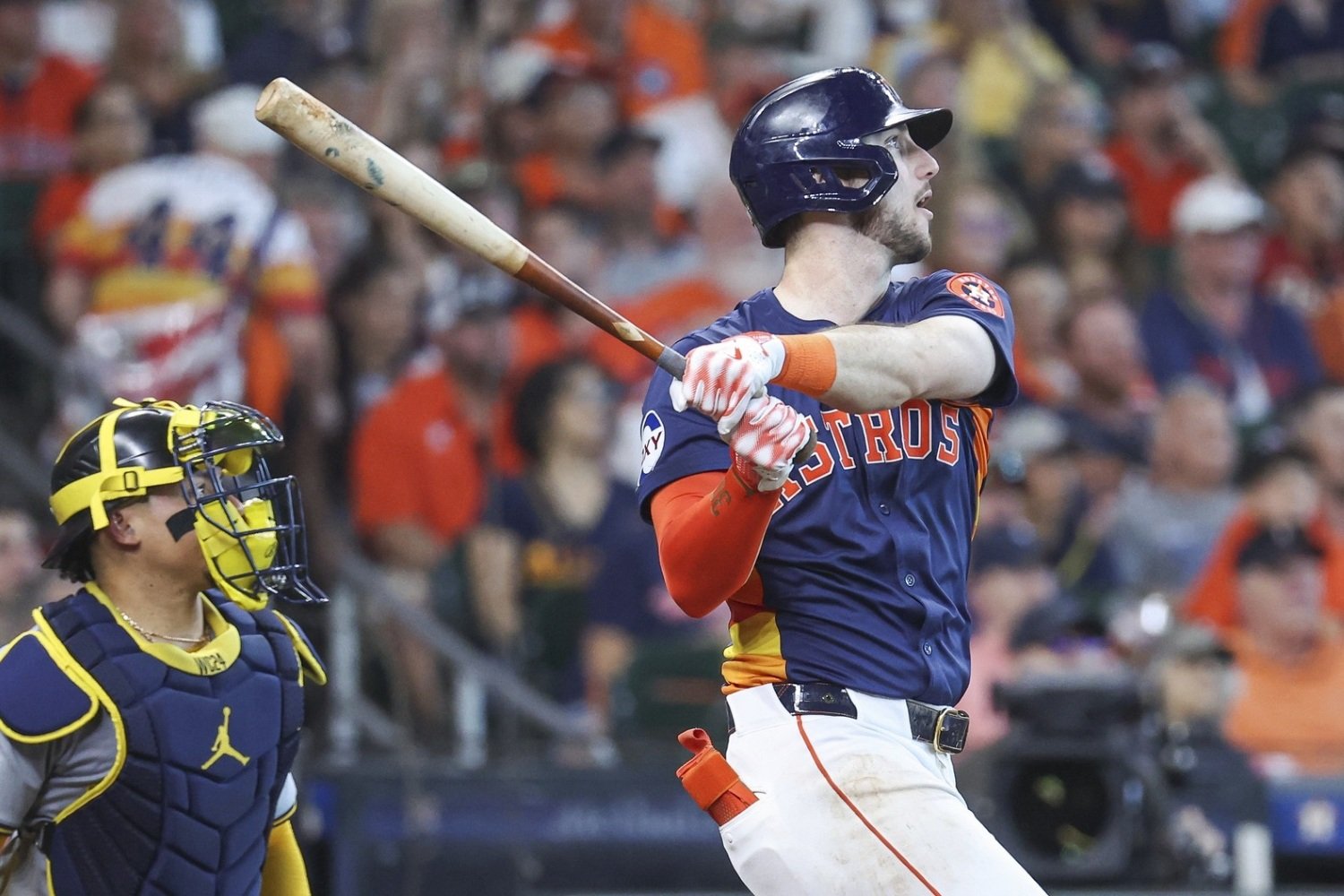
Kyle Tucker was a very, very good hitter even before 2024. From 2021-23, he emerged as a superstar, with a .278/.353/.517 batting line and an average of 30 home runs per season. If he had merely reproduced those numbers last year, he would still have been a perfect target for the Cubs when the Astros decided to trade Tucker before he hits free agency. Instead, though, he went a little crazy—albeit in just half a season.
In a campaign truncated by a broken shin, Tucker hit .289/.408/.585. He swatted 23 home runs in 78 games, putting him on pace for well over 40. It was a power breakout that, in one sense, makes a lot of sense; plenty of very good hitters have become truly great sometime around age 27. That the forward leap would come in the form of a power surge was only natural.
Was that newfound pop sustainable, though? That's the only relevant question now, as the Cubs turn their attention toward 2025. If Tucker becomes the first left-handed batter to hit 40 homers while calling Wrigley Field home since Billy Williams did it in 1970, the Cubs are going places. If he hits 25 in a full season, the picture is a lot muddier.
The first thing you might want to know, if you're trying to forecast Tucker's power output, is this: only free agents Anthony Santander and Enrique Hernández had a bigger difference between their raw home run total and their xHR (expected homers, based on the balls they hit that had any chance of becoming a homer, anywhere) than Tucker's. He hit 23 homers, sure, but he only had 16.7 xHR. I'm highly skeptical of data like these, but there's a threshold beyond which they become compelling, and Tucker is beyond that threshold. He missed half the season, but he pointedly did not miss the Mexico City Series between Houston and the Rockies, when the extreme elevation of that venue turned two well-struck but lazy fly balls Tucker hit into long homers. As you know, he also played in a very hitter-friendly home park, which I'll call continue to call The Juice Box until we can all agree on a non-corporate name for it, and that helped him further outperform his expected slugging production.
However, you might also want to know this: According to Statcast, this batted ball would have left just one park in MLB, but that park is Wrigley Field.
And you might also care to know that the same is true of this fly ball.
This one would have left a whopping two parks: Wrigley and Shea-Under-the-Airport in New York (I'm not using corporate names for stadia today; not sure why).
This one would have left both in Lakeview and in Chavez Ravine, but nowhere else.
Now, again, I'm a skeptic about these claims by Statcast, and I invite you to share in that skepticism. Their estimates of whether the ball would leave the park claim to incorporate the trajectory of the ball, but the other factors they name are the distance it traveled, the distance to the walls of all 30 parks to that specific angle, and the heights of those walls. I believe the last three, but am slightly dubious of the claim that trajectory is fully accounted for—and they don't even pretend to account for the weather or the exit velocity of the ball or the tendencies of the ball to carry well or poorly to various parts of the field in various venues.
So, would all of these really have landed in the basket in left-center? I'm not sure. It probably depends on the weather, and we just saw a whole year of unfriendly weather for hitters at Wrigley. On the other hand, though Statcast doesn't think this ball would have left any stadium in the league, I think it probably leaves Wrigley.
You get the point. Tucker might have gotten lucky and found some power down the lines last year that he won't find when playing at home in 2025, but only half the games are at home; the other NL Central parks (especially Milwaukee and Cincinnati) seem very inviting for his power; and he has an abundance of power to left-center field, the very place where Wrigley is most hitter-friendly. In this admittedly flawed analysis, there's room for both optimism and pessimism about his dinger count for the coming year.
Let's do some more robust analysis, though. Where, exactly, did Tucker find his power increase in 2024? If it was a conscious change of approach, maybe we can infer that it has some staying power. If (on the other hand) it was just a matter of getting a bit lucky and hitting in conducive environments, we should prepare for heavy regression as he joins the Cubs.
Here's a pair of charts showing Tucker's average exit velocities and launch angles by pitch location for 2023.

This is about what you'd expect to see. Tucker hit the ball hard when it was down the middle, and when it was either up and away or low and in. Most lefty batters' charts for exit velocity look like that. Most hitters, too, lift the ball when it's high in the zone and when it's inside, but tend to hit grounders more often on pitches low and/or away, which shows up in the average launch angle for each spot. This is a snapshot of a very good hitter with a standard-issue contact profile, based on location.
Here's the same pair of charts for 2024.

Aha! There's been a major change here. Tucker dedicated himself much more to lifting the ball in 2024, and in particular, look how hard he hit pitches low and in (and how successfully he lifted them). That's not normal, and it requires a conscious adjustment. Taking pitches in the lower inside corner of the zone and those outside the zone down and in as one big group, you can see a huge change in Tucker's contact profile in 2024.

This approach was only undertaken for one half-season, disrupted by an injury suffered when Tucker fouled a ball hard off his own leg—a vicious swing on a misplaced Kyle Gibson cutter, down and in. He might not stick to that approach in 2025, out of self-preservation or because it wouldn't have stuck, anyway. If it does, though, then there's a full-fledged slugger here, with that very real 40-homer upside. Tucker has another level, above the one we've seen to date (at least over a full season), and Wrigley Field might help him attain it.






Recommended Comments
Create an account or sign in to comment
You need to be a member in order to leave a comment
Create an account
Sign up for a new account in our community. It's easy!
Register a new accountSign in
Already have an account? Sign in here.
Sign In Now