


Cubs Video
The Chicago Cubs drubbed the Los Angeles Dodgers in their season opener Thursday. If you're in a certain kind of headspace and it would be helpful, feel free to ignore the fact that it was the Cactus League opener, and that the game's biggest single blow was a three-run home run by obscure prospect Ivan Brethowr, and just savor that victory.
Yes, it was just a spring training game, and an even wilder, more minor-league-flavored one than most, but there were two features of major interest in play:
- The first test of the automated ball-strike challenge system in an MLB game; and
- Statcast data flowing freely from Camelback Ranch, the spring home of the Dodgers.
The first is neat, a little bit of a novelty and a preview of 2026, when we're very likely to see a debugged version of the challenge system come into play for balls and strikes in MLB games that count. The Cubs got the better side of the first challenge ever in a game featuring big-leaguers, when Reese McGuire challenged a called ball thrown by Cody Poteet and the computers overturned the call, granting Poteet a strike.
Much more fun and exciting, though, is the Statcast info. Until this year, the only park in the Cactus League that had Statcast data freely available to the public was Salt River Fields at Talking Stick, where the Diamondbacks and Rockies train. Whether because of the ABS system being installed or just because that's the direction things are heading, we now know that Camelback Ranch will offer another source of data we outside observers can capture and analyze. It wouldn't be surprising if we end up with such data for a majority of spring games this year—and that would mark a big step forward in our ability to evaluate performances and the decisions teams must make based on them in the weeks ahead.
I want to talk about the standout performances from the game, and we will, but first, a word of caution is in order: It seems clear to me that the Statcast system in that park was improperly calibrated. As you'll soon see, there were some velocity readings parading past viewers in this game that simply can't be right, so we need to mentally discount them just a little bit. That's ok. It's too early to be taking such readings at face value, anyway. We should allow for lots of tinkering and working on things. Nonetheless, numbers like these—numbers that measure movements and processes, rather than multivariate on-field outcomes—matter even in tiny samples, and we can glean a little bit from them even in this strange context.
The Shadow Bullpen
If the season began tomorrow, instead of four weeks from now, the Cubs' relief corps on Opening Day would probably include:
- Ryan Pressly
- Ryan Brasier
- Porter Hodge
- Nate Pearson
- Caleb Thielbar
- Tyson Miller
- Eli Morgan
- Julian Merryweather
Of course, that assumes perfect health and roughly the expected performances by all the candidates for various jobs, which won't come to fruition. Still, that's the baseline octet slated to fill out their bullpen. So when I tell you that Cody Poteet, Brad Keller, Daniel Palencia and Jack Neely did most of the heavy lifting Thursday, you don't automatically need to care how they did.
But they did very well.
Poteet was the mixed bag. His secondary stuff was all over the place, and he struggled to repeat his delivery, leading to some walks and some hard contact on fat pitches. An inconsistent release point was a major source of his struggles (when he had them) in the Yankees system, so it's discouraging that he ran into that very problem in his first game as a member of the Cubs.
On the other hand, Poteet's fastball averaged 94.4 miles per hour on Statcast, touching 96. Last season, his average heater was just 93.3 mph. We should assume that that 94.4 was really about 92.5, and make the 96 a 94, but that's still an exciting amount of zip from the possible long reliever, given that it's only Feb. 20. His first inning of work was strong. He ran into a mechanical or grip issue in the second that led to his heater flattening out, even as it held its velocity. At this early juncture, that type of stuff is supposed to happen. We'll see how he progresses, but it was a fine debut.
Things only got better. Keller, a minor-league free agent who signed with the Cubs and who made sense as a target for them all along, was pumping gas in his 1 2/3 innings of scoreless, two-strikeout ball. His average fastball velocity last year was 93.8 miles per hour. On Thursday, Statcast registered him as high as 97.9 and had him averaging 96.2. Again, there's no way that's right, but it seems as though he was throwing at least as hard as he did during the regular season last year.
Even more interesting, arguably, was an apparent adjustment to his pitch shapes. Keller's fastball had a little less cut to it, but to compensate, he was throwing a version of the hard slider he used in 2024 that plays more like a cutter: less depth, but the same amount of horizontal swerve. He might be unlocking a new arsenal, of sorts, though we need more data to tell for sure. Keller is a very long shot to make the roster right away, but he could easily end up contributing as a spot starter or long reliever by the end of May—especially if he really is on the way to sitting 95 or so this year.
Palencia and Neely were the showstoppers, though. If you care to suspend your disbelief for a moment, Palencia's first pitch of the spring was 100.0 miles per hour, and he sat right around there throughout a scoreless inning, touching as high as 101.3 mph. Even if we apply a skepticism discount to this one, it's awesome. Palencia has been the easiest dark-horse reliever to dream on all winter for this team, even though holding a spot for him was never an option. He looked as good mechanically Thursday as he did at times late in 2024, and if he can keep up any semblance of that, he has a chance to become this team's relief ace over the next year or two.
Neely and Palencia make a truly delightful one-two punch, and if they pan out, we need to cook up a dynamic double nickname for them. Palencia is built like a middle linebacker; Neely is built like a rim-protecting center. Palencia's pitch mix is surprisingly varied for a reliever, but he certainly lacks the command to be a starter, and his sheer, explosive power makes up for imperfect fastball shape. Neely, all neverending limbs and with pretty good command of just two pitches, gets plenty of his value from that subtle art of the vertical approach angle. He pitched the sixth after Palencia's scoreless fifth, and fanned two without allowing a baserunner. He sat 97, and if you only believe it was 94.5, who cares? He also used his slider more than his fastball, anyway, and it displayed its usual chaotic filthiness.
I don't think anyone would even argue with the idea that Palencia and Neely represent the highest-upside back end of the Cubs' possible bullpens. It's just too risky to have come into this season counting on anything from either. They're a shadow bullpen, a second unit—along with Poteet, Keller, Ben Heller, Luke Little, and whoever falls through the cracks in the battle for rotation spots in Chicago and/or Iowa. That they have so much promise and are yet inessential to the team heading into the season is awfully exciting, as Thursday affirmed.
They Don't Call Him Tater for Nothing
At this moment, the battle for the final bench spot looks likely to come down to Vidal Bruján and Gage Workman. Bruján started in center field in this game, and he looked fine. He's a bit less selective than you'd like a player with his contact profile to be, but in a game like Thursday's, you also want to see him get his rips. He got a great jump on a stolen base; he got a less impressive jump on a probably-uncatchable-anyway fly ball, and was otherwise untested in center.
If Bruján proves he can hit a little and patrol center well, that could seal the gig for him, but Workman put on a show in his Cubs organization debut. He rapped a second-inning single sharply through the infield against Yoshinobu Yamamoto, and started two slick around-the-horn double plays at third base. The big moment, though, came when he rode a Justin Wrobleski pitch out of the park to the opposite field. The homer only had a 101.5-mph exit velocity, so it wasn't a no-doubter, but his huge frame and ability to generate bat speed even deep in the hitting zone was eye-opening. He's a tremendous athlete; it would be a bummer to ship him back to Detroit.
Miscellany
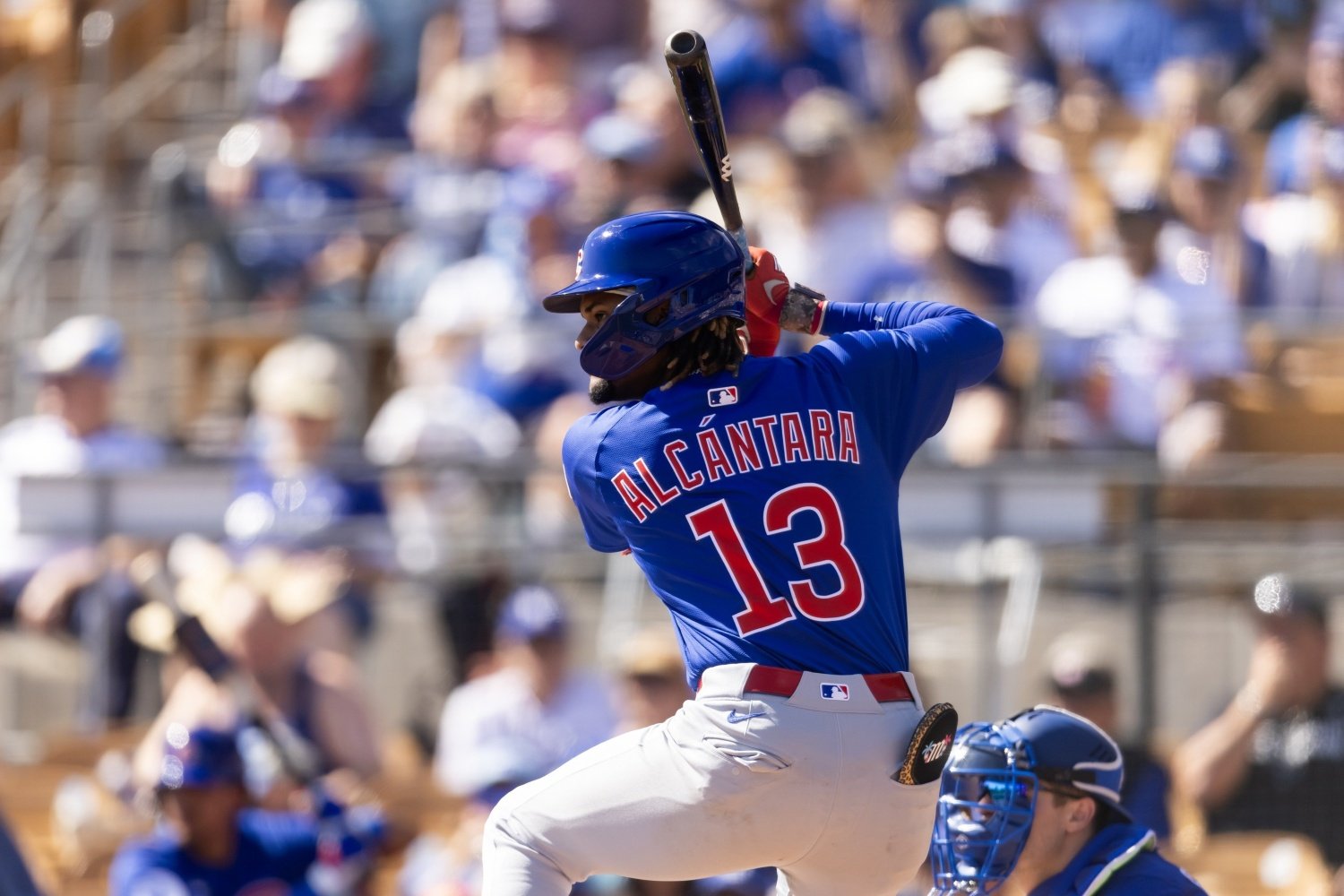
It wasn't just Workman who lit up Statcast with some exit velocities worth monitoring. Kevin Alcántara hit a ball 107.3 miles per hour, scalding it through the left side of the infield. That he didn't life that ball mitigates the celebration a little, because as we know, that's the hurdle he most needs to clear to emerge as a productive big-league hitter. In that very vein, though, it was interesting to see him take a Yamamoto fastball off the plate away and float it into right field on a nice line-drive trajectory for a first-inning single. He's learning to make some of the adjustments that could unlock his enormous upside.
Meanwhile, Moises Ballesteros swung five times in 16 pitches seen, and made contact all five times. Two of those were foul, and none of the three he put in play was especially impressive. He went 0-3, but he did draw a walk, and that plate discipline is going to be crucial to his development. With the feel for contact he boasts, there's no reason he should be swinging as often as he was late in the year with Iowa. He looked hitterish, but mature Thursday.
Finally, let's applaud Michael Busch, the only true regular for the team who was tasked with playing on the first day of his strange spring season. He went 2-3, with a neat opposite-field liner single off Yamamoto (a mirror image of Alcántara's, really) and an absolute laser that (scarily) hit Dodgers hurler Bobby Miller in the head. Miller was ok, but that was a frightening moment. Busch had scalded the ball at 105.7 mph back through the box. The two overlapped for years in the Dodgers system, after both went from high schools in the Upper Midwest to the ACC for college. They know each other well, and Busch would have been especially wrecked if things hadn't turned out ok. They did, though, and Busch's first game was a success. His only out was also hit over 104 mph, but on the ground.
It's just one game, that doesn't count. Still, that was a fun start to what the Cubs hope will be a fun season. It'll be fascinating to see how much of that tantalizing pitching data carries over into the next appearances for each of those arms, and how these key young hitters continue to handle their big chances in camp.





Recommended Comments
There are no comments to display.
Create an account or sign in to comment
You need to be a member in order to leave a comment
Create an account
Sign up for a new account in our community. It's easy!
Register a new accountSign in
Already have an account? Sign in here.
Sign In Now