



Cubs Video
Though his season was hollowed out in the middle by a month lost to arm trouble, Javier Assad entered mid-August with things going swimmingly. Despite walking 10.5% of opposing batters and not striking out even a league-average number of them, he kept working out of trouble. Through 21 starts and 103 innings, he had a 3.24 ERA, and the Cubs were 12-9 when he took the ball. Then, he voluntarily derailed it all.
Assad moved over from the middle of the pitching rubber to the far first-base edge, in a semi-gradual shift over the course of two starts. Here he is in a start against the Brewers, in early May:
It was a conscious choice, aimed at opening up new angles for his attack on opposing hitters. Here's a pitch he threw after making the change, in August, for comparison:
And here's the difference, in data form:
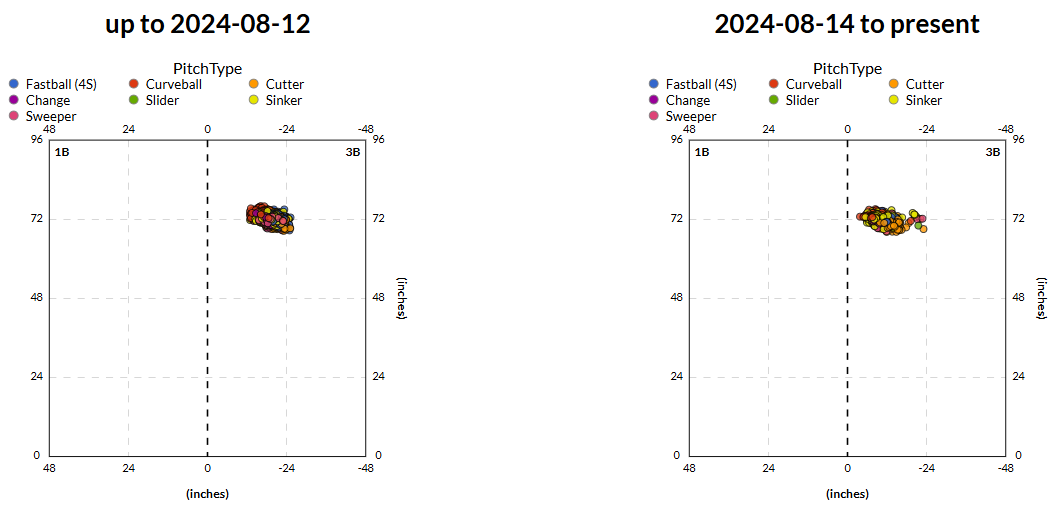
He has a very deep arsenal, but not all of his pitches were working well from the release point he reached while pitching from the arm side of the rubber. His primary fastball, a sinker, had more room to run in on right-handed batters without getting obviously clear of home plate once he slid over. He could (and did) even try to aim that sinker off the outside corner and run it back, seeking to freeze hitters on that pitch and to play his four-seamer off of it for whiffs. With a more direct line to the plate, he clearly felt more empowered to throw his curveball, and he also ratcheted up usage of his sweeper, on the theory that once he had righties looking for the outside sinker, he could throw that sweeper and induce fruitless chases.
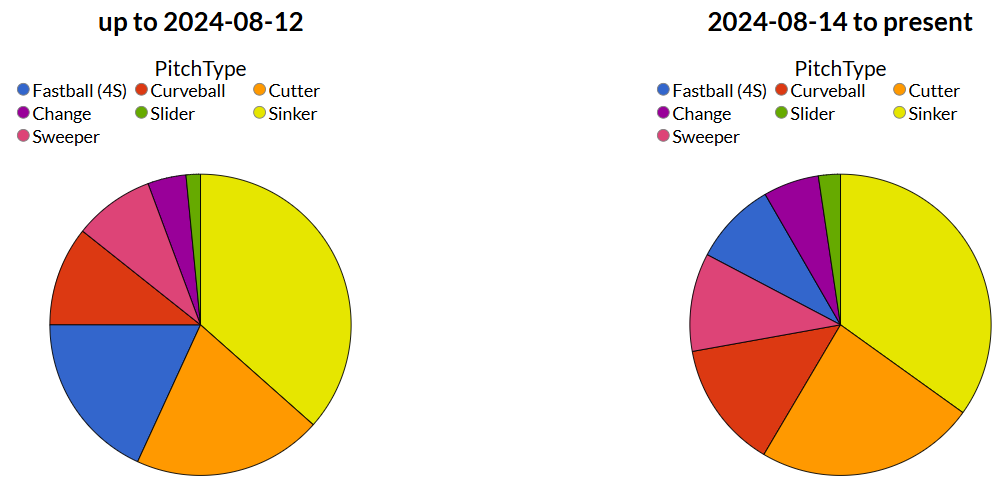
There were lots of use cases, in theory, for the move to a new home on the rubber. Quickly, though, it became clear that it was actually a bad idea—maybe worse than bad. From Aug. 14 through the end of the season, Assad's ERA was 5.22. He got a bit less lucky, perhaps, because he did also substantially increase his ground-ball rate, but he got hit much, much harder, especially when hitters did elevate the ball. His migration yielded more strikes, but too many of them were in (or near) the middle of the zone, and opponents punished him for it. Even Stuff+ and Location+ testify to the folly of the lane change. He dipped from an 86 in Stuff and 100 in Location before the move to 83 and 98.
It's understandable that, despite surface-level success, Assad and the Cubs went looking for better angles and better answers late in 2024. In fact, since too many players, organizations, and people wait until they're forced into a change before making one, we should applaud the proactivity of this move. It was worth a shot. Whether it will remain laudable, though, depends heavily on a simple question: Did they learn their lesson?
Assad will never be the guy with plus stuff. He's unlikely to strike out 25% of opposing batters, even if he moves back to the bullpen. It's not how his game works. Nor is he a precision arm, in terms of location. However, he can be extremely effective at times. The key variable is the very thing Assad sacrificed by sliding over on the rubber in 2024: deception, and the tough angles that beget mishits. If he goes back to pitching where he was for the majority of 2024, Assad can still be a solid third or fourth starting pitcher.
Working away at the corners will work better, and the batted balls he induces will be less dangerous, if he can get back to giving hitters those tough looks. They picked the ball up too early and too well against him in the late going. It fueled a derailment that plenty of analysts were waiting to see, from a pitcher they all swore would fall off the tightrope soon. While his poor stats tickled the confirmation bias region of the brains of many fans, though, they were at least as illusory as his great numbers prior thereto. When he's himself—the ball coming out of his hand well, in his usual spot on the mound, mentally strong and confident—Assad can be that solid mid-rotation starter. He just needs to walk back the small changes he made late in 2024. They weren't misbegotten, but they were failures, and it's important not to repeat the foible under what should be harsher demands of a team right in the thick of a postseason race.





Recommended Comments
There are no comments to display.
Create an account or sign in to comment
You need to be a member in order to leave a comment
Create an account
Sign up for a new account in our community. It's easy!
Register a new accountSign in
Already have an account? Sign in here.
Sign In Now