


Cubs Video
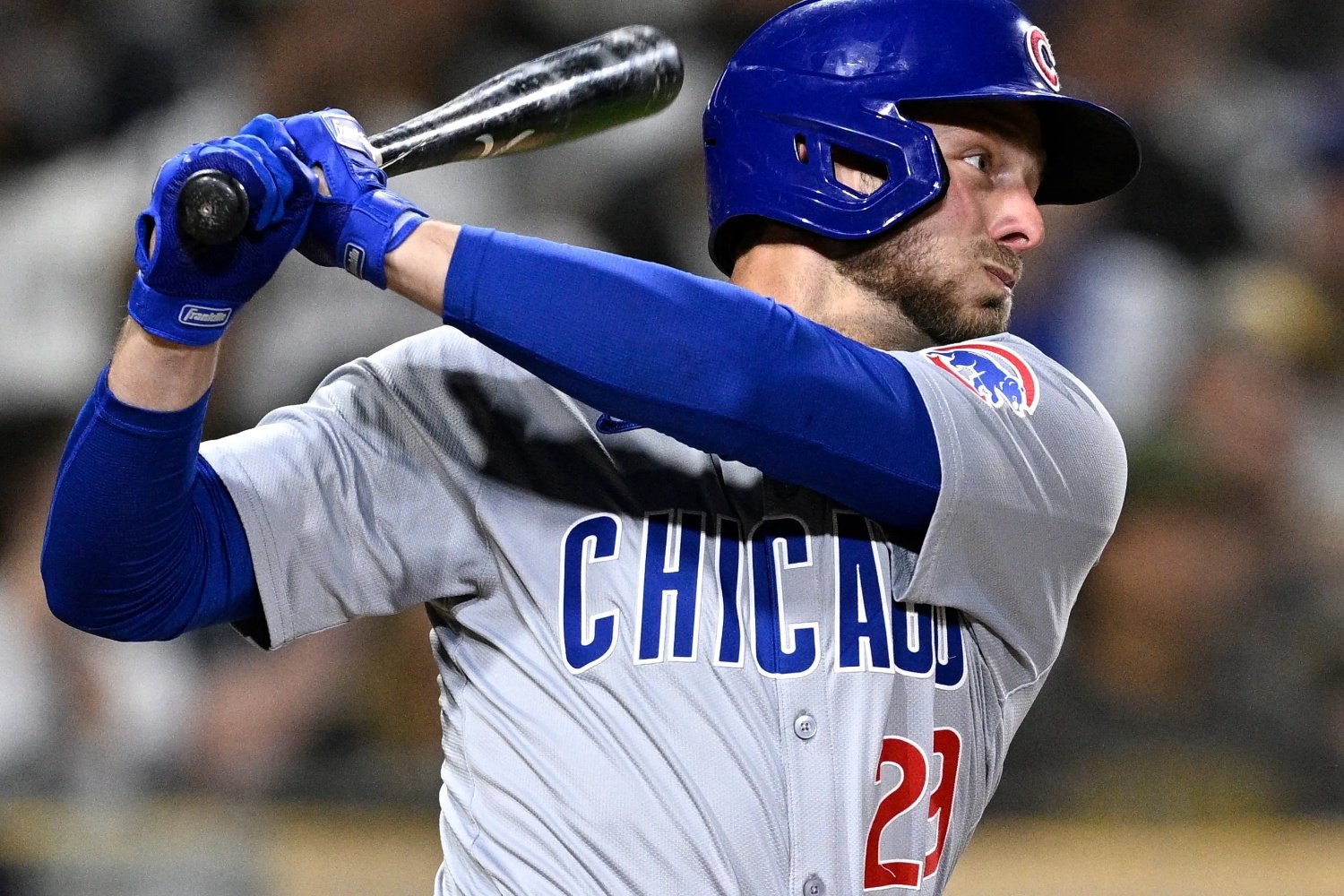
With Michael Busch’s torrid start to the season, it’s worth asking how much of what he is doing is real. There will be regression — his start is almost certainly not sustainable — but by how much will Busch regress? There are some important stats that suggest the Cubs might have a better first baseman than anyone thought. And for a good argument for why Busch should be allowed to face more lefties, check out Randy Holt’s deep dive on him. I will reference a couple of the stats also used in that article, but I’ll be framing them differently in this piece.
Methodology:
When doing analysis of a player’s potential breakout, the obvious question becomes: What stats are predictive of future performance, and are there meaningful changes in any of those stats? In general, some stats that tend to help us improve predictive value are ones like xBA, xOBP, xSLG, and xwOBA. They aren’t perfect, but they can help identify players who are changing for the better.
In addition, other stats that I use to make decisions about players are power metric changes (such as exit velocity, barrel%, hard-hit%) and plate discipline stats (Contact%, Z-Contact% [which measures contact% in the strike zone], and O-Contact% [which measures contact% outside the zone]). When I look at plate discipline stats, I’m looking for positive changes; plate discipline is something that can be improved gradually and is far from linear. And young players in their often experience quite a bit of growth in that area as they get comfortable at the MLB level.
Analysis:
So, after looking at Michael Busch’s xStats, power metrics, and plate discipline stats, is the breakout real?
The best answer I can give is: sort of, at least to a degree. There does appear to be measurable growth that will likely result in a noticeable progression this year.
Why is that? Let’s take a look:
First, let’s check out those stats I mentioned above that help us improve predictive value. Starting with xBA, Busch has gone from .217 in 2024 to .253 so far in 2025. It’s also worth noting that while last year’s xBA was only .217, he ended up hitting .248. His current .306 AVG is probably higher than we can expect, but he's long had a habit of outperforming the expectations in terms of average. Case in point: He's outperforming his xBA by .053 (roughly 21%) in 2025, which isn’t a massive step up from how he outperformed xBA (.031) last year (roughly 14%).
Do I think Michael Busch is going to hit over .300 this year? No. Do I think he can and will improve from last year’s .248? Yes. His current BABIP is higher than last year’s and will probably level out closer to his .322 average of 2024, but that will simply bring Busch’s batting average down to the .260-.270 range. I think his current performance suggests that range is a real and sustainable possibility.
His current .339 xOBP is well below his current OBP of .385, but is slightly above last year’s OBP of .335, which outperformed last season’s xOBP of .309. I’m seeing a pattern of Busch outperforming expected stats.
And for the final two: his current xSLG is above his results from last year (.475 compared to .418) as is his xwOBA (expected weighted On-Base Average) compared to last year (.354 to .319). But it’s worth mentioning that, once again, Busch outperformed those 2024 expected stats, finishing with a .440 SLG and .336 wOBA. Undoubtedly, expected stats aren’t perfect, but the fact that he continues to outperform them makes it look like a possible feature of Busch’s game.
So, let’s look at a few stats that don’t rely on expectations. Like last year, Busch is hitting the ball hard: a HardHit% of 38.7 is right in line with last year’s 39.9%, and his EV, maxEV, and Barrel% are all within 1.5 points of last year’s numbers. Again, he may be getting lucky, but Busch doesn't outperform the metrics purely thanks to dumb luck. This is supported by the fact that his O-Contact%, Z-Contact%, and overall Contact% are all comparable to last year’s numbers and above league-average.
So, what, if anything, is different? Well, three things stand out to me.
1) His K%, CSW%, and CStr% are all down. What that means is he’s striking out less, and he’s getting into more hitters’ counts. Fewer strikes overall = good, as long as the O-Swing% doesn’t drastically increase. That would indicate he’s swinging and making contact with pitches he probably can’t do much damage on, but his O-Swing% has actually gone down by 2.4%. Patience is a good thing; being selectively aggressive is even better. Busch is starting to master the latter trait.
2) He is hitting the ball in the air more often — not significantly, but more than last year. More balls in the air naturally means a better chance of doing damage, especially when Pull% increases. And, wouldn't you know it, Busch is pulling the ball at 48.4%, compared to 42.9% last year.
3) He’s dropped his soft contact by 8%, which is significant. This ties back to the first point, but it's nice to see that the swings are more purposeful this year. Hitting the ball and hitting the ball with authority are two different skills.
So, what does this all mean? It could be nothing — maybe Busch is just on one of his month-long heaters. However, while I may be looking through rose-colored glasses, these changes look to me like real growth. I don’t think Busch is about to have an MVP year, but I do think he’s about to have a markedly better year than 2024. Last season, he finished with a 119 wRC+, which ranked 42nd among all qualified hitters in the league. Not bad. This year, his 171 wRC+ has him at 14th. If he can become the Robin to Kyle Tucker's (187 wRC+) Batman, the Cubs lineup may be better than we thought.




.thumb.JPG.19c99ddd60a76edf810c77d321439828.JPG)



Recommended Comments
Create an account or sign in to comment
You need to be a member in order to leave a comment
Create an account
Sign up for a new account in our community. It's easy!
Register a new accountSign in
Already have an account? Sign in here.
Sign In Now