


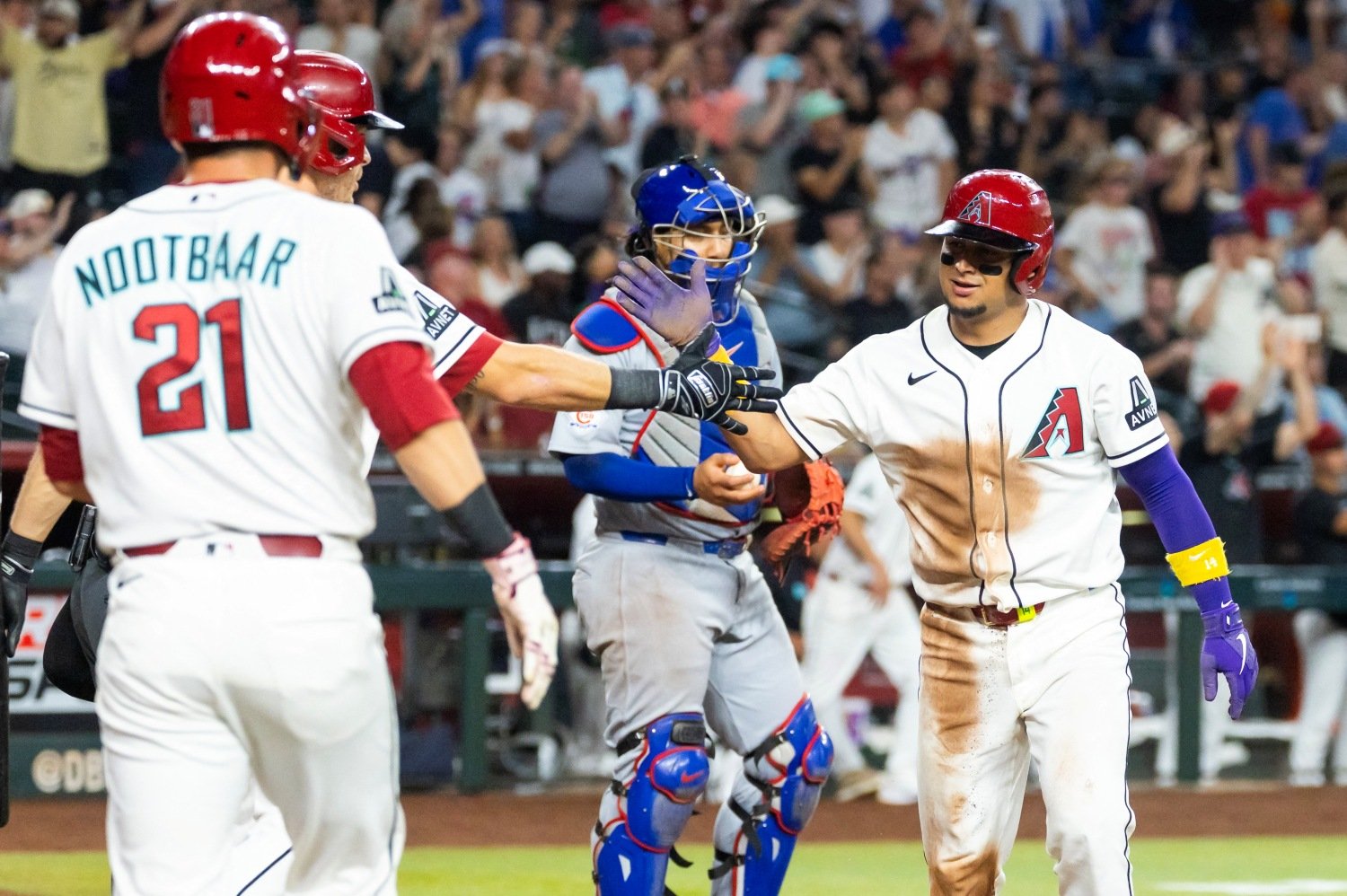
Cubs Video
Calling the Cubs' loss Tuesday night in Arizona a gut punch would be inaccurate. A gut punch is a single, sudden blow to which you left yourself open, but which required the opponent to spot the vulnerability instantly and attack without hesitation or error. What happened to Chicago was more like losing your cap on a windy day; missing a chance to seize it before it spins away; and then plunging down a roadside embankment chasing the damn thing because you weren't watching where you were going. Let's review the carnage.
Clay Holmes did everything the team could have asked of him. A sudden ace with a chance to pitch at the front end of Chicago's postseason rotation, Holmes was stellar, spinning seven scoreless innings against a Diamondbacks lineup that lacks some of its dynamism right now amid the ongoing Ketel Marte drama. Meanwhile, Ian Happ paid off a great at-bat with a three-run homer, and the team even tacked on an early insurance run. It looked like smooth sailing. To ensure it stayed that way, Holmes got some defensive help from newly-minted second baseman Pedro Ramírez.
After seven innings, the Cubs not only enjoyed a comfortable lead, but hadn't been scored upon since early Sunday. They'd scored 30 runs since then, the first time they've put up that many runs between opponent tallies since 1969. It was all looking easy.
That was the trap. It's never easy. In the bottom of the eighth, the Cubs found that out the hard way. Daniel Palencia's efforts to get back into a groove since coming off the injured list have been erratic, in costly ways, and this was no exception. After one quick out, he hit a batter, then walked a batter. He struck out the dangerous Corbin Carroll, and he had a 2-2 count on Gabriel Moreno; he was almost out of the jam. Then came that gust of horrible wind: a check-swing grounder by Moreno that somehow stayed fair up the first-base line. It eluded Michael Busch and trickled down the line, allowing one run to score and resulting in two more in scoring position. A Geraldo Perdomo single plated both runners, and Craig Counsell had to lift Palencia in favor of closer Jacob Webb.
Four-out saves are a tall order for Webb. His improvements this season have been real, and he's a legitimate high-leverage arm, but he's not a top-tier relief ace. That means he's going to fail sometimes. To minimize the number of times those failures happen, it's important to avoid asking too much of him too often. To minimize the impact of the times when he does fail, it's important to have a decent-sized margin for error as often as possible. Lately, the Cubs are asking a lot of Webb, and doing so when the margin for error is minimal.
Flawed Catch and Tag Cost Cubs Chance to End Game on Stolen Base Attempt
Thus, even after he got the team out of the eighth with a 4-3 lead intact, Webb had a gauntlet to run, and this time, you knew it wouldn't be easy. With one out in the bottom of the ninth, he walked Tim Tawa. With two outs and pinch-hitter Ryan Waldschmidt at the plate, pinch-runner Jose Fernandez took off for second base, and that moment came when the Cubs could have spared themselves the loss of that cap to the win, before it even lifted off their head.
Webb did a reasonably good job holding Fernandez. Miguel Amaya got off a good (though certainly not a great) throw, and there was a chance—or maybe just a ghost of a chance—to get Fernandez. The play was close enough that, even after the initial safe call, the Cubs elected to go to replay, because if the out had been converted, it would have ended the game. It was a very quick review; the call was confirmed. But we don't have to focus on the fact that Fernandez was safe; let's examine how close he came to being out, and whether he should have been.
Amaya's throws to second on steal attempts have largely been quite accurate this year. He rates as average in terms of pure arm strength, the rapidity of his exchange and release, and that accuracy, but he makes lots of throws that feel even more accurate than the metrics reflect. He belongs to the class of catchers who generally see their throws tail into the runner, in a good way. Here's an example:
There are other times when Amaya seems to be throwing a bit wide of the bag to the third-base side, only for the ball to run back over the base almost perfectly, like this:
Unfortunately, the throw he made Tuesday night wasn't quite like either of those. It stayed true, and it stayed on the third-base side of second. Here's where Ramírez was (and Fernandez, the incoming runner, too) when the ball arrived:

At this point, Fernandez is only a few feet from the base, and getting all the way from where Ramírez catches it to the runner's arm or shoulder before their hand reaches the base is no easy task. At this point, there was no chance of getting an out on the play. However, even a beat sooner, there was a chance to do so. Understanding how that chance slipped away offers some insight into the nature of this kind of play.
Here's where everyone relevant was when the Diamondbacks broadcast first cut from the center-field camera to the one high and behind home plate.

That looks innnocuous, but there's a morsel to comment on even here. Ramírez is in this habit, when playing second: he curls to the shortstop side of the bag, then gets out in front of it. That's how Dansby Swanson receives throws on plays like this one, but it's not how you typically see a second baseman do so. Most of them prefer to achieve that same position right at the front edge of the bag via the right side of the keystone. Here's Nico Hoerner on the play against the Pirates that we looked at earlier:

This initially seems like a detail so small as not to matter, or at least to be rightfully subject to the comfort and whims of each inidividual, but how you address the base can change how the whole play works. Broadly speaking, the sooner you get to that spot right in front of the base, the less hurried all of your actions thereafter will be. Which side you arrive on will also color the way you prepare your body for the quick-twitch movements required to convert a caught-stealing opportunity, and what type of movement you (subconsciously) choose when that situation presents itself.
Here's a key moment in the flight of this particular throw. Ramírez established his initial position, but now, he's reacting to the throw itself. The rest of this play is an improvisation, based on past reps that bear at least some resemblance; this is the last moment when he'd really deciding how to play the ball.

By now, it's clear that Amaya's arm angle was a hair higher than usual, and that this ball is going to end up wide of the bag on the third-base side. In a way, that works out nicely for Ramírez, who showed up on that side of it, anyway. Now, though, he has to react and move quickly, to get into position for when the ball arrives. Here's the fateful step he chooses to do that.

Just before this, Ramírez had taken a step that put his left foot about a foot in front of second base. That was a bit too aggressive, but it got him into position to stick that right foot out farther, building potential energy within his frame. It also gave him something firm to put his weight on, so he could edit that first step with the left foot. Had he turned his hips a bit more toward first base at that moment and pulled the left leg through, he could have moved toward the near-default of Swanson, an expert on these plays. He could have dropped into the one-knee tagging stance Swanson adopts on virtually every such play. (Yes, that stance can still work even when a throw looks like Tuesday night's did, a bit to the third-base side of the optimal spot.)

Instead, though, Ramírez's rebalancing step with the left foot just went backward. He achieved a wider base and a powerful position for the turn-and-dive tag, but his hips got locked into place. From the reverse angle, you can see (as he's about to receive the ball) that he wasn't in a stable position where he could shift and turn off that left leg, either.

By the time the ball got to him, Ramírez was pretty off-balance. He needed some of that lean, because he was a long way from getting his tag to its mark and was running out of time, but some of the awkwardness in his position really was just that. He ended up reaching for the ball, snaring it a bit sooner than was necessary, and his tag couldn't reach Fernandez in time.
This might sound overwrought, but a throw-and-catch to nail a would-be baserunner really is a rapport play. Amaya and Ramírez, unfortunately, have almost no established on-field rapport. That matters on multiple levels. Catchers get used to throwing with certain defenders' moves and positions in mind. Infielders, on the other end, move in response to and in anticipation of a catcher's typical throws. Greater trust between catcher and middle infielder allows those infielders to let the ball travel more, which nearly always produces an earlier tag arrival than going and snatching the ball.
Swanson is special as a receiver of these throws, too. His absence is heavily felt, on plays like this just as on balls hit in the hole or when it's time to turn a double play. But as is true in other areas, moving Hoerner over to stop the gap also leads to a downstream downgrade. Hoerner not only has much more experience working with Amaya, but is a lighter-footed athlete around the base than Ramírez is. Here (on the same play we studied above), look how he creates a moment in which both of his feet are off the ground just before the ball arrives, maximizing his opportunity to contort himself where needed to cover a big space with a lightning-fast tag move.

Less explosive and less polished, Ramírez just isn't the whiz that Swanson and Hoerner are, and on the fateful play Tuesday night, those disadvantages were compounded by the fact that he and Amaya have worked together very little on throws like these. Swanson and Hoerner each could have gotten an out on that play, ending the game. Ramírez couldn't make that difficult play, so the game continued.
Jacob Webb's Sudden Home Run Problem Dooms Cubs
That just leaves falling down a hill, from our earlier metaphor. That's just what Webb did next. He hung a 2-1 slider in the thick of the zone to Waldschmidt, who launched a two-run, walkoff homer. It was the third time the team has been walked off in their last five gaesm, and the second time it came on a homer against Webb. The righty didn't have great feel for his fastball or for his signature changeup, so he went to the slider he's taken pride in this year—the one he believes has made him less predictable and harder to hit for right-handed batters. He just didn't execute it.

It's always the little things that add up to something big and insurmountable. It's never just bad luck. It's bad luck, compounded by a slight deficiency in a skill you barely notice most of the time, and then seasoned with a combination of a bad mistake and an opportunistic foe. The Cubs found a uniquely excruciating way to lose Tuesday night, with a few small mistakes made worse by circumstances and sequencing. That's not easy to shake off, no matter what, but coming on the heels of two other games that slipped away in similarly miserable ways makes it exponentially worse. All the team can do is come back Wednesday and try to secure a series win, hoping they gained at least a little experience, rapport and wisdom from their failures.
Do you approve of the job Craig Counsell is doing as Cubs manager?

Follow North Side Baseball For Chicago Cubs News & Analysis



-
 1
1


Recommended Comments
There are no comments to display.
Create an account or sign in to comment
You need to be a member in order to leave a comment
Create an account
Sign up for a new account in our community. It's easy!
Register a new accountSign in
Already have an account? Sign in here.
Sign In Now