


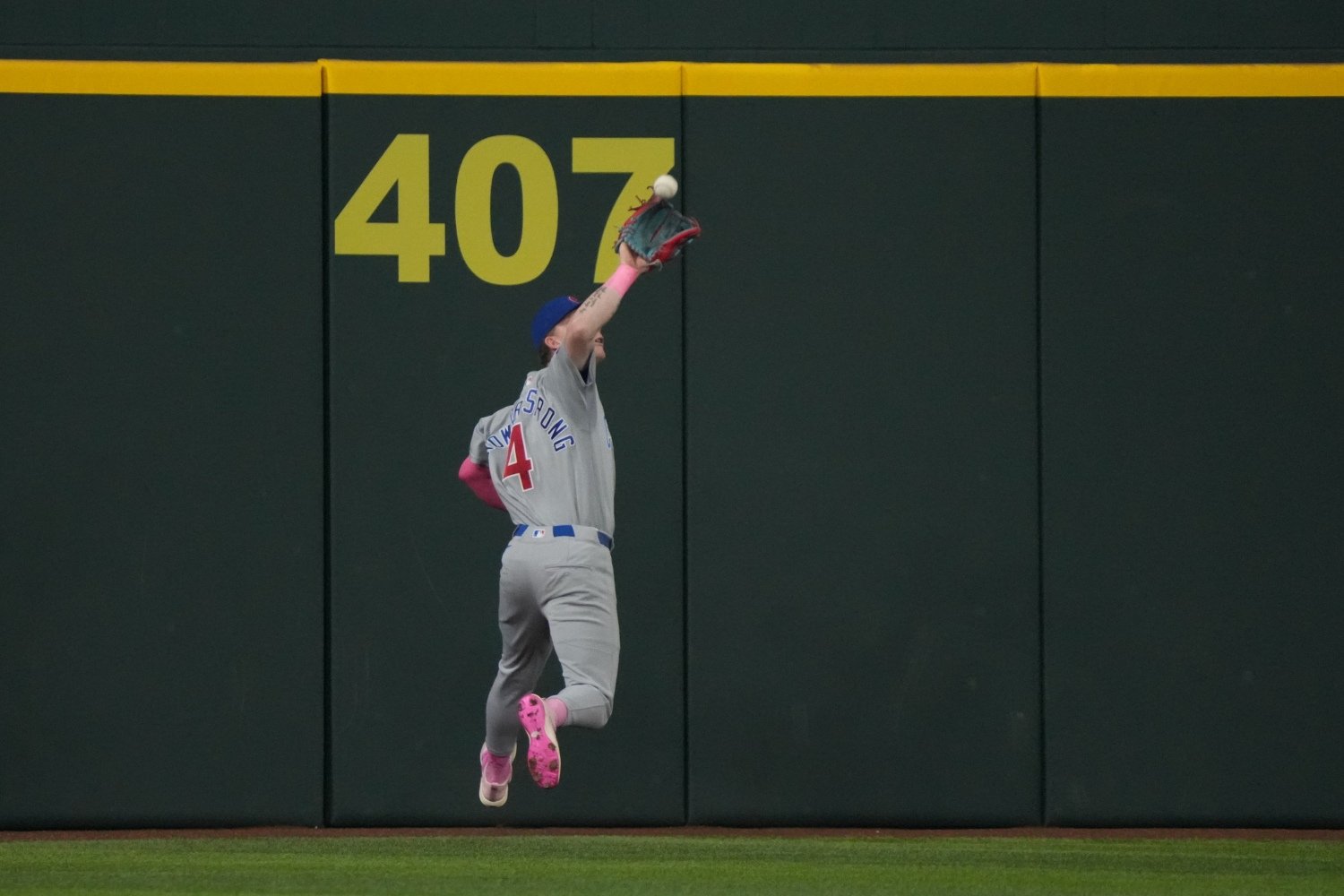
Cubs Video
This might sound a bit joyless, at first, but lately, I find myself trying to catch Pete Crow-Armstrong lacking. It's become a pet project for me. I watch any single to center field against the Cubs several times. Each morning, I refresh Crow-Armstrong's page on Baseball Savant to see what new points have been added to the peculiar pointillist masterpiece that is Statcast's chart of balls hit toward him, with catch probability estimated based on the hang time of the ball and the distance Crow-Armstrong would have had to cover to get to the ball. I want to know: is it possible to hit a ball that any other center fielder could catch, but which Crow-Armstrong can't?
It sounds a little silly, because (as we've already documented) Crow-Armstrong has made a couple of misplays this season. He misplayed a sinking liner during the first week of the season. He misplayed a ball at the wall during the Cubs' trip to Dodger Stadium. But we know those were just hiccups. As if to neatly confirm that, he's made the play on near-identical balls hit his way on other occasions this year. It's possible to be (very slightly) more reliable than Crow-Armstrong in catching routine fly balls, but it's his incredible range extension and the jumps he's using to beat every ball to its spot that make him special. I'm trying to figure out whether there is, in effect, any weak point in the phalanx he forms in the Cubs outfield.
You've probably heard it said, by some broadcaster or other, that if a certain outfielder didn't make a play, it was impossible to make. Andruw Jones had that reputation. So did Willie Mays. Like the apocryphal story of an umpire telling a whiny pitcher that if he'd thrown a strike, Ted Williams would have swung at it, there are a handful of center fielders in the game's history of whom it's been said that if they didn't get there, it was an ironclad, unquestionable hit. In addition to Jones and Mays, Tris Speaker and Devon Whyte enjoyed that reputation. Broadly speaking, it was earned, in all cases.
That doesn't mean it wasn't exaggerated, though. It almost certainly was. The halo effect often leads us to imagine that someone doing 97% of what's humanly possible is really touching or busting that 100% threshold. Jones, for sure, would sometimes be caught flat-footed on sinking line drives in front of him, and at other times, he'd be victimized by balls hit over his head. (He played way too shallow, even for his era.) Great defenders end up being remembered for their highlights, rather than their foibles, and anyway, the balls that separate a superb player from a nigh-supernatural one don't look like mistakes. They look like innocuous hits—balls they couldn't have done anything about.
We can quantify defense much better than we used to, though. We can find those hang times and distances to cover on every ball hit toward a fielder, and Statcast can feed that into their model and tell us where the boundaries of possibility lie. Last summer, Crow-Armstrong made one catch the system thought had a 0% Catch Probability, so we already know he pushes that limit. But how consistent is he? Aren't there some balls falling in at the edges of his range that he could, theoretically, have gotten to?
Don't get mad, but the answer is: yes, and no. Already, though, I think that means Crow-Armstrong is doing something extraordinary and historic.
Here's a ball that caught my eye and raised my suspicions.
Yes, that's a line drive, and yes, Crow-Armstrong was shaded toward left-center, but we've seen him run down balls at least a bit like this one. Was his jump even a half a second slow? Did he fail to accelerate all the way through the catchpoint? Was there a chance missed?
Well, Statcast says no. This hit didn't register as having any catch probability assigned to Crow-Armstrong, and on a closer watch, I'm forced to admit that if there was a failure here, it was one of location: either Shota Imanaga throwing a ball there to Nolan Arenado, or Crow-Armstrong being set up where he was before the pitch. Besides, the elements were against him. Here's the first frame after the switch from the center-field camera to the one high and behind home plate on the play. I've put a square around the ball's position at that moment and a dot where it will land.
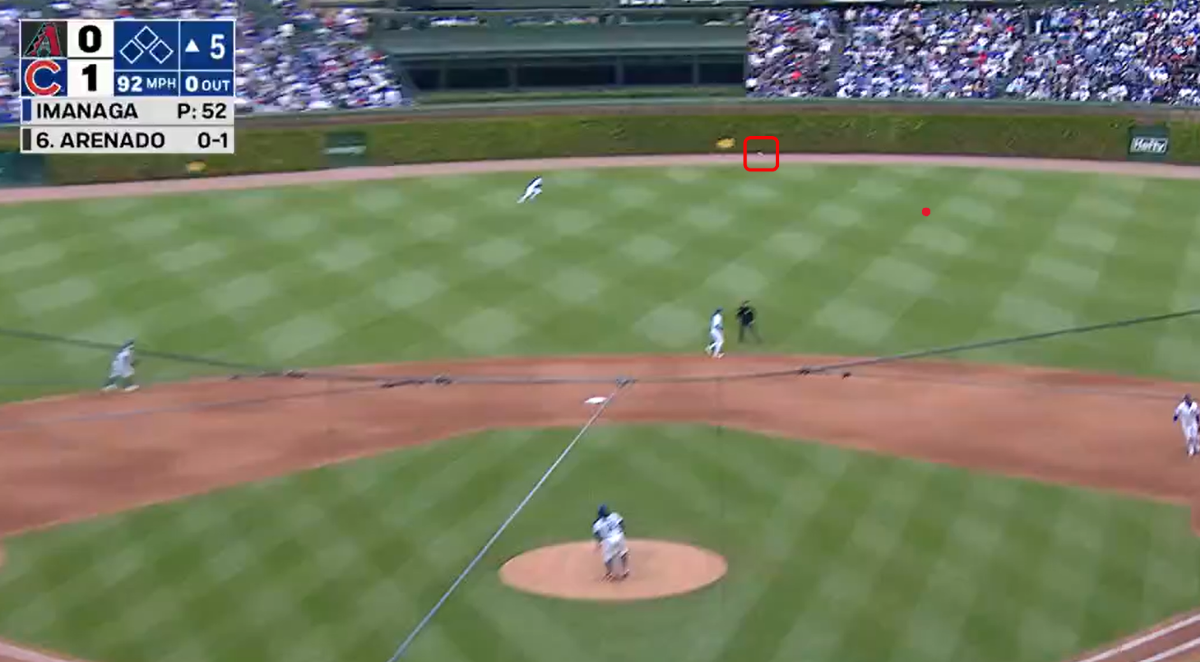
This is a hard-hit ball, but it's both knocked down and pushed toward right field by the wind, in addition to slicing that direction because of its spin. Crow-Armstrong got a great jump, really, but he's 10 feet from the ball when it lands, which was the responsible way to play it, given the only read he could have gotten off the bat. He probably could have gotten much closer to catching it, but I don't think he could have caught it, and the truth of the art of outfield defense is that you occasionally have to play the angles, rather than trying to catch every single ball hit your way. For great outfielders, those plays are rare, but they do happen—especially outdoors, on windy days.
Here's the other play from the first 10 days of this month that had me checking things.
This one feels more like a limitation, right? You can see Crow-Armstrong balk just a bit off the bat. First, then, I checked whether he was caught unprepared when the pitch was thrown. Not so, though. Here's the Gameday 3D animation of Crow-Armstrong and Bleday at (essentially) the instant of contact. The center fielder timed his hop correctly; he was slightly in the air (and on his way down) as the ball passed through the hitting zone. (By the way, how cool is it that we can do this now?!)
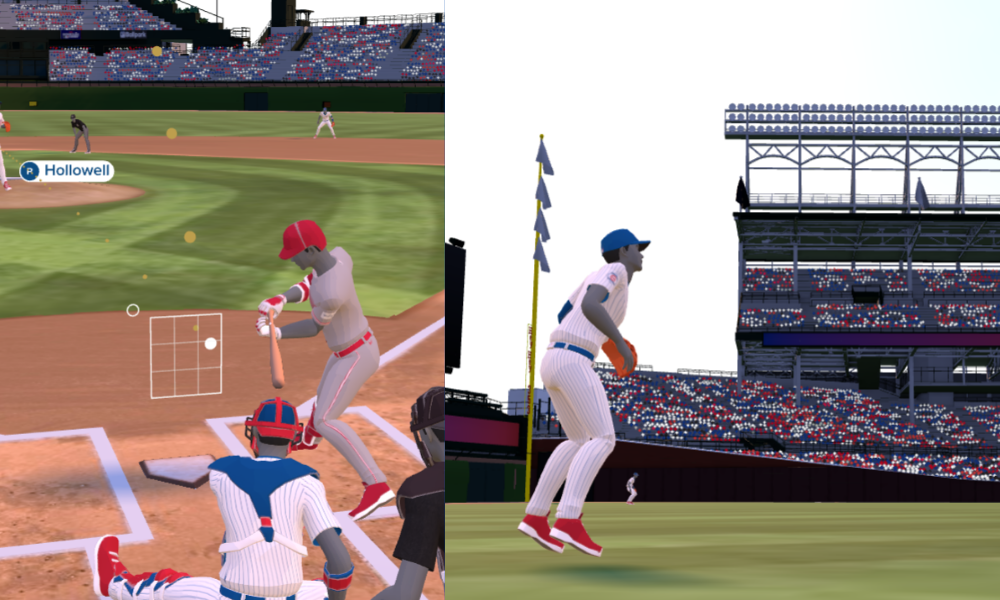
Crow-Armstrong does take a false turn, though. When Bleday makes contact, he initially turns his left shoulder back and takes a half-dropstep with his left leg. All weekend, it seemed, Bleday hit the ball hard to that very part of the park, and Crow-Armstrong might have been caught anticipating solid contact that didn't come. It takes him a split-second to get his momentum moving forward, instead.
By the time the ball falls, you can certainly convince yourself that he should have been able to get there, with a better jump. He's much closer to this one than to the Arenado ball, and his jump was clearly worse. So the question becomes: was a better jump possible? Could any other outfielder have made this play better?
Here's one piece of what looks, at first, like damning evidence. It's from a Marlins-White Sox game on the other side of Chicago, last season.
That's a heck of a catch, by Dane Myers—now of the Reds, as it happens. But Statcast didn't even rate it as overwhelmingly impressive. It gave a 95% catch probability on the ball. Yet, it didn't ding Crow-Armstrong at all for not catching the Bleday bloop. His catch probability on it was 0%, as far as the model is concerned.
First, let me explain that briefly. I picked the above catch by Myers because it was the only ball since the start of 2025 that fit the same contact constraints as Bleday's (a 77-79 MPH exit velocity, a 33-35° launch angle) and was hit to center field, but which was hit as shallow or shallower than Bleday's. It's not hard to see that the wind played with both balls. Without wind (and with truer batted-ball spin), most balls hit like this travel an extra 10-20 feet, which makes them relatively easy to catch. These two are good foils for each other. They were hit relatively high, but they weren't really pop-ups, and they weren't hit hard enough to go a long way, but they were clearly over the infield. Conditions kept each from flying very far, though. Already, these are extreme plays, in terms of where the ball ended up relative to what the outfielder could reasonably have hoped to read off the bat.
Two things separate the two plays in important ways. First, Tim Elko's flyout to Myers hung in the air a hair longer. Its hang time was 5.0 seconds, which is a lot of time to run under a ball. Bleday's wasn't much less, but slightly so. That left Crow-Armstrong with less time to make up for that misstep off the bat.
Secondly, though, Crow-Armstrong was playing deeper than he usually does on his play. With two outs in the ninth inning of a game that wasn't especially close, and with a batter in the box who'd showed good power in the series, he was 326 feet from home plate when the pitch was thrown. Myers was only 318 feet from home when Edward Cabrera threw his pitch to Elko last year. One could pick nits with the Cubs' positioning, perhaps, but it seems like Crow-Armstrong was in a smart spot, in general. On this particular ball, it just left him with zero margin for error. The combination of these two factors means Myers had a good 15 feet on Crow-Armstrong, before accounting for Crow-Armstrong not getting a clean first step on the ball. It's not such a wonder, then, that two similar balls produced Statcast estimates at extreme ends of the catch probability spectrum.
Here's the crazy takeaway: Crow-Armstrong could have caught this ball. That's true, even though Statcast absolutely would have regarded it as uncatchable, anyway. He could have drawn an earlier bead on the ball, but misreading the contact is almost a necessary part of this unusual piece of contact. Were the stakes higher, however, he probably would have dived for it—and he might have had a play.
It's getting very, very hard to find balls Crow-Armstrong can't catch that are (in any realistic sense) catchable. That doesn't mean he's perfect. But as we've discussed before, he's pushing the boundaries of defensive possibilities. Hitting the ball to center field just isn't a viable option for Cubs opponents. Crow-Armstrong is, in some sense, a fulfillment of the hype attached to so many generational center fielders before him. He might force us to reconsider what the position can be.






Recommended Comments
Create an account or sign in to comment
You need to be a member in order to leave a comment
Create an account
Sign up for a new account in our community. It's easy!
Register a new accountSign in
Already have an account? Sign in here.
Sign In Now