


Cubs Video
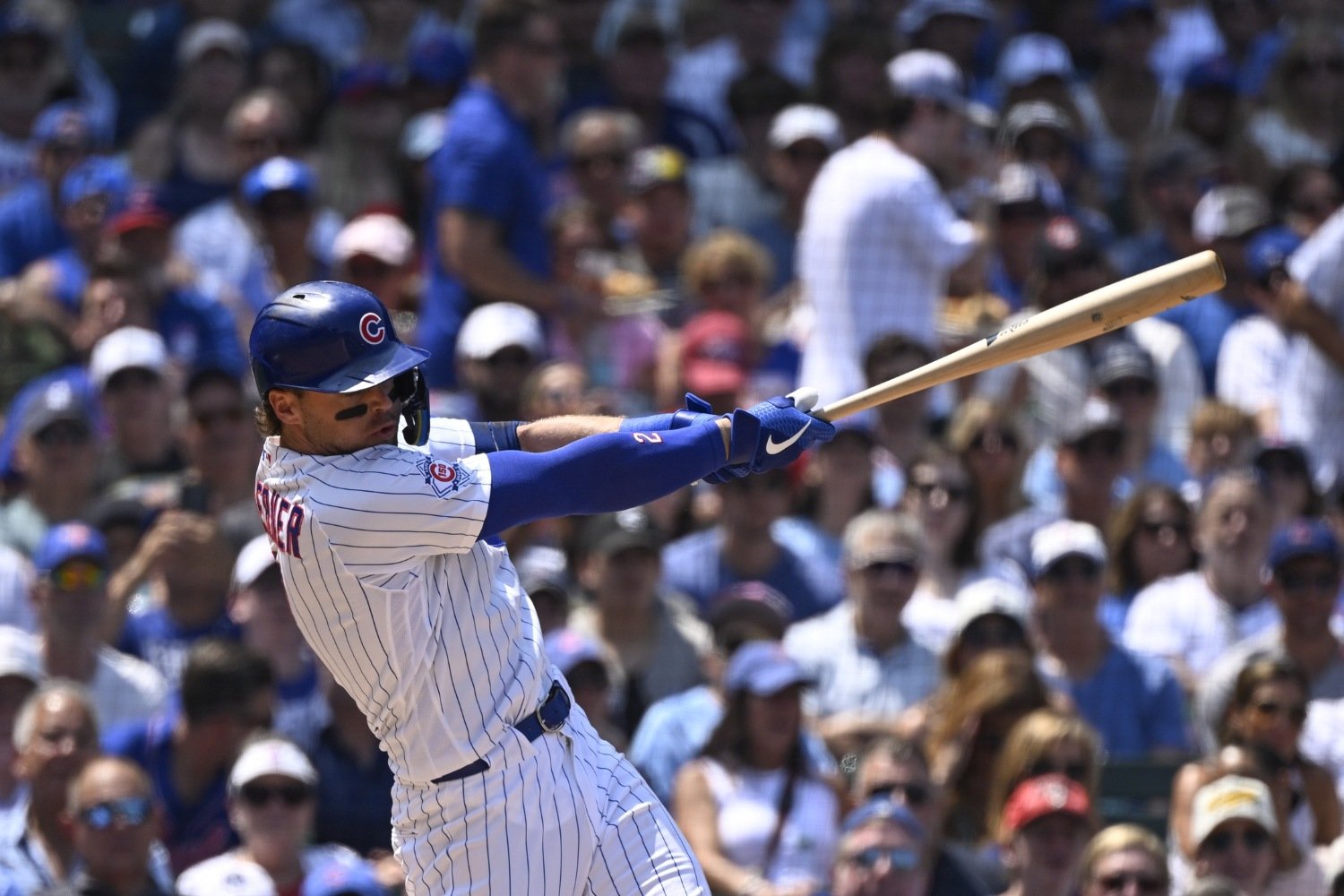
As far as hitting coach John Mallee's concerned, Nico Hoerner was never even slumping, really. He just got unlucky for a while.
"Look, some years, you hit .300, and other years, you hit .250 or .260, just because of whether it’s finding gloves," Mallee said Sunday. He watched Hoerner square the ball up relentlessly from late April through the end of June but find lots and lots of gloves.
From April 24 through July 1, in fact, Hoerner batted an anemic .213/.288/.272, with a .228 BABIP. In that time, he hit 14 doubles, but no home runs, and despite walking more times (24) than he's struck out (17) in 267 plate appearances, he was hurting the Cubs lineup, rather than fueling it. Yet, Mallee was unworried, and Hoerner never got the reset sitdown manager Craig Counsell gave to (in turns) Moisés Ballesteros, Ian Happ, Alex Bregman, Seiya Suzuki and Dansby Swanson.
Why not? What prevented panic, about a player who had just signed a lucrative nine-figure deal and was so deeply mired in the muck for so long?
"I’ve never been around a more winning player, more dedicated to the work and demanding of himself, other than maybe Mike Trout," Mallee said of Hoerner, unashamed to gush a bit about a favorite pupil. His faith in Hoerner never wavered, because he never saw a breakdown in Hoerner's trademark tenacity.
Over the last three weeks, Hoerner has begun to reward the confidence of both his manager and the coaching staff—though only begun to do so. He had two hits Friday and four Saturday, but still entered Sunday's series finale against Minnesota hitting .268/.279/.317 in his last 11 contests. He's not red-hot again, or anything, but something has changed.
"You can see him getting more aggressive," Mallee said. "You could see it, the frustration of it, it did affect him a little bit. Now, he’s relaxed, and when he’s getting that pitch, he’s on time, he’s on it."
A more aggressive Hoerner will be more prone to strikeouts and less likely to get on via the walk, but swinging more is a sign that he's feeling better about his swing. There's some reason for that, too. Let's talk about the newest creation of the FanGraphs Lab: the squared-up explorer tool.
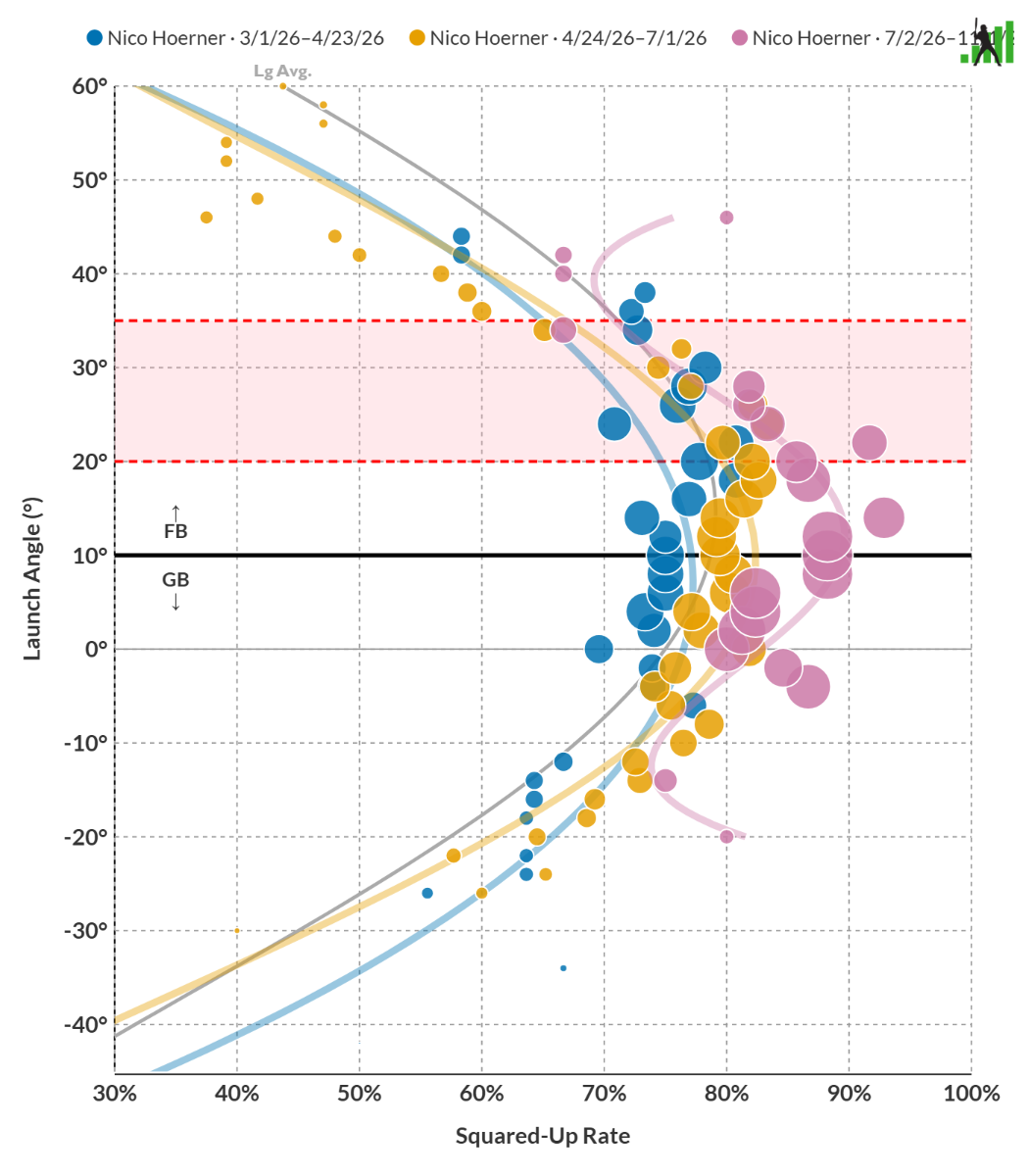
These are the distributions of Hoerner's batted balls in each of the three segments into which we've broken down his season—the scalding start; the long downturn; and the recent rebound—based on launch angle and Squared Up percentage. Each batted ball is plotted based on the percentage of the theoretically possible exit velocity (given the speeds of both the swing and the incoming pitch) realized, and on its launch angle. Rather than show the chaos of each individual point, though, the frequency of batted balls falling into each relevant bucket are represented by those bubbles you see, and the relationship between the two variables being studied is expressed by smoothed curves.
Early this season, when he was not only hitting for average at a superb clip but slugged a surprising four homers in the first four weeks, Hoerner hit a good number of balls in the 20-40° launch angle band, nearly all of which were squared up fairly well. That period is the set of bubbles and the curve in blue. Then came the slump, in yellow. Note how he not only lifted true fly balls less often, but met the ones he did hit much less cleanly. He was technically squaring the ball up more consistently, and the balls on which he was doing so tended to be in the 0-20° launch angle band where a lot of hits should be. They weren't showing up, though.
"There are two ways to be unlucky, too," Mallee theorizes. "One is, you’re squaring up balls, but they’re just not going where you expect or you want them to. And the other way, sometimes, you hit it and there’s a guy standing there, waiting. And Nico had a little bit of both."
In other words, by his coach's reckoning, Hoerner was getting profoundly unlucky, because none of his schtoinkers were landing—the kind of good luck to which a great contact hitter should occasionally be entitles—and all of his line drives were dying a hair short or not quite splitting the gap. We can visualize that, too, in a slightly different way.
Here's the heat map showing where Hoerner hit the ball most often during his great start to the season.
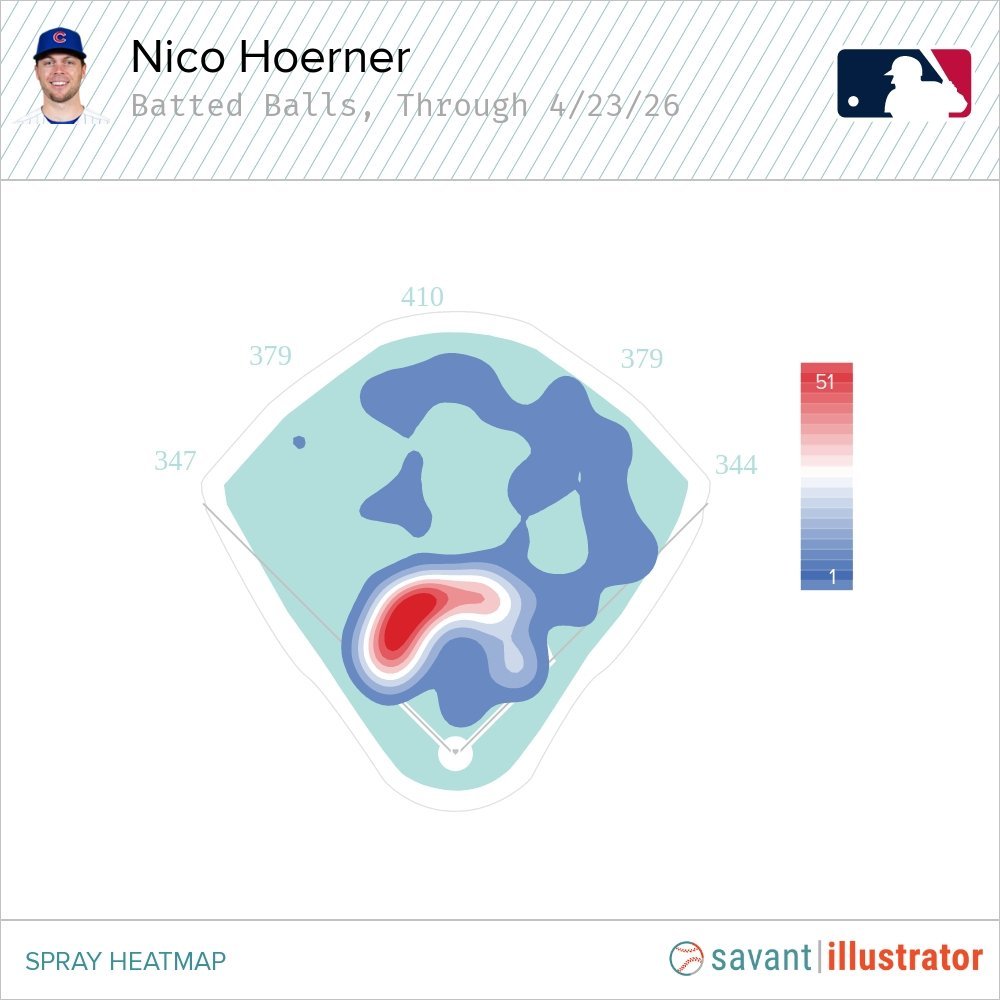
This looks relatively unimpressive, compared to a similar chart for a star slugger like Pete Crow-Armstrong, but this is what it looks like when Hoerner is going well. He hits a lot of hard ground balls and low line drives to left field; he hits a good number of line drives to right field. He doesn't hit the ball to center field very much.
Here's the slumping Hoerner's spray heat map.
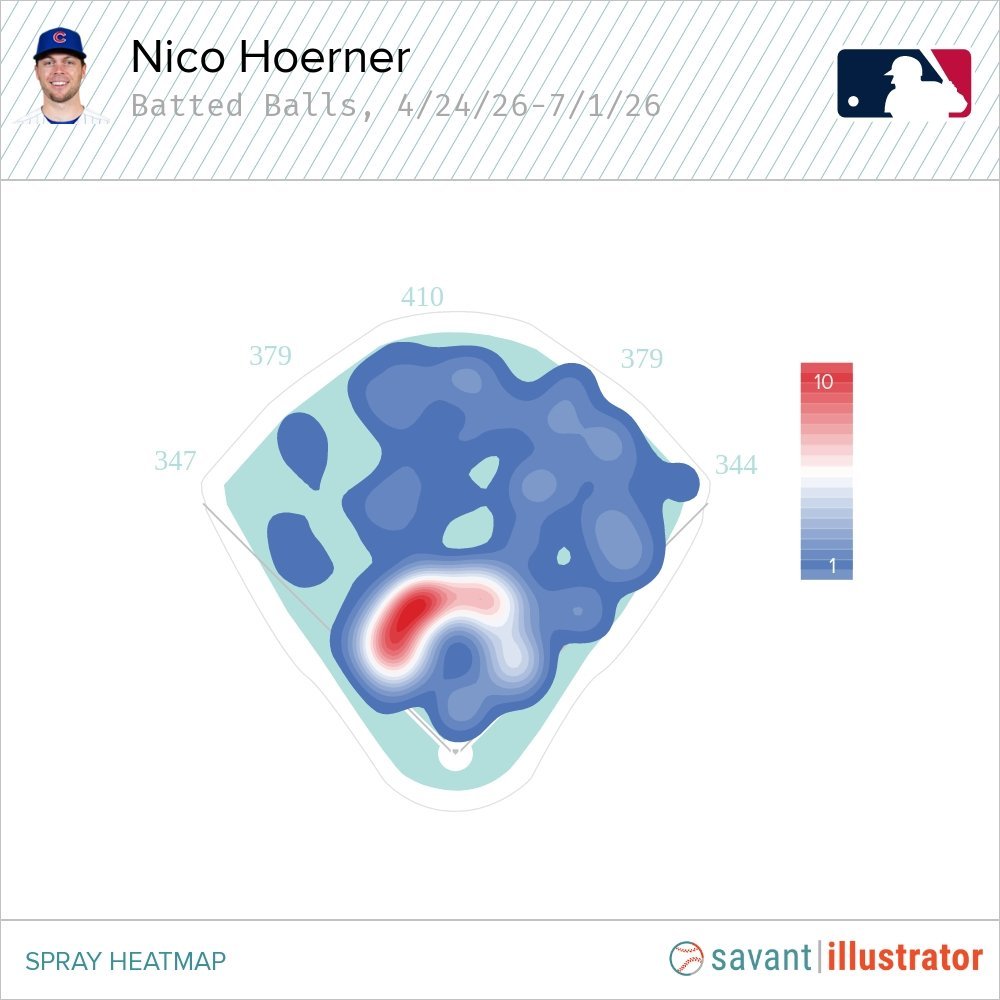
People talk about hitting the ball "to the big part of the field," like the sheer vastness of center field is a guarantor of hits falling in. Not so, as Hoerner learned the hard way. He tried not to change anything, but acknowledged that it was hard—and that he needed to remain open tto change, lest he "get stubborn" and miss his chances to escape the slump.
"I think the challenge is, no matter what the results, I want to help the team, and so sticking to my routine was important," Hoerner said Sunday morning, before collecting two more hits as the Cubs routed the Twins. "Trusting the coaches and trusting myself. It can be frustrating, but that’s our game; there’s a lot of randomness in this game. My approach stayed pretty similar. You want to make enough changes to get out of it, but you don’t want to change too much and lose what makes you good."
Finally, recently, that diligent work and that intensity have paid off. Here's Hoerner's heat map for the last three weeks, showing that even if his process stayed mostly the same, he began to find ways to direct the ball that eluded him for a long, long time.
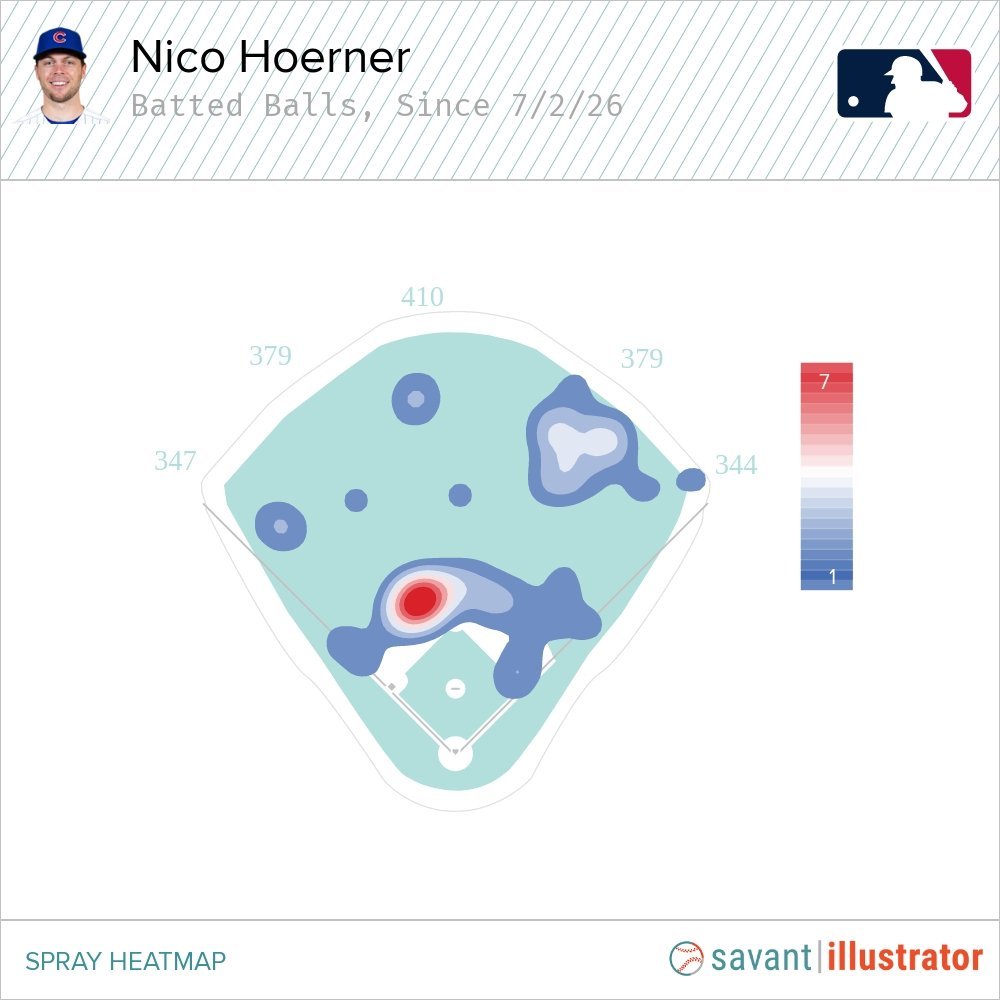
Ironically, one of his hits Sunday—initially ruled a bases-clearing triple, though it should and could be changed to a single and a two-base error by Twins center fielder Luke Keaschall, who was playing too deep and then got handcuffed by the ball as he tried to play it on the bounce—came on a line drive to dead center. Call it corroboration of Mallee's theory that Hoerner was getting unlucky and was due for a bout of better fortune, even if there was also some deeper level of analysis to be done and some minute adjustment that needed to be made.
Broadly, at least, the manager agrees with both coach and player.
"Nico is one of those hitters where sometimes it’s really hard to evaluate, because the ball is just always in play," Counsell said. "You can say Nico’s struggling, but like, in Cincinnati, Nico swung the bat good, just like he did [Saturday], but no results. The ball doesn’t go over the fence that much, and he doesn’t strike out. So the fielder has an opportunity on every play to catch his ball. [Saturday] they didn’t; in Cincinnati, they did. But it’s kind of the same him.
"That’s baseball. That’s part of it. But I think what happened [Saturday] was, line drives to the opposite field. That’s always a sign for everybody that he’s [right]."
Counsell is right about that, though it's only half the story. Hoerner also needs the line drive to the pull field to be his best self, and he did have one of those Saturday, too. He chalked up another in the fourth inning Sunday, lacing a ball to left field for a clean single. Over the two-plus months in which he was hitting .213, it must have seemed like fielders had opportunities to make a play on everything, but when Hoerner gets going, he hits balls that are as undefendable as if they'd landed five rows deep in the bleachers—just for singles and doubles, rather than homers.
Going back to the first visual in which we saw Hoerner's squared-up profile evolve throughout the season, yoyu can see that he's doing that more often right now. He's hitting a lot of balls extremely squarely, and nearly all of them are in the launch-angle range where they have a good chance to be a single and at least some chance to for extra bases.
As any good hitter or hitting coach will tell you, the key to producing those perfectly struck balls lies in getting the right pitch. Doing that means not expanding one's zone overmuch, though it also means covering the zone thoroughly—and closing holes in your swing. Hoerner had two hits on high, upper-90s fastballs on Saturday, much to Mallee's delight.
"Yeah, got to 98! It was great," Mallee enthused. "Any time you can take something off the scouting report, force them to change that, it always helps. And then when they have to throw that low ball, he can crush those."
Hoerner doesn't like to spend much time studying what opposing pitchers are throwing him, but if he can force them to change tack while staying locked in on what he wants to do, that's a win.
"It absolutely helps. I haven’t been in the game that long, but it’s always evolving, they’re always trying to find new ways to get you out," Hoerner said. "So anything you can do to disrupt that is great, but I don’t want to go up there overthinking what a given pitcher is trying to do against me. It’s more staying in my strengths and focusing on what I’m looking for."
For a long time, that's not how his at-bats were actually unfolding. Now, though, Hoerner seems to be back in his groove. The hitting coach, the manager and the player all downplayed the extent to which his lackluster production was ever a source of concern. It should have been one, at least—but it probably needn't be now. The slump is over, and a new streak is very much underway.





Recommended Comments
Create an account or sign in to comment
You need to be a member in order to leave a comment
Create an account
Sign up for a new account in our community. It's easy!
Register a new accountSign in
Already have an account? Sign in here.
Sign In Now