


Cubs Video
Making sense and use of weather data about baseball games is difficult. No publicly available sources give the temperature, humidity, wind speed, and wind direction for each pitch and batted ball. Instead, we have to try to use large samples of data to smooth out the fact that, within a given game, the temperature might change 15 degrees, and the wind might gust and die or swirl and reverse course. All of the data points within such a game will have the same weather data attached to them.
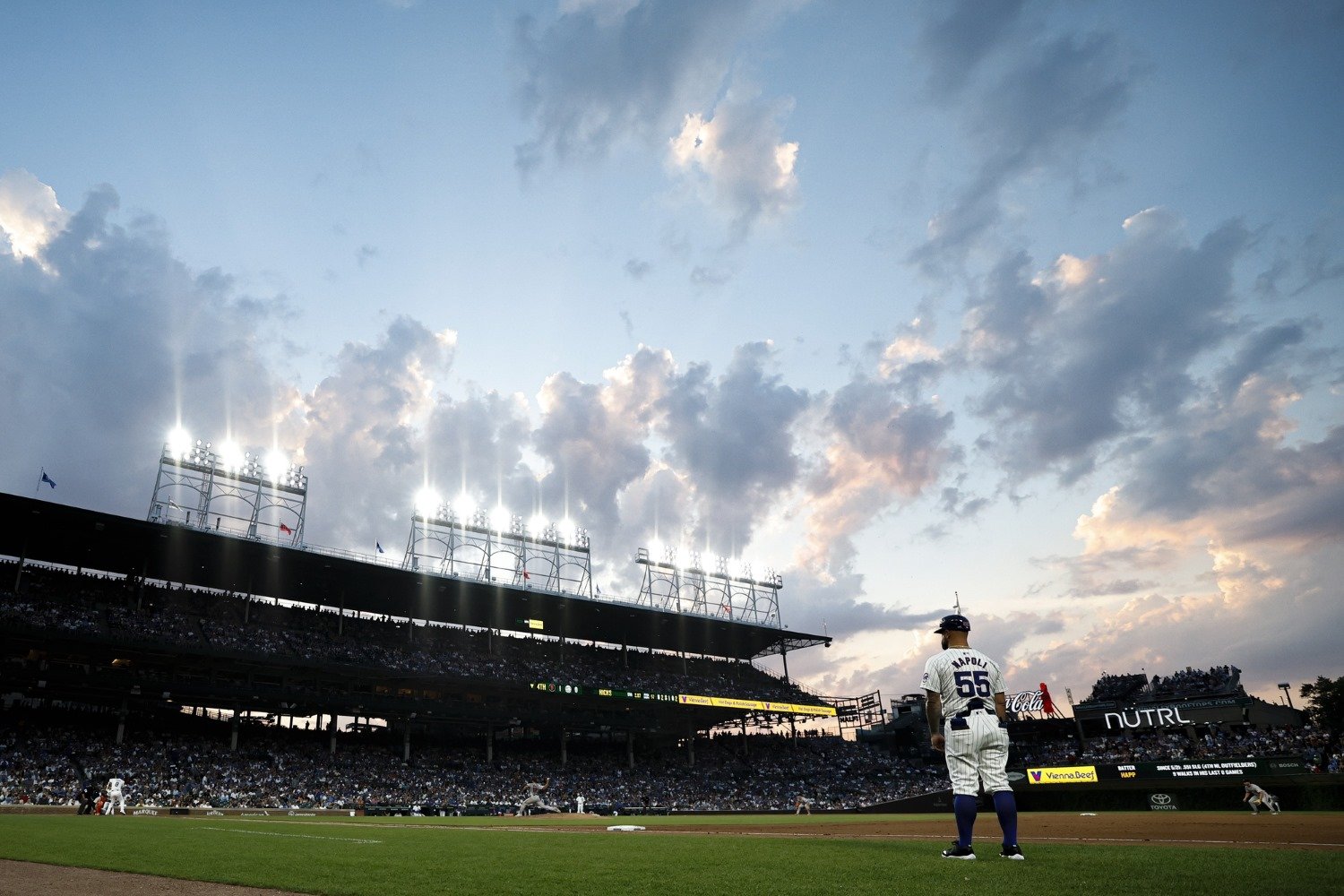
Still, we do have (relatively) comprehensive data going back to 2004, and that gives us a large enough sample to do some of that analysis. When it comes to Wrigley Field and its (historically) highly weather-dependent influence on the run environment, that's an especially good sample for study, because roughly halfway through that period, the renovation happened. That's when the outfield walls and the bleachers were torn down and rebuilt, and when huge video boards increased the height and breadth of enclosing features above those bleachers. Since that happened, many observers believe, there have been some changes to the way the park plays, and to how the wind affects that.
Let's not trust the wisdom of crowds on this one. There's too much noise competing with the signal. Instead, we can turn to the data, so let's do so. I've broken down all games into pre-renovation (2004-14) and post-renovation (2015-24), and created five wind designations for the games:
- Hard In: Blowing in at least 7 MPH
- Soft In: Blowing in, less than 7 MPH
- Crosswind and Calm
- Soft Out: Blowing out, less than 7 MPH
- Hard Out: Blowing out, at least 7 MPH
Based on those dividing lines, here's how Wrigley Field has played:
|
Pre-
|
Post
|
|||||||||
| Wind Speed, Dir. | AVG | OBP | SLG | HR/FB | Wind Speed, Dir. | AVG | OBP | SLG | HR/FB | |
| Hard In | .246 | .317 | .374 | 9.3% | Hard In | .234 | .315 | .366 | 13.0% | |
| Soft In | .252 | .323 | .400 | 11.4% | Soft In | .238 | .317 | .382 | 14.8% | |
| Calm or Crosswind | .255 | .325 | .408 | 12.0% | Calm or Crosswind | .239 | .317 | .391 | 17.2% | |
| Soft Out | .265 | .332 | .456 | 16.3% | Soft Out | .253 | .320 | .445 | 21.7% | |
| Hard Out | .283 | .348 | .503 | 18.0% | Hard Out | .264 | .335 | .478 | 23.4% |
The trick here isn't in finding or presenting the data; it's in the many-layered interpretation of it. Overall, you might be tempted to note, offense is down at Wrigley in the last decade. Comparing these two decade-long data sets is treacherous, though, because within each, there have been changes in the league's overall run environment. From 2004-08, the league was very much still in the late stages of the double-expansion era, still juiced up a little, and runs still scored in bunches. Then, from roughly 2012-14, there was a deep valley for offense. The two stretches partially cancel out, but it's hard to strip those changes out of the numbers above.
It's hard, too, because of how much has changed about the ways in which teams score runs over that 20-year period. At a glance, we would say that it's clearly easier to hit homers at Wrigley now, but that's not about Wrigley, per se. It's about, in equal measure, a game that has moved toward emphasizing power more with each passing year, and about the ball being very, very aerodynamic from 2016-19. In 2007, 11.2% of fly balls league-wide left the park. In 2017, that number was 17.7%. It's not Wrigley making more fly balls leave Wrigley; it's the hitters and the ball.
So, strip that away, and the best we can do is compare the relationships between each row of that table, on the left side and on the right. Doing that, I would boil down the above to the following conclusion: power is a bit less elastic, less based on the wind, than it was before the renovation. The theories about the boards blocking some wind blowing in, but also stopping and creating eddies in the wind when it's blowing out, hold up. The effect is small, but yes, Wrigley's a little bit less of a wind-altered park than it used to be.
While we're here, let's take a look at the same table, but using temperature instead of wind as the variable.
| Pre- | Post- | |||||||||
| Temperature (deg. F) | AVG | OBP | SLG | HR/FB | Temperature (deg. F) | AVG | OBP | SLG | HR/FB | |
| Under 60 | .246 | .322 | .378 | 9.9% | Under 60 | .232 | .317 | .366 | 13.1% | |
| 60-70 | .254 | .322 | .404 | 11.9% | 60-70 | .237 | .314 | .378 | 14.8% | |
| 70-80 | .262 | .328 | .432 | 13.6% | 70-80 | .241 | .316 | .400 | 17.5% | |
| 80+ | .273 | .340 | .466 | 15.8% | 80+ | .259 | .329 | .456 | 22.8% |
This data interests me more. Over the last decade, Wrigley has played more like a bandbox when the peak of summer has come. Looking at the pre-renovation numbers, you can make a strong argument that offense was more responsive to temperature than to wind. Looking at the post-renovation ones, you can say that the effects of temperature seem to be muted, now, until we hit the 80s--but then it's more dramatic than ever.
The game is evolving away from being very responsive to weather effects. Strikeout rates and walk rates change little when the wind shifts or the mercury rises. From 2004-14, the average strikeout rate in games at Wrigley was around 19.5%. Since 2015, it's been around 23%. Walks are pretty much flat, but perhaps a tick higher, too. That difference makes the impact of weather smaller, and washes it out a bit.
We can still say, I think, that some things have changed. Wind changes things less than it used to at Wrigley. Temperature does, too, except when it gets really hot--at which point, it has a bigger effect than ever. That's all only when contact is made, though, and the fact that the game involves less contact than it used to matters more than any of this.
There are still crazy days at the park, when things like this happen.
Such games are much less common than they used to be, though. They're less common than they were in 2017, when Happ hit this dinger, and they were less common then than a decade before. Part of that is due to the changes in the architecture of the park and the surrounding city, but a greater part is due to the undercurrents of the game's evolution. Wrigley is less distinct and less fickle than it used to be, but that's true of all the other parks old enough not to smell like fresh paint and taxpayer dollars, too.





.thumb.JPG.19c99ddd60a76edf810c77d321439828.JPG)


Recommended Comments
There are no comments to display.
Create an account or sign in to comment
You need to be a member in order to leave a comment
Create an account
Sign up for a new account in our community. It's easy!
Register a new accountSign in
Already have an account? Sign in here.
Sign In Now