


Cubs Video
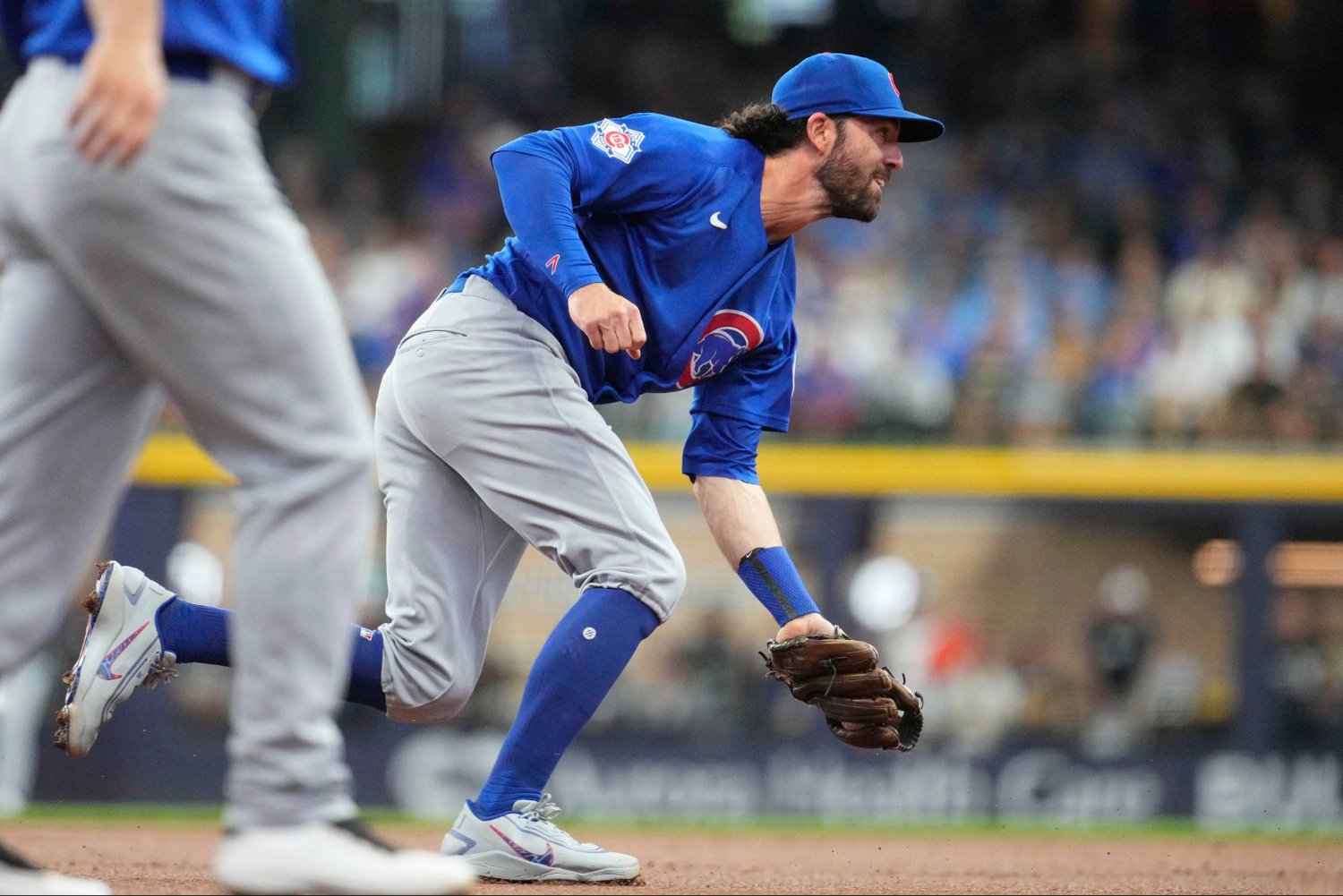
To love Dansby Swanson as the starting shortstop for the Chicago Cubs is to accept him for what he is. Unfortunately for Swanson, the 2026 season actually made what he is a touch murkier while having the subsequent effect of sapping the love he might've generated from the team's fanbase nearly out of existence.
Such is life when your slash line at the end of the season reads a mere .213/.297/.397. When your wRC+, at 93, sits at its worst mark since 2019. When your contact rates remain pretty similar and you can draw a walk, but you lose seven points on your hard-hit rate. Things that weren't necessarily overt concerns for Swanson in his first handful of seasons with the Cubs have definitely emerged as so, which makes what lies beyond the 2026 season quite difficult to project.
Prior to this year, there were certain truths that one had to accept about Swanson. The first was that there's an inherent streakiness to his game. In 2025, he had months where his wRC+ sat up at 138 and 114 but also months where it was 76 & 81. It was true in 2024, as well, as Swanson went for wRC+ figures of 111, 120, and 140 across three separate months while also enduring months of a 39 and a 63 wRC+. It was a truth that we saw play out in an even more severe fashion in 2026.
Swanson got off to a decent-enough start. He wRC+'d 118 in in the season's first month, combatting some awful batted ball luck (.224 BABIP) with the ability to draw a walk (16.4 BB%) and provide occasional power (.224 ISO). That's how one overcomes an early .214 batting average. Unfortunately, the following month saw him lose his ability to make quality contact while still wrapped up in his battle with the BABIP monster, leading to a walk rate that was cut in nearly in half (9.6 percent), an ISO that fell all the way down to .065, and an absolutely miserable 30 wRC+. The rest of the season, unfortunately, kept trending in that direction.
The power was there in June even if the strikeouts went up and the walks continued to decline. Then, his ISO fell by over 100 points in July, along with a strikeout rate below five percent. In August, that wRC+ was back up to 125, with a walk rate near 14 percent and a .209 ISO before an oblique injury sent him to the shelf for much of the rest of the year. When he returned, any chance of regaining form was apparently lost as he limped toward the finish line (52 wRC+ in September).
So, while Swanson's inherent streakiness was very much present in 2026, it also manifested differently. Some months, there was an approach. Others, there wasn't. Some months, he had power. Others, it was gone altogether. In general, we're accustomed to seeing Swanson succeed when he hunts fastballs to the point where he even overdoes it. The 2026 season, thus, lent itself to far more questions than answers regarding what lies ahead for the 32-year-old.
The most discernible of the trends from Swanson's season are in his timing. There weren't too significant of changes in his mechanics, but timing certainly stifled his ability to make quality contact:

The off-speed element here is particularly notable. Swanson was early and over off-speed pitches quite often, hence a 50.0 percent groundball rate on that pitch type for the season. He also managed a hard-hit rate of just 38.9 percent against that pitch type. That would be less of a problem if it didn't serve as the pitch type at which he swung at the highest rate in three out of the six months of the year.
So, while some of the trends—like a higher overall walk rate, poor batted ball luck, or more isolated slugging—may try to tell us that Swanson is doing something differently, the issue really is the same as it's always been: He is swinging at the wrong pitches. And this isn't even from a zone standpoint, as many of his zone trends and plate discipline metrics are in-line with recent years. This is an inability to recognize pitches and opposing pitchers continuing to maximize their own results while Swanson endures shorter stretches of good play than he used to.
Swanson is under contract for another three seasons at a pretty high price point ($28 million in 2027, which then decreases by $1 million in each of the two subsequent years). It's an immovable contract and one the team would likely be unwilling to eat. His bat, as he continues to rack up vacuous plate appearances, appears entirely unlikely to earn that pay.
At least the defense is still elite.






Recommended Comments
There are no comments to display.
Create an account or sign in to comment
You need to be a member in order to leave a comment
Create an account
Sign up for a new account in our community. It's easy!
Register a new accountSign in
Already have an account? Sign in here.
Sign In Now