


Cubs Video
It would be unfair to suggest that the Cubs haven't gotten contributions from homegrown players signed as amateur international free agents over the last decade. Three such players amassed at least 2 wins above average for the team at age 27 or younger from 2010-24: Welington Castillo, Willson Contreras, and Javier Assad. Beyond them, there are players whom the team traded for key pieces of their various contending teams, from Starlin Castro to Gleyber Torres, Eloy Jiménez, Jeimer Candelario, and Isaac Paredes--two of whom have come back to the team later on in their careers. The Cubs front office has decided to trade a few of the successful prospects they've developed after signing them from the Dominican Republic, Venezuela, and Mexico, rather than holding onto them and trying to realize that latent value by developing them into homegrown stars.
Still, this is a bad track record. If we can slough some of the blame for players who were traded and then failed to live up to their ceilings off onto the organizations who acquired them, we also have to acknowledge that the Cubs haven't even turned the international prospects they've signed and kept into useful role players--let alone stars. Castillo and Contreras were both signed before the Ricketts family even bought the team, and Castillo never became a true star, even for a moment. Injuries derailed countless promising players, but so did systematic failures of scouting, acquisition, and development.
We live in an era defined by Ronald Acuna Jr., Juan Soto, Fernando Tatis Jr., Jackson Chourio, Elly De La Cruz, Rafael Devers, Yordan Alvarez, Vladimir Guerrero Jr., José Ramírez, Starling Marte, Julio Rodríguez, Ketel Marte, Sandy Alcántara, and Luis Castillo. That list isn't even close to exhaustive, but it exhaustively demonstrates the point. There is huge, often unmatchable value in finding and developing stars through this market. The Cubs are disastrously bad at it.
Every year, a division rival seems to call up a new player who poses long-term problems for the Cubs. In 2023, it was De La Cruz. In 2024, it was Chourio. The team is lucky that the Cardinals misevaluated Adolis García and Randy Arozarena. Otherwise, they might already have fallen even further behind the curve. Oneil Cruz, though initially signed by the Dodgers, was traded to Pittsburgh when he was 18 and is now finding himself as a budding star for the Pirates.
That Cruz and Alvarez were both signed first by the Dodgers--and that Jasson Dominguez is a member of the Yankees--reminds us that getting ahold of top talent doesn't have to be a priority only for smaller-market teams. The rules changes around signing international amateur free agents that took effect in 2012 did make it harder for big-market teams to compete for top talent, but they've kept finding it, and some of those teams are doing much better work than the Cubs when it comes to developing the players they acquire.
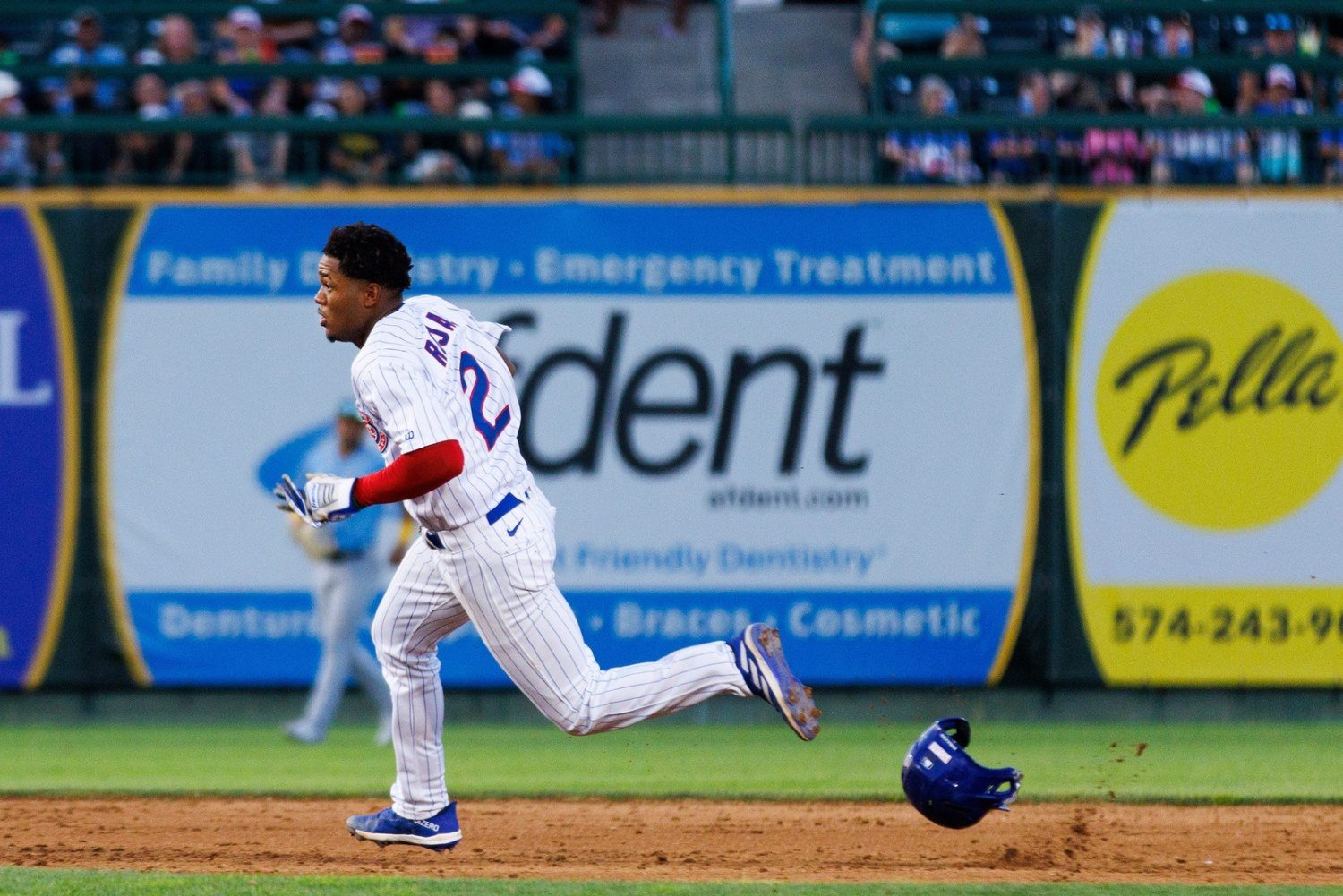
Hype has not been in short supply. The team signed Cristian Hernandez to a high-dollar bonus in 2021; Jefferson Rojas to one in 2022; Derniche Valdez to yet another in 2023; and Fernando Cruz for $4 million earlier this year. It's too early to fully assess any of those players, but Hernandez and Rojas have given the team consecutive seasons of the same experience:
- Hot young prospect wows many over offseason, is talked about as potential superstar and breakout player.
- Hot young prospect gets aggressive assignment when minor-league season begins.
- Hot young prospect essentially flops, and their star dims going into next season.
Development need not be linear; the team could help these guys turn things around and fully tap into their tools. Alas, in the modern game, it's not a good sign when it takes a while for young player to catch fire in the low minors. Chourio, Tatis, Rodríguez, and Acuna didn't need to survive sidetrack seasons; they were good big-leaguers by Hernandez's current age.
Has the team's investment in the international market gone only press release-deep? Are they funneling almost all their bonus money to one high-profile prospect, to make news and generate some hype, without real hope of getting a return on that investment? Or do they view that as the best way to turn things around and find a homegrown star? Either way, the results suggest that a change in tack is needed. Since Theo Epstein took over the team after the 2011 season, the only unmitigated, wire-to-wire success--the only guy they identified and acquired as an amateur, helped along and extracted real production from, and then signed to a deal to keep around into the middle of their career--is Ian Happ, who cost the team a valuable, non-renewable resource: a top-10 first-round pick.
This organization desperately needs a star they create out of almost nothing, and then retain as a difference-maker for 10 years, the way all the teams who found and developed the long list of superstars above had a chance to do. Until that happens, it's hard to take their stated ambition to be a perennial contender seriously. The lack of just that kind of player and cost confluence is what's holding them back from it.





Recommended Comments
Create an account or sign in to comment
You need to be a member in order to leave a comment
Create an account
Sign up for a new account in our community. It's easy!
Register a new accountSign in
Already have an account? Sign in here.
Sign In Now