


Cubs Video
With the exception of the two-year stretch when Dexter Fowler held it down, it seems like the onset of each year brings new conversation about the Chicago Cubs’ leadoff spot. A true, consistent leadoff hitter just feels like one of those things that has regularly eluded the organization.
For the most part, this is a conversation we likely won’t lean too heavily on as the season approaches. It’s Ian Happ’s role to lose. Happ represents the most logical candidate for the top spot in the lineup, especially with Nico Hoerner’s availability somewhat up in the air in the short term. Happ is kind of exactly what the modern leadoff man looks like: a steady approach and subsequent on-base presence. Even if the speed isn’t there, a certain level of baserunning acumen is. His numbers are reflective of exactly that.
Happ’s 4.12 pitches per plate appearance (P/PA) ranked 22nd of 131 qualifying players last season. His 27.1 Chase% was the 27th-best of roughly that same group. He was able to parlay that patience into the eighth-best BB% (12.2) and, as a result, a .341 OBP that sat 35th. There are some other intricacies at play, but as far as broad strokes go, Happ’s skill set is certainly best suited to continue in that capacity.
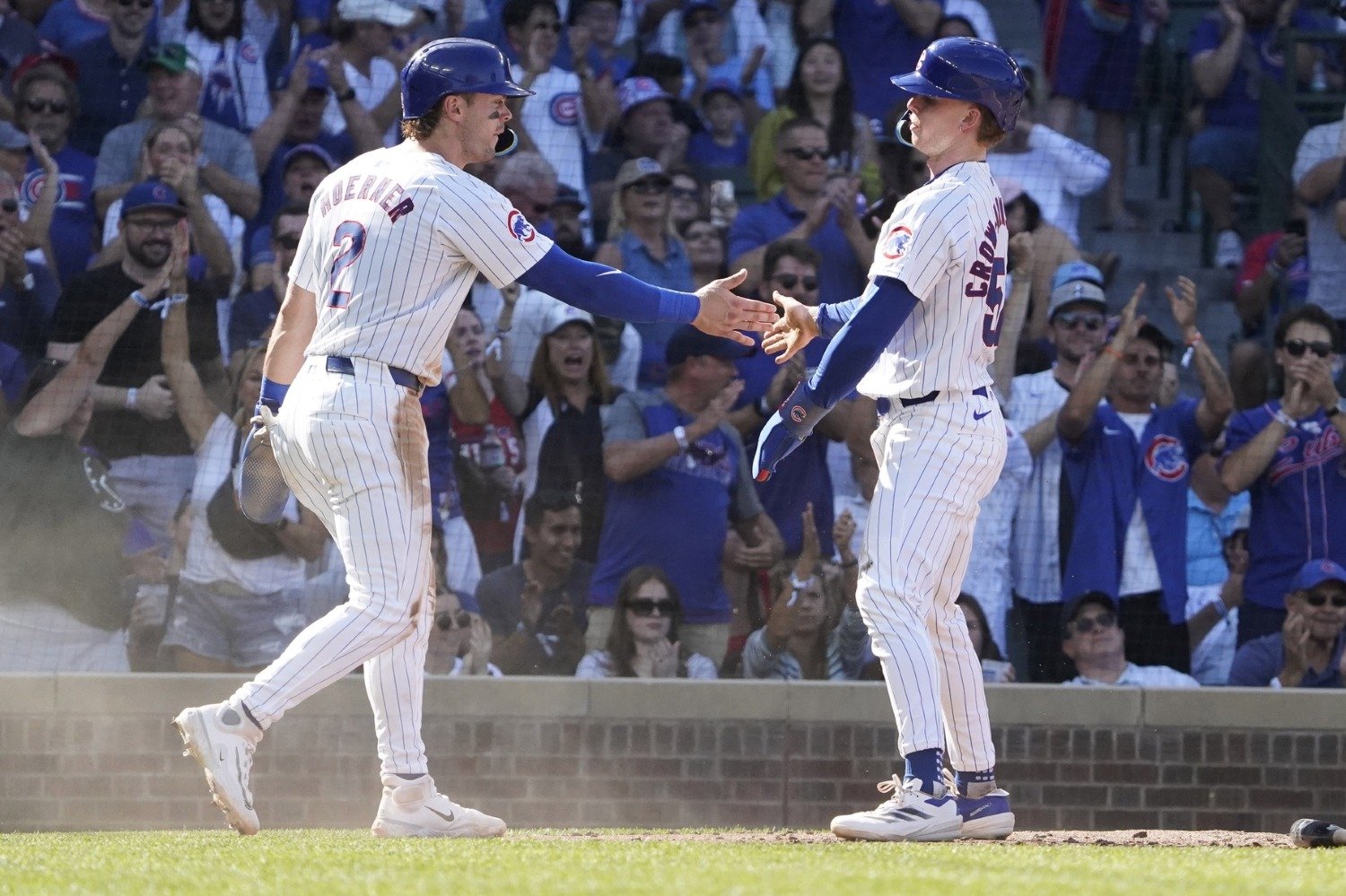
But suppose the Cubs wanted to pivot toward something of a more traditional archetype in the top spot of their lineup. Say, more of a burner with a more aggressive (read: less developed) approach—someone who can serve as an absolute nuisance on the basepaths out of the gate. I am talking, of course, about Pete Crow-Armstrong.
Crow-Armstrong did most of his work out of the 7-9 spots in 2024. He was specifically entrenched in the no. 8 spot, with 286 plate appearances there against 40 as the seventh hitter and 79 as the ninth. The timing of his breakout likely coincided with how successful he was in that spot, finishing with a 107 wRC+ as the team’s eighth hitter. Given the breakout itself, though, it stands to reason whether he represents a viable option to ride out in that spot, especially if the Cubs want to be a bit more aggressive on the bases earlier in games.
Whether or not the skill set itself transfers, however, is the question in need of answering.
Again, if we’re talking about a more modern concept of a leadoff hitter, it’s more about the approach than the speed. As a (barely) non-qualifier, Crow-Armstrong’s 3.46 P/PA sat 604th of the roughly 800 players that had at least one plate appearance in 2024. With that, it’s probably not surprising that his Swing% (59.2) was the fourth-highest of 207 hitters with at least 400 PAs. His Chase%, at 43.5, was the seventh-highest. Neither of those would be an issue if he was making contact, but his 73.2 Contact% ranked 156th, including one of the worst rates on pitches inside the strike zone (79.3). So it’s probably not a surprise that his OBP came in at a mere .286.
While the eye test supported some growth at the plate, it’s clear that there is still more work to be done with respect to the approach. In June and July, Crow-Armstrong’s first two months of genuine run in center field, he maintained an overall Swing% of 61.5 and a Chase% that lingered around 48.0. His contact did jump up between the two months, however. He went from 68.4 percent in June to 74.1 percent in July. With that, his OBP grew from .192 to .232.
August was where we saw the biggest improvement. His Swing% was cut to 56.0 percent and his chase rate fell to 36.0 percent. The contact rate bumped up to 79.5 percent and, subsequently, his OBP shot up (.375). Of course, things came back down in a big way in September, where his swing tendencies were nearly identical to June & July, with a contact rabte even lower.
If that wasn’t enough, Crow-Armstrong’s Baseball Savant page illustrates a man who doesn’t quite know what he wants. Despite relative consistency in terms of the way he was being pitched, the month-to-month variance in his approach is stark. In each of June and July, he swung at breaking and offspeed pitches at a far higher rate than that of the hard stuff. That flipped in August, when he was more aggressive on the hard stuff than the other two. During September, he allowed breaking pitches to serve as the object of his desire at the plate once again. The difference in chase rate vs. breaking and offspeed and chase rate vs. fastballs is intense. Perhaps it’s somewhat obvious, then, that the fastball focus being dialed in August was part of what allowed him to experience as much success as he did.
This all speaks to the idea that Pete Crow-Armstrong doesn’t have the maturity as a hitter quite yet to be considered in a leadoff spot. While he represents a somewhat archaic ideology for the spot, it would still be a somewhat ideal scenario for someone with his on-base ability to serve as the table-setter. For now, though, he’s best served in those spots that more often feature lower stakes. Plus, it’s not as if the Cubs are hurting for someone to fill the role admirably. Happ is more than capable given his own skill set, even if he doesn’t have quite the baserunning prowess of his outfield counterpart.
It’s worth noting, however, that Happ’s contract extension only runs through the end of next season. Crow-Armstrong will still be pre-arb at that point, and very likely still in the organization. At that point, the Cubs could very well be searching for a new leadoff man. How the lefty swinger's bat matures over that span is going to be a fascinating development as far as the lineup – and the future of the leadoff spot along with it – goes.





Recommended Comments
There are no comments to display.
Create an account or sign in to comment
You need to be a member in order to leave a comment
Create an account
Sign up for a new account in our community. It's easy!
Register a new accountSign in
Already have an account? Sign in here.
Sign In Now