


Cubs Video
Ben Brown will take the ball for the Chicago Cubs on Monday night in Miami for his ninth start of the year. He's up to 16 starts, 24 total apppearances, and 97 innings in the majors, going back to last year, but it doesn't feel like we're all that close to feeling certain about a long-term role on Craig Counsell's pitching staff. Could he be a rotation fixture? Maybe. An effective multi-inning reliever? Perhaps. A lockdown guy in the late innings? Sure.
At present, Brown's role is locked in not by performance, but by circumstances beyond his control. A spring injury to Javier Assad pushed him into the starting five. Further injuries to Justin Steele and Shota Imanaga ensured he'd be there for the foreseeable future. The performance to date, though, has been something of a mixed bag.
Brown's ERA currently sits at 4.75. His FIP (3.32) indicates he should be at least a little better in the broad scheme of run prevention (though his xERA does still sit at 4.18). He's inducing more ground balls (43.0%, but from roughly 37% last year), but is also in just the 34th percentile in Hard-Hit% (43.4). His strikeout rate is the selling point: a sturdy 26.2%. Somewhat surprising is the fact that Brown is more along the average line in walk rate; his 8.4% walk rate is not egregious.
I say that's surprising, because Brown's starts are heavily dictated by what type of command he demonstrates that day. On occasion, he's looked untenable as a starter, but he does appear to be on his way to stabilizing there lately, thanks to one key element: strike one. That seems like an obvious concept. Yes, if you did not know, a pitcher's success is heavily reliant on what type of command said pitcher is able to demonstrate. But with Brown, the line seems a little bit finer than with a more seasoned starting pitcher.
Until his last three starts, Brown was unable to work his way deep enough into games. He threw four innings in his second start (vs. San Diego), four innings in his fourth start (vs. Arizona), and 3 2/3 innings in his fifth start (vs. Philadelphia). He ran up pitch counts of 79, 100, and 80, respectively, across that trio of outings. That's 259 pitches in exchange for just 35 outs, averaging roughly 23 pitches per frame. When you're working with a bullpen that hasn't been terribly reliable through the first two-ish months of the year, efficiency is desired above almost everything else.
From a command standpoint, those were his three worst outings of the year—again, somewhat obvious when you look at the raw pitch counts. But Brown hit the zone for strike one only 54.4 percent of the time against San Diego and 66.7 percent of the time against Philadelphia. His first start against the Athletics notwithstanding, those are his two worst first-strike rates of the year. If you factor in overall Zone% (while again excluding the A's start), those three account for his worst starts of the year in terms of zone efficiency. He went 54.4%, 52.0%, and 50.0% across those three outings. Obviously, you don't want to fill the strike zone all the time, but you need to at least entice hitters to swing on occasion.
But something has happened in each of Brown's last three starts (Milwaukee, San Francisco, Miami) that should increase confidence in his longer-term viability as a starter. He's been more efficient. He's maintained a first-strike rate of at least 71%, while catching the zone at 59.5%, 58.3%, and 66.7% rates, respectively. With the exception of a start against the Dodgers back on April 12, those are his three highest rates in both respects.
Focusing on the concept of strike one specifically, an interesting thing happens when he's working with a higher rate:
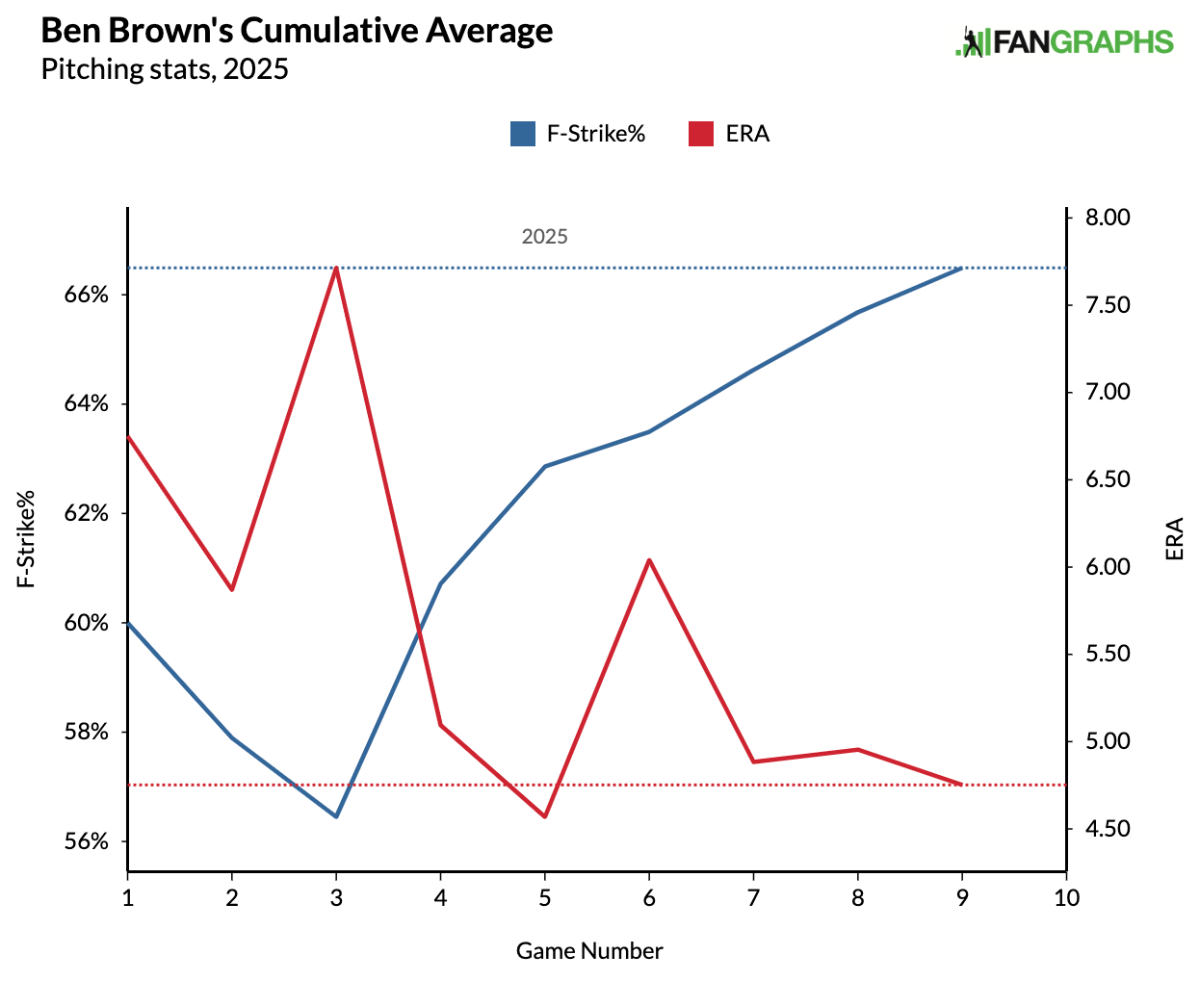
With the exception of that wonky start against Philadelphia, the higher the first strike rate, the lower the ERA in a given start. The above graph would look much smoother had it not been for the April 26 outing. Nonetheless, it does give us a nice little visual as to what Brown can accomplish when he's working with efficiency to open up counts.
Not that any of this rings as surprising, but it does matter more to Brown than to others. He faces two major limitations, beyond or alongside whatever lack of command shows up on a given day:
- His fastball shape is a drag on the utility of his plus velocity. He's induced whiffs on fewer than 19% of swings against the heater in each of his big-league seasons, and when batters do put that pitch in play, it's often in the air, with some authority. Ball one isn't just a head start on a walk. He can't afford to work from behind, because when hitters can sit on the fastball, they do major damage.
- Relatedly, Brown has just two pitches in his arsenal. That both makes it easier for hitters to lock in on the fastball when they have count leverage, and risks leaving Brown more exposed than most pitchers the second and third time through the order if he works deep counts. He needs to get quick outs. The way to get quick outs is to throw strikes and take control of the at-bat.
There isn't quite enough data yet to say that Brown should be opening up with a specific pitch type. It is worth noting, though, that three of his most efficient starts have come in three of his four starts where he opened up with the four-seam the most. Regardless of type, it's ultimately about strike one.
If Brown's got that, he's got everything.





Recommended Comments
There are no comments to display.
Create an account or sign in to comment
You need to be a member in order to leave a comment
Create an account
Sign up for a new account in our community. It's easy!
Register a new accountSign in
Already have an account? Sign in here.
Sign In Now