


Cubs Video
On Wednesday, teams can once again begin signing international amateur free agents for 2025. There will be dozens of millions of dollars handed out to dozens of Latin American teenagers, but this year, there will also be a handsome sum paid to one of the most sought-after free agents in recent memory. By next Monday, we might very well know which MLB team Roki Sasaki will play for over the balance of the 2020s. Sasaki has taken meetings with several teams and mulled his many options, and it's very nearly time to select the best one.
When they met with Sasaki in Los Angeles last month, the Cubs surely made an impassioned case that they are that best option. It's not a ridiculous notion, either. In fact, it has deep roots in fact. I would not categorize the team as the favorites to land Sasaki, but don't read too much into the tea leaves and the half-sourced reporting that has tumbled unimpressively across Baseball Twitter for the past several days. Instead, let's talk about why the Cubs really might be as ready to help Sasaki as any team in baseball—if not more so.
Firstly, of course, an existing support infrastructure for Japanese players and experience with helping them assimilate with the culture of the team and the country are valuable in this circumstance, and the Cubs have those things. They're far from alone in that aspect, but not that far from alone. The Yankees and Red Sox have done this, but not especially recently. The Padres have onboarded talented players from NPB, but no one with this kind of profile to them. The relevant comparators to the Cubs (who have brought over Seiya Suzuki and Shota Imanaga on this side of the COVID-19 pandemic) are really just the Dodgers and the Angels, and the latter is a generous grandfathering-in based on Shohei Ohtani.
Neither Sasaki (who, after all, hasn't said much of anything for himself in the American press) nor his agent Joel Wolfe has indicated that not having these things in place already is disqualifying, but consider that a point in the Cubs' favor. The other (much more important) criterion Sasaki figures to consider, beyond things utterly outside teams' control (like geography, an advantage that keeps the Dodgers and Padres at the head of the pack), is in what ways the teams interested in him propose to help him blossom into the ace hurler he believes he can be—the one who can make $300 million or more when he hits free agency in six years, to make up for the money he won't get as part of this initial deal.
The Cubs can be that team, and they can prove it. Consider this data on Sasaki for 2024, taken from the superb NPB Pitch Profiler app.

Translate those kilometers per hour into miles per hour, and you have a pitcher with a fastball that sits around 97 miles per hour; a devastating splitter, north of 88 MPH; and an 83.6-MPH slider that is almost equally excellent. More important than those pitches and their outcomes, though, are where he throws them. Consult those heat maps, thumbnail sketches though they might be.
Against righties, Sasaki hammered away at the glove-side edge of the plate, working hitters away. Against lefties, though, he focused heavily on the opposite edge. The idea was the same: keep the ball away. He was pitching away from power, even in a league with less overall power than one finds in an MLB lineup. While he did throw those heaters all over the zone to each type of hitter, he was dedicated in his assault on one edge for each.
Notice, too, the way he keeps his splitter south of the zone, almost all the time. He really worked that pitch down to the shins of batters, from each side; it wasn't thrown for strikes at all. He won by inducing chases on that pitch. For that matter, you can see that he threw his slider low and away from righties, diving out of the zone at the corner, but tended to throw the slider to lefties as a backdoor offering.
Compare the above to this image, which represents Shota Imanaga's approach to NPB hitters in 2023, before he came over to the Cubs.

Ovviously, Imanaga and Sasaki are not the same guy. When you look at the locations of certain offerings, though, similarities stand out. Unlike Sasaki, Imanaga had a strong preference for one side of the plate with his fastball in his last year in Japan, wearing out the third-base side of home plate against both righties (it was the inside edge to them) and lefties (to whom it was the outside edge). He threw the pitch a bit higher to righties, trying to crowd it in on their hands, but aimed low and away from lefties, just as Sasaki did to righties. See, too, how much he focused his splitter (labeled above as a changeup) along that line just below the zone.
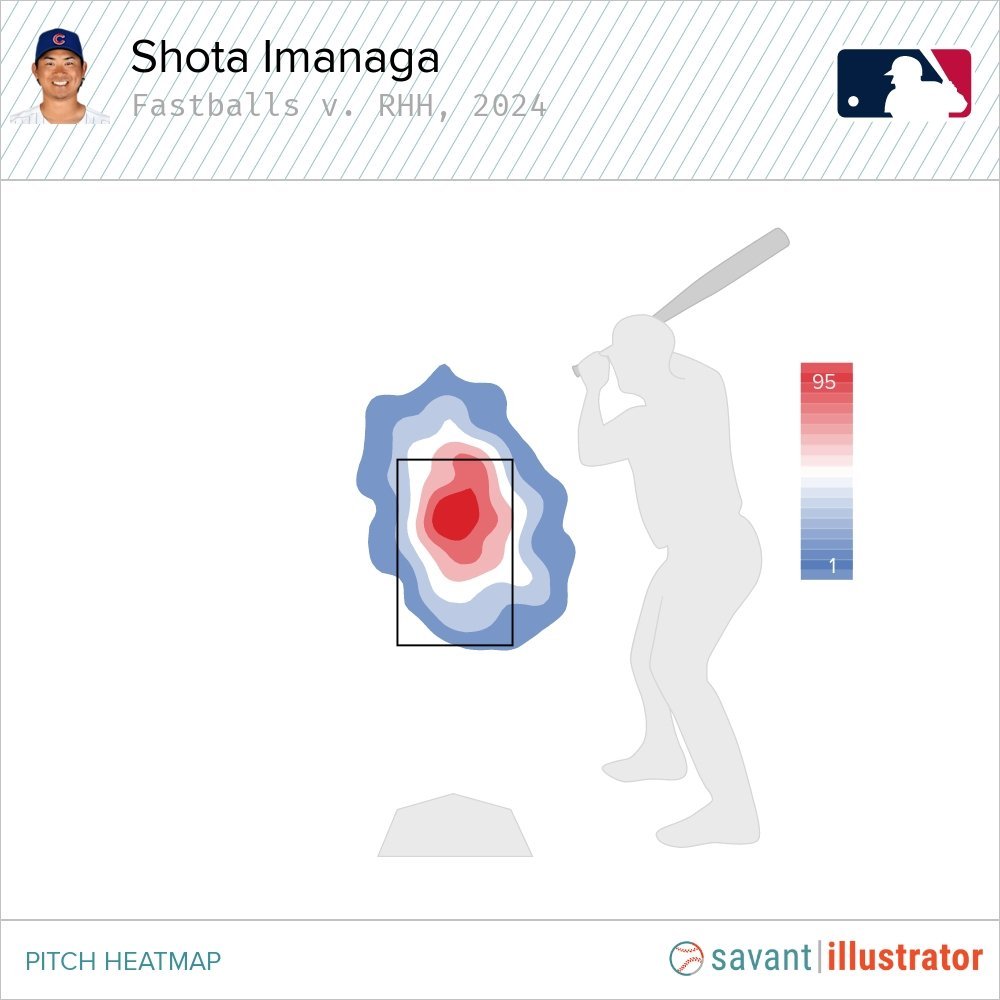
Now, look at where Imanaga threw his fastballs against righties in 2024, Stateside:
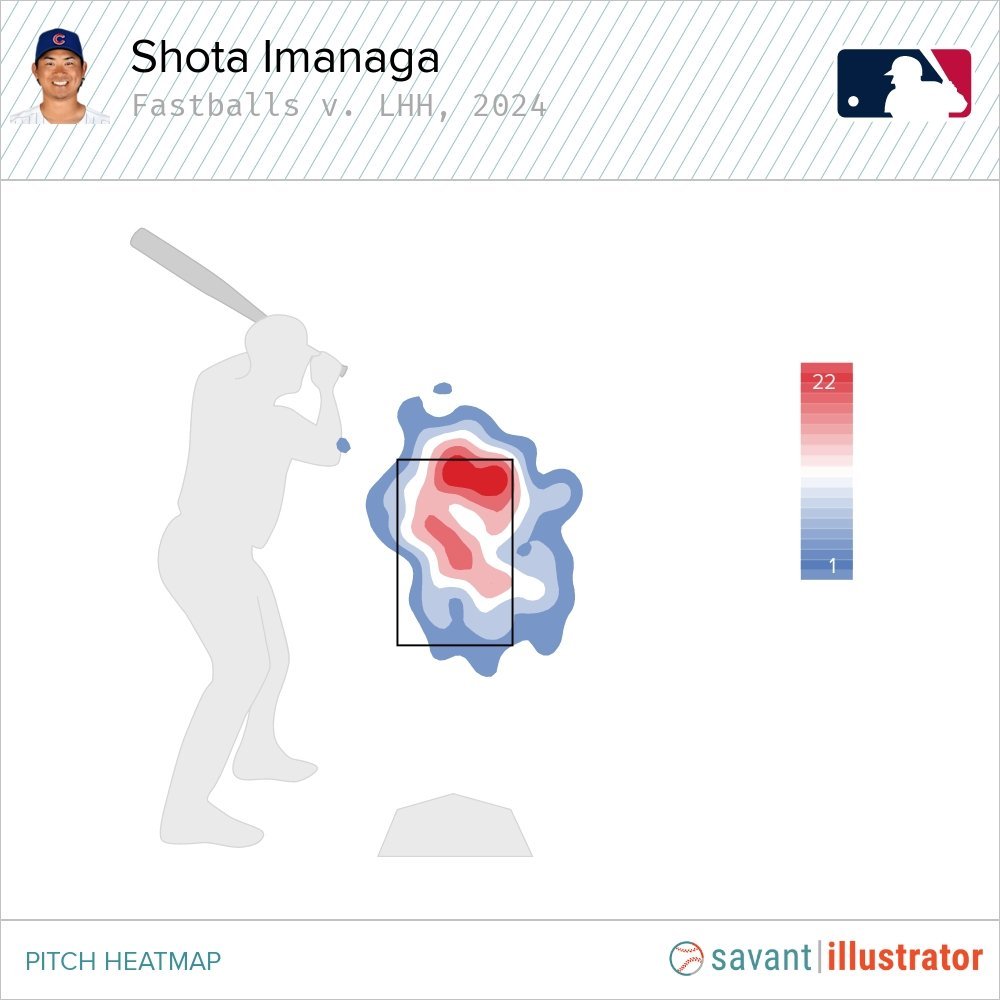
And where he threw the same offerings against lefties:
And where he threw his changeups and splitters, to righties:

You can't pitch the same way in MLB that you do in NPB. The strike zone is different; the ball is different; the fielders behind you are different; the ballparks are different; the opposing hitters are different. If you dedicate yourself to aiming at the edge of the plate with fastballs over and over, you're going to end up giving up hard contact, because MLB hitters can cover the whole plate fairly well. If you can't elevate the fastball consistently, you won't miss enough bats with it to do what you want. If you can't throw even your diving splitter for strikes now and then, you won't get the chases you need, and you'll walk too many batters.
That's a far cry from suggesting that Japanese hurlers can't come to MLB and dominate; we know that much by now. However, even a pitcher who has had tremendous success in NPB and boasts multiple killer offerings in terms of velocity, movement and release point often has to learn to locate differently when they come to MLB. They have to pitch with a different mindset. That's a hard thing to do; the Cubs just proved they can help a hurler do it well.
Sasaki has bigger question marks attached to him than most fans or media seem to grasp. Most of them are associated with health, and no team is systematically good at preventing pitcher injuries. The Cubs' track record is unremarkable in that area. So is everyone else's. If they can convince Sasaki that they'll provide a conducive environment to stay healthy, though, they have a firm footing to claim that they can also help him be the best he can be when he takes the ball. Now, they just have to see whether they've made that case well enough to land a pitcher who represents a once-in-a-generation opportunity, and turn him into a real, live once-in-a-generation pitcher.
Are you optimistic about the Cubs right now?

Follow North Side Baseball For Chicago Cubs News & Analysis



-
 1
1


Recommended Comments
Create an account or sign in to comment
You need to be a member in order to leave a comment
Create an account
Sign up for a new account in our community. It's easy!
Register a new accountSign in
Already have an account? Sign in here.
Sign In Now