


Cubs Video
Baseball Savant is out with a new batch of data Wednesday morning, adding the swing speeds for hitters from the second half of 2023. That information was collected during a debugging phase for that aspect of player tracking, and it wasn't initially released when Statcast began to publish bat-tracking data early last season. Now, though, we have it, and while it's only half a season of extra information, it's valuable.
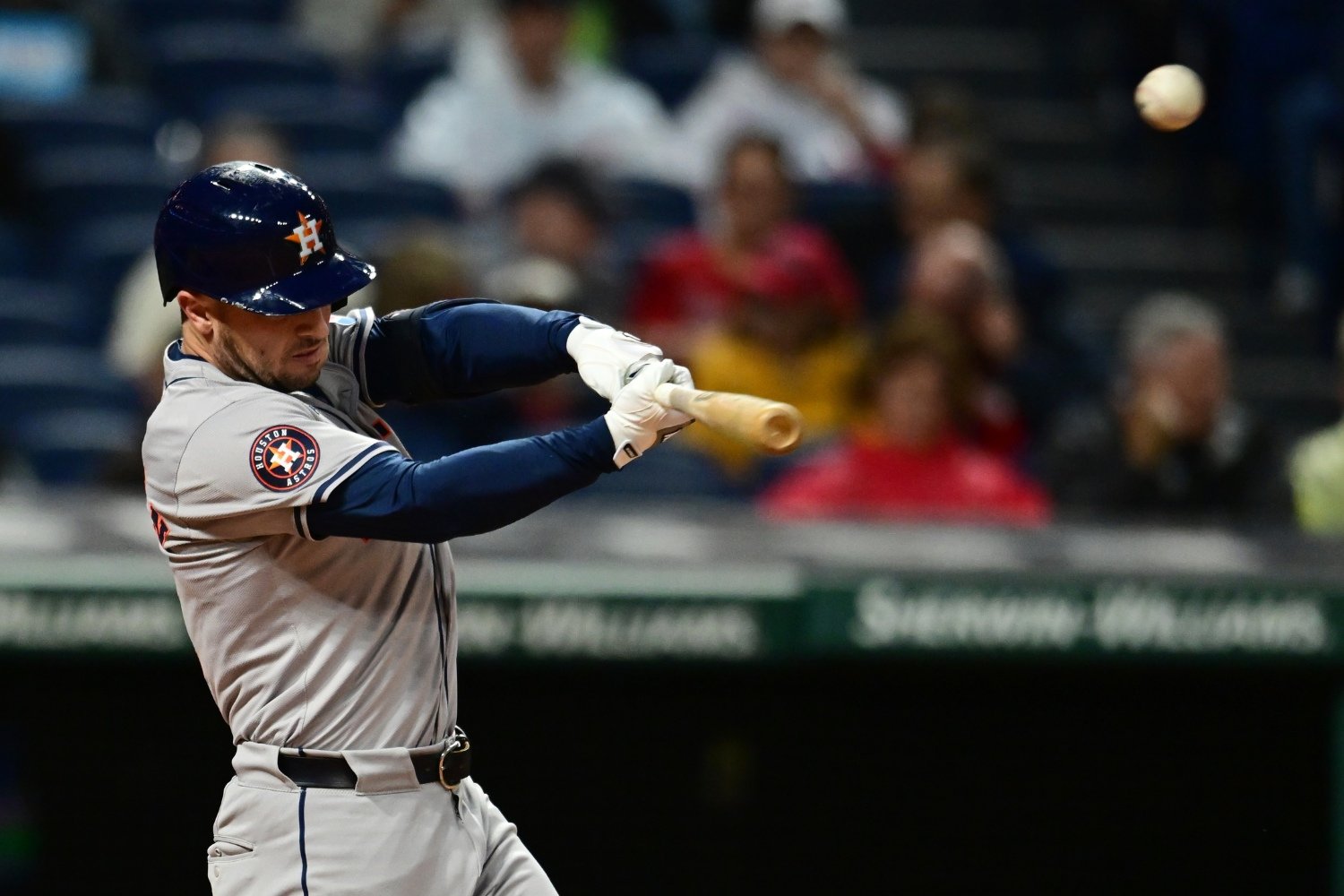
Alex Bregman, the Cubs' top target left on the free-agent marketplace, had a peculiar season in his final year with the Astros. He didn't draw walks at anywhere near his customary rate, and he had a dreadful start to the season. Many have posited that his performance last year could indicate a steeper decline being right around the corner. Naturally, some wondered whether his bat speed was a bit down, forcing him to make earlier (and, therefore, worse) swing decisions, and whether playing in Houston's cozy Minute Maid Park had allowed him to cheat on fastballs and yank cheap home runs into the Crawford Boxes there.
Let's at least partially allay those concerns, right now. Bregman's average swing speed in 2023 was 70.2 miles per hour. In 2024, it was 71.3. He was among a significant but not large number of batters whose average bat speed went up by a substantial amount in 2024, even after he turned 30. As the season went on, he recovered from an early malaise, both overall (he batted .221/.287/.351 through May 15, but .274/.326/.489 thereafter) and in terms of bat speed.
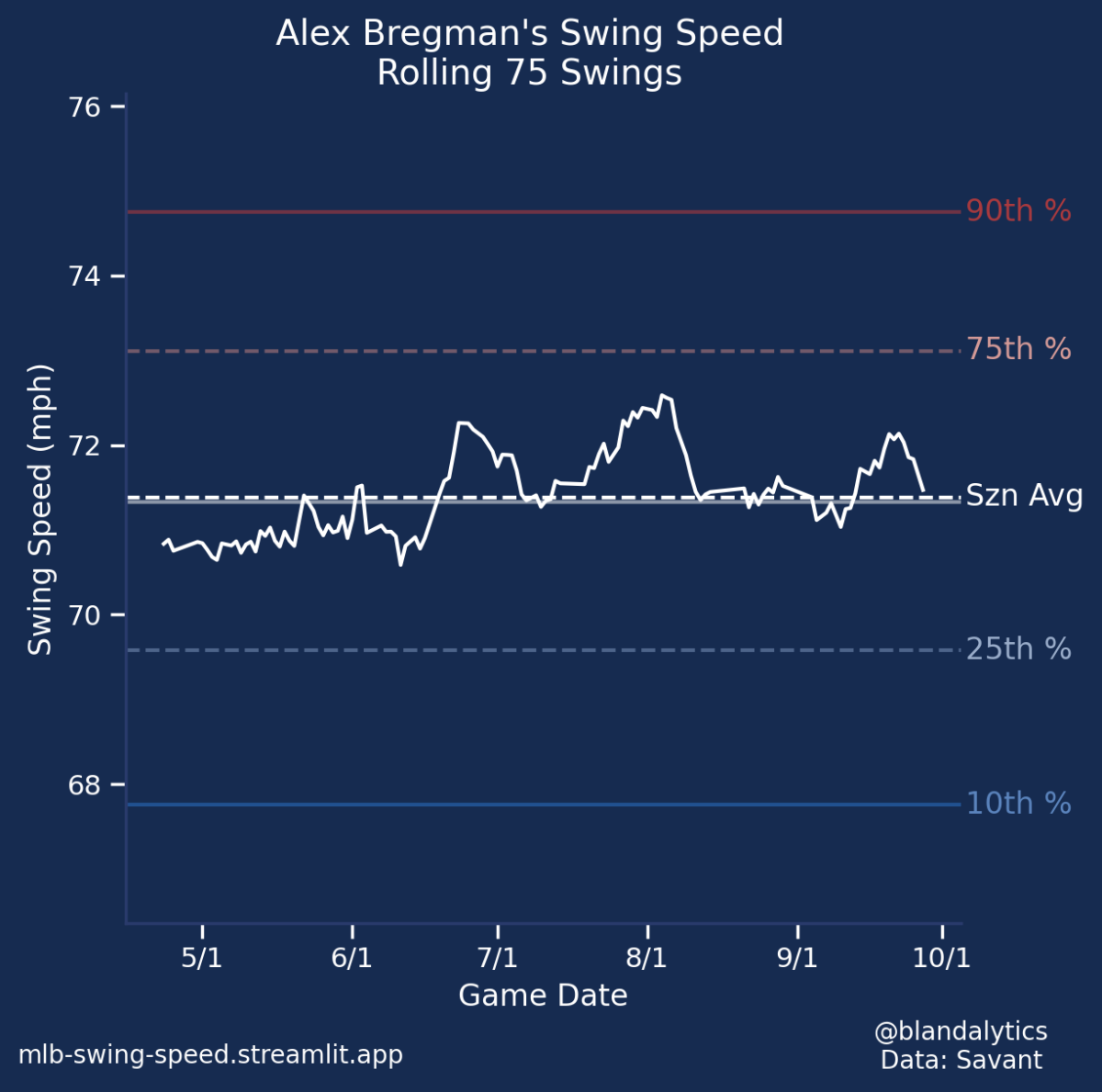
Of course, bat speed (the single number captured by this kind of technology, anyway) is not a universal and unmitigated good. Sometimes, faster swings can indicate that a hitter has sacrificed considerable control over the path of their swings, which might increase power but reduce contact rate drastically. Sometimes, more swing speed can mean you're getting started too late and rushing the bat to the zone, with much the same effect as if you were consciously trading contact for power. It can point toward a problem with either pitch recognition or timing and mechanics at the start of the swing, albeit only very indirectly.
In Bregman's case, though, I think the evidence suggests he simply trained over the offseason of 2023-24 to generate more bat speed, with the specific idea of getting to more power. Fellow 2024-25 free agent Willy Adames also added 1.1 miles per hour of swing speed between 2023 and 2024. So did Matt Chapman, who languished long on last winter's market but then had such a good season with the Giants that he got a six-year deal without even having to venture back into free agency. Sometimes, hitters smell the money and try to go seize it—and sometimes that works, and sometimes it doesn't, and sometimes it was worth trying, and sometimes it wasn't. Bregman did hit 26 home runs in 2024, and no, that wasn't just because he played for the Astros.
Bregman's added bat speed didn't cost him much pitch-to-pitch decision value. He still chased outside the zone at one of the lowest rates in the league, made contact on one of the highest percentages of his swings of any hitter in the league, and struck out less than almost any hitter in the league. He drew fewer walks, but that feels almost like a statistical fluke, given his pitch-by-pitch data. To whatever extent it's not a fluke, it seems to have been a conscious choice. Bregman swung much more often in three-ball counts than he ever has before; that's an easy adjustment to correct if he wants to.
Alex Bregman, Swing Rate and xwOBA on Swings, 3-Ball Counts, By Season

In short, the evidence says Bregman has proactively worked against the likely erosion of aging by increasing his bat speed within the last year. It didn't come without some snags, and he's not guaranteed to age perfectly because of it, but no team (least of all the Cubs, who will sign him only if he accedes to a creative, shorter-term deal than the six-year pact he and Scott Boras continue to seek) should worry about a sudden collapse from him. He's one of the most well-rounded hitters in baseball, and is more likely to be better in 2025 than in 2024 than to continue an early decline.
To address a natural question many might have: it doesn't seem as though having only half the seasonal data for 2023 should distort the reading of these numbers. Last season, the league's average swing speed was 71.4 miles per hour in March and April, and 71.5 miles per hour in all other months. There's a notable jump in swing speed during the postseason—suggesting that we should treat the adrenaline hitters feel in the box as more of a tangible factor than we do—but not from, for instance, the cold spring to the hot summer, or from midseason to the end of a weary year.
Bregman still might well sign elsewhere, of course, so the Cubs have been cultivating some alternatives to landing him. One of those is Justin Turner, but alas, the swing speed trendline is much less friendly to the 40-year-old. He had an average swing speed of 66.4 miles per hour in 2023. Obviously, that's already far below the league average. In 2024, though, it sagged hugely, to 65.1 miles per hour. Turner, like Bregman, is still a savvy, balanced righty batter, and he did manage a .259/.354/.383 line in robust playing time last year. That slugging average looks unlikely to climb back to .400, though, given not only his age but the steepness of that trend in bat speed. Everyone in the game likes Turner, a community pillar and solid contributor. He's unsigned as spring training begins, and maybe that tells us that the league knows about that drop in bat speed and doesn't like the number that comes next in along that line.
Even as they await a decision from Bregman (which they've pushed to get within the week), though, the Cubs can feel good about where they are offensively, partially thanks to the good work their hitting coaches did in 2024 to secure the power potential of their key veteran bats. As frustrating as the results sometimes were, the Cubs had several key players whose ages would not have led you to expect improved swing speed, who nonetheless saw some improvement, even if it was small:
| Player | 2023 Swing Speed | 2024 Swing Speed |
| Ian Happ | 71.8 | 72.4 |
| Dansby Swanson | 71.5 | 71.7 |
| Seiya Suzuki | 72.4 | 73 |
| Mike Tauchman | 68.4 | 69.3 |
The news wasn't all good. Cody Bellinger's swing speed fell from 69.9 MPH to 69.0, which helped the team decide to move on from him in December. Nico Hoerner's dropped from 68.8 to 68.2 MPH, as the fantasies some have harbored of him developing more power continue to fade. Still, on balance, Dustin Kelly and John Mallee did a good job helping players find slightly more bat speed, or hold onto what they had, just when many players begin to lose that very skill. The Cubs also traded for Kyle Tucker, whose bat speed ticked up from 71.8 to 72.1 MPH from 2023 to 2024.
One way or another, this offense should get better power production in 2025. Tucker is the dominant slugger who'd been missing from their mix anyway. The weather figures to be more favorable to hitters than it was in 2024. If they add Bregman, though, the Cubs look like they'll get another 25 home runs from a veteran who knew better than to let Father Time rob him of his bat speed—and if they just put the take sign on when it's 3-1 a little more often, they might also help him reclaim his old OBP.




.thumb.JPG.19c99ddd60a76edf810c77d321439828.JPG)



Recommended Comments
There are no comments to display.
Create an account or sign in to comment
You need to be a member in order to leave a comment
Create an account
Sign up for a new account in our community. It's easy!
Register a new accountSign in
Already have an account? Sign in here.
Sign In Now