


Cubs Video
Matt Shaw looks weird;. I said what I said, don't act like you weren't thinking it, too. That's not a personal attack against the Cubs rookie, either. I'm not making fun of his physical looks or anything else. It's just that when he hits, he looks weird. He has an incredibly odd setup where his front foot toes in. Frankly, that looks painful, but who am I to judge? But it doesn't end there, as once he initiates his swing, he uses a fairly large, sweeping leg kick to help generate torque and power. There isn't another hitter in the league who looks like that right now. But here's the rub... weird doesn't always mean bad.
To highlight how bold his setup is, we only need to turn to Statcast's new ability to track where a player stands in relation to the batters' box. Using this, we can see how far or close to home plate a hitter stands, how open or closed his stance is, and how deep in the box he stands. We can also track where the point of contact is. When it comes to Shaw, Statcast agrees with your eye test - the third baseman is a bit of an oddball. Below is a chart of all MLB hitters in 2025, sorted by distance off of the plate. Shaw is among the leaders in this category.

A few other names on this list may jump out to you; the leader in the clubhouse is former Cub farmhand Cam Smith, as well as names such as Elly De La Cruz, Lawrence Butler, Max Kepler, Willson Contreras, and most notably, superstar Aaron Judge. In and of itself, standing close or further from the plate may not necessarily matter. What makes Shaw unique on this list is that he's much shorter than the others I have listed. Judge is listed at 6'7", Elly is 6'5", and even Contreras is 6'1". Comparatively, Matt Shaw is generously listed at 5'10". One of these things is not like the other.
One way that Shaw makes up for this is his stance. Remember how weird Shaw looks at the plate? With the awkward toe-in? The far end of that chart shows how open or closed off a hitter stands. The names listed above all clock in as "open" stances... Shaw is not. In terms of stance angle, Shaw has the 11th most closed-off stance in Major League Baseball. We also see another interesting relationship: hitters with closed stances generally hit further from the plate.

This feels like it makes sense in theory. As a hitter angles his body towards the plate, they may become more susceptible to being jammed on inside pitches. To compensate, hitters seemingly stand further from the plate. This allows them to go from a closed stance to a more neutral one, allowing them to get inside the pitch better. Statcast has a visualization tool allows one to see the start position (in black) and the finishing position (in red). Below, you can see how Shaw uses his closed stance to open up a little more. Rememberthis, as I'll come back to it in a bit.
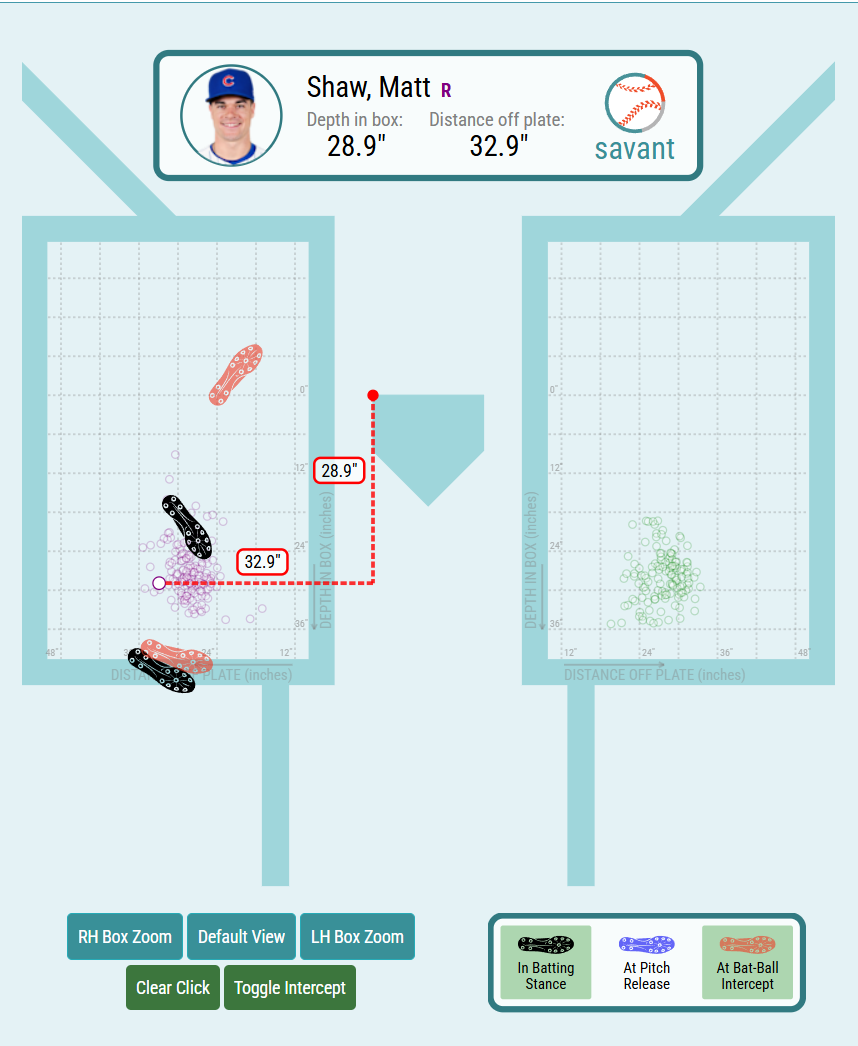
While these pieces of information are interesting, attempting to figure out what it means for Matt Shaw is important. The first concern I think you could have is, "Can Matt Shaw, especially with his height disadvantage, get to the outside pitch?" We are currently in "small sample size extreme" territory, but as of Friday morning, it seems the answer is "mostly yes." Below are a few heat maps to visualize how Matt Shaw has been pitched early in the season (left), where Matt Shaw is swinging (center), and what his average is on pitches hit in those zones (right).

Pitchers are attacking Matt Shaw up and in as well as low and away. Shaw is swinging, more so at the up-and-in pitch, but when he has to, at the low-and-away. He's also using the away pitch to his advantage when he does swing there - though a further look shows that Shaw knows this is not a favorable zone for damage. He can hit it when he must, but it's not a pitch he wants to swing at. On the left is Shaw's overall swing%, while on the right is his swing% when he is behind in the count. It's a swing choice out of necessity, not of pure want, but one he's still capable of using if he must. It reflects the beginning of a mature approach at the plate. Shaw is who he is. He will swing, but he's at least capable of knowing that when he's ahead in the count, he understands his pitch.

It should be noted, however, that while the average on low and outside is good, he hasn't been making a ton of contact in that region. Again, it's not one that is likely to be a strong suit for him, but he's at least shown glimpses of competitiveness there. It's something to put in our back pocket as a potential issue or place for polish down the road.
One thing that has been levied against Matt Shaw so far is that his exit velocities have been unimpressive - and I don't disagree. But it's likely because Shaw has a weird ability to take the outside pitch and hook it into left field. The Cubs rookie has yet to log a hit that would be classified "going the other way" despite the above swing decision chart showing he can make contact with that outside pitch. On Wednesday alone, he notched two hits, one to left field and another to center, with 82 mph and 74 mph exit velocities. However, the xBA on both were .880 and .940, respectively. It's yet to be seen if he can continue doing that, but being pitched away is probably why the EVs have remained low.
I don't think we're at a place yet where we can say exactly what this all means, but I feel comfortable saying that Matt Shaw has a somewhat defined plan with his stand-and-swing decisions. He clearly would like to hit the ball on the inside portion of the plate (and using how he opens his body and front side up, it makes sense), and specifically, higher in the zone, likely to use his leg kick and momentum to generate extra power in a frame that does not help with leverage. He uses his 17-degree launch angle to help with this as well. He's shown, thus far, that while he's capable of guarding the outside of the zone, this isn't his zone. This is all probably fine - we know power comes from a player's pull side and that going the other way can be a helpful tool; it should not be your zone of power, either.
It will be interesting to see how pitchers use the information and data presented here. So far, pitchers have not been afraid to throw him in the high middle of the plate but have also identified that low-and-away isn't where they should probably worry about damage being done. That's not a uniquely Matt Shaw thing, either, as it's just not a good place to generate power.
If pitchers begin to avoid the high-middle and go more and more on the outside, how Shaw handles that new plan of attack will be something to monitor. But again, this is not an issue that should be considered unique to Shaw. Instead, it's the push and pull of a young player. As the rookie gets a foothold in the league, there will be a consistent back and forth of the league learning about Shaw and Shaw learning how to adjust to a new attack pattern. If there's a positive to remember, it's that Shaw showed an ability to hit home runs to the opposite field in Triple-A, though those pitches were more middle-high and not low-and-away.
So, yeah, Matt Shaw is weird. He's among the furthest away from the plate, using one of the most closed stances in the league and having some of the shortest distance between his front and back foot. But so far, his weirdness doesn't seem to be an overall detriment. As such, while he looks weird, Shaw seems to have an internal understanding of his skills and how to use them, as evidenced by his swing decisions. That's usually a good sign for a hitter when we can visualize a plan of attack like this, which ultimately fills me with more hope than anything. It doesn't mean tweaks or changes may still not be on the table, but this initial setup doesn't appear to be a complete non-starter for MLB success.
What do you think of Matt Shaw's stance and performance thus far? Is this sustainable? Let us know in the comment section below!





.thumb.JPG.19c99ddd60a76edf810c77d321439828.JPG)



Recommended Comments
There are no comments to display.
Create an account or sign in to comment
You need to be a member in order to leave a comment
Create an account
Sign up for a new account in our community. It's easy!
Register a new accountSign in
Already have an account? Sign in here.
Sign In Now