


Cubs Video
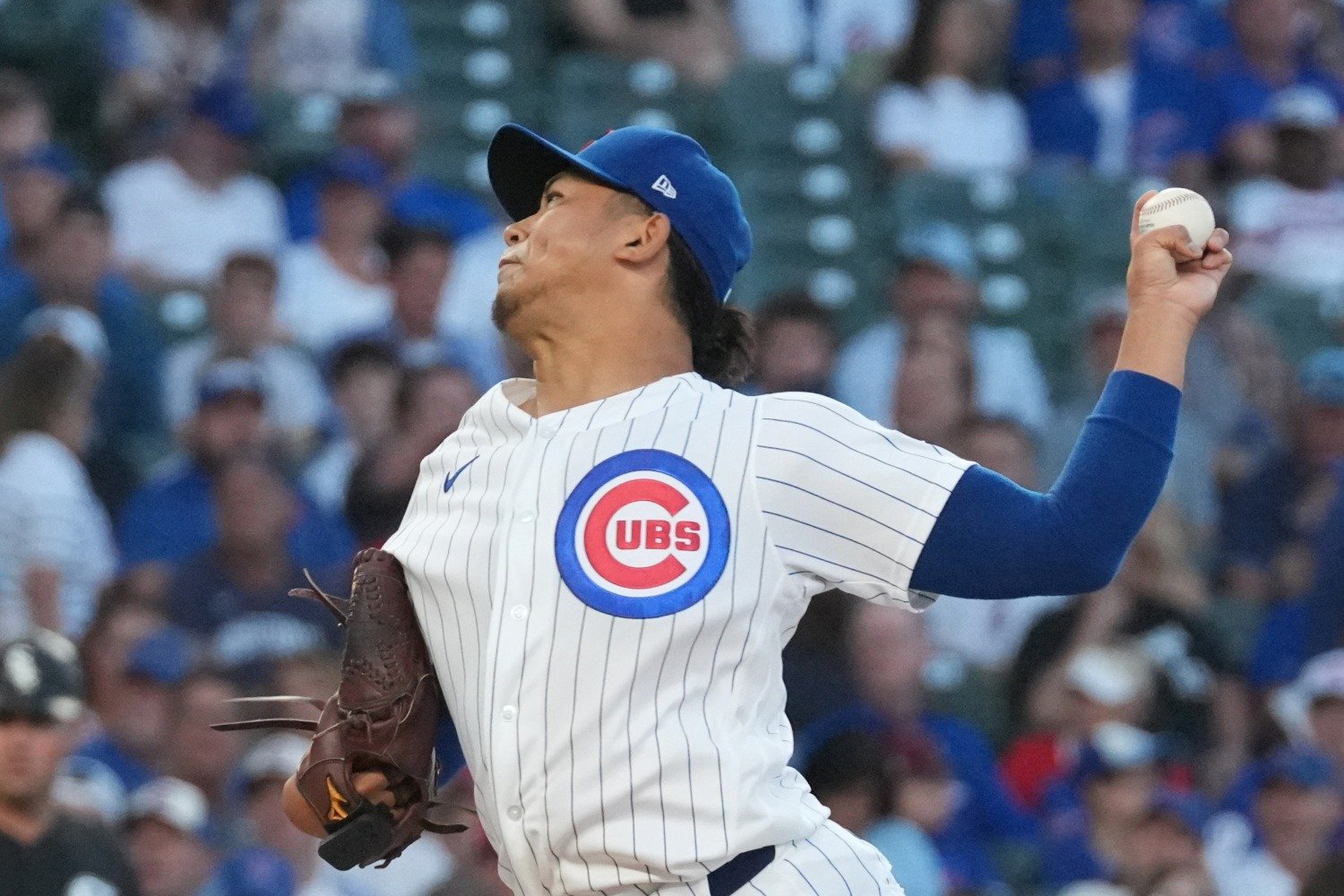
The end of the 2025 season—and specifically the playoffs—was an ugly stretch for Chicago Cubs starting pitcher Shota Imanaga. The affable lefty was pounded in his last two starts of the season and then rocked in the playoffs by the arch-rival Milwaukee Brewers. Imanaga started the season as the team's co-ace; he ended it by being passed over for a do-or-die start in Game 5 of the NLDS.
The culprit in this demise was Imagana's propensity to give up the long ball at the wrong time. Sadly, that's cropped up again this year, as he's given up 29 homers already. Figuring out how to work around these is key as the team begins to look beyond the regular season (while continuing to pursue the Brewers in the NL Central).
Sometimes, however, we have a bad habit of focusing on just the home runs. Imanaga's most recent start against the crosstown White Sox is a great example of this. The home run Randal Grichuk hit in the top of the fourth was the talk of social media; it defined his start for many people. Grichuk has made life hell for lefties for more than a decade, sporting a career 121 wRC+ against southpaws. Despite being 35 years old now, he's shown no signs of slowing down, posting a 161 wRC+ on the year against them. A left-handed pitcher with home run issues giving up a bomb to a guy who crushes lefties is not a wild outcome.
What you may have missed, however, is that Imanaga had a great start minus that outcome. Not only did he strike out 10 hitters, but he induced 20 whiffs on 40 swings. The fastball velocity sat at 91.5 MPH—an important metric for Imanaga, who struggles significantly when the velocity dips below 91. The splitter was especially good, as it notched an 80% whiff rate when the Sox swung at it that night. That came against the offense with the 7th-best wRC+ against lefties this season. With Imanaga, there will be some home runs given up, but he has shown time and time again that despite that, he can dominate.
Outside the 29 homers, Imanaga has had another fine season. He has a 3.77 ERA in 143 innings. With all of the injuries, he's been a rock in the rotation, taking the ball every turn and delivering as many quality starts (11) as the next two Cubs on the leaderboard (Matthew Boyd, 6; Colin Rea, 5). The underlying data assure us that the results aren't fluky; his xERA is 3.81 and his xFIP is 3.85. He's a fine mid-rotation starter.
That said, the Cubs shouldn't enter the postseason having forgotten what happened last year, either. That Grichuk home run felt inevitable because it was an obviously bad matchup for Imanaga. But the worst part about that home run was the walk that preceded it. The Cubs lefty can survive a solo shot or two, but he cannot survive three-run blasts. Walks aren't generally an issue for him, but they will happen from time to time, and that's when things get a little scary. Walk the guy before a lefty-masher, and what seemed like a clean inning could turn into two runs.
As you enter the playoffs, you're far more likely to face lineups that will force Imanaga into those exact uncomfortable situations. That will (rightfully) make most Cubs fans uneasy, The margin for error is razor-thin in the playoffs, and Imanaga lives on a razor's edge already.
To mitigate the risk he presents, the Cubs should shield him from the third time through the batting order. The first time batters see him in a game, Imanaga has a 3.33 xFIP and a 29.3% strikeout rate. The second time he sees hitters, he has a 3.55 xFIP and a 25.3 K%. Once he gets to a third time, his xFIP jumps to 5.67 and his K-rate drops to a measly 12.6%. As a pitcher who really relies on two pitches as his primary options (fastball/splitter), it makes sense that he struggles the third time through. As often as the Cubs can avoid this, they should. With their roughed-up rotation leading to an exhausted bullpen, they haven't always been able to shield him from this during the regular season. Instead, they've often asked him to get through that one extra inning, maybe a little too often.
The good news for the Cubs is that the rules of the game (figuratively) change in the playoffs. Teams don't use their starters or bullpens the same way they do over the first 162. The Dodgers won a World Series two years ago with two starters, using their bullpen the rest of the time; you can hide deficiencies in interesting ways. Luckily, the North Siders might just be set up perfectly to use Imanaga with these changes. Enter: the Cubs' changing bullpen.
Between today and the end of the season, the Cubs' bullpen is likely to see lots of reinforcements. Ben Brown, Edward Cabrera, Daniel Palencia, Justin Steele, Hoby Milner and Shelby Miller might all return, building depth and variety for the pen. There are pitchers who may give you some length (two or three innings) and others who give you funky looks. There are pitchers who can attack very specific weaknesses, and others who will blow hitters away with pure stuff. That should allow the Cubs to utilize Imanaga more optimally.
You can help Imanaga avoid bad matchups and the third-time through the order penalty by using those options. The Brewers might stack lefty-mashers Andrew Vaughn, Jackson Chourio and William Contreras at the top of their order to face Imanaga as many times as they can. Instead of letting the southpaw take the first inning, they could allow (say) Brown to take the first four or five outs of the game, then turn it over to Imanaga.
Because of the sheer amount of trustworthy arms that may return and how teams handle playoff pitching staffs (being far more aggressive with early pulls), Imanaga also wouldn't be asked to go 18+ outs or be forced to see a lineup a third time. It's much more likely he would be asked to get something closer to 12 outs. He could give up a few baserunners and still never see a hitter a third time. Plus, by shortening his usage, you can ameliorate the issue with his fastball velocity. In shorter stints, it's more likely that he can max out the effort on the pitch. He may even be able to get it to the 92-93 MPH area that former Driveline pitching instructor Chris Langin suggested as the threshold Imanaga needs to reach to be at his best.
Fans should hope the Cubs need to use four starting pitchers in the playoffs. As a team probably headed for the Wild Card round (FanGraphs gives the Cubs just an 11.1% chance to both win the division and secure a bye), the Cubs would only need a fourth starter in the second round. If the season ended today, recently-acquired starters Kevin Gausman and Clay Holmes would start two of the three games in a Wild Card round, leaving a decision to be made by Craig Counsell on whom the third pitcher would be.
That debate would come down to Boyd and Imanaga. The team will need both if they move on, but finding a way to get the best out of Imanaga is key. Thankfully, the Cubs are getting healthy (at least, pitching-wise) at the right time, which should allow them to optimize usage of both hurlers. Unlike in 2025, this team looks ready to cover its October innings.
In the interim. the Cubs will hope for more starts like Imanaga's against the White Sox. He will be a little more exposed going forward. Even with the rosters expanding, they'll ask him to get through five or six innings in most starts. They'll hope they see more solo bombs than ones with runners on. He'll have to face a few hitters (like Grichuk) who are just bad matchups. And he'll probably be just fine, as he's been most of the season. But when the playoffs happen, they'll be able to try different things. Piggybacking might be an option. Openers might be an option.
In a way, Imanaga is the Cubs' glass cannon. The traditional glass-cannon arm is someone who's wonderful when healthy, but who rarely are. Imanaga isn't a big injury risk, but he tends to "break" in the ways described here: giving up home runs, diminished velocity and seeing the order a third time. He can be a hitter's nightmare when everything is working, but he has some serious flaws.
Maybe the right term for him is Plexiglass Cannon, instead. He's not as breakable as many hurlers in the traditional sense, but pressure and repeated exposure can still crack him. Deploying Imanaga may take a deft hand, a strong bullpen and knowing when to pull him, but if you get it right, this Plexiglass cannon can be a real weapon.





Recommended Comments
Create an account or sign in to comment
You need to be a member in order to leave a comment
Create an account
Sign up for a new account in our community. It's easy!
Register a new accountSign in
Already have an account? Sign in here.
Sign In Now