


Cubs Video
It's every human's greatest (if, at times, subconscious or unwanted) wish to be understood—to have others really see us as we see ourselves and grasp what we believe gives life its meaning. The great danger of being a parent lies in either being too successful at imprinting your understanding of the world on your child (thereby passing down to them your biases, your shortcomings and your ossifications of thought, and making a clone of yourself, which will become an ill-adjusted being in a world very different from your own), or in feeling an eternal frustration that grows from the inability to communicate to someone so close that essential self-understanding that must be communicated to bring happiness.
I have always feared the former, more than the latter. I don't want my kids to be too much like me; I try to teach them mostly by pointing out my own mistakes and demanding that they avoid repeating them. Sometimes, though, that internal truth breaks containment, even when we don't want it to. In ways big and small, conscious and utterly accidental, we bare our souls to one another and a certain transference happens, whether we like it or not. In early August 2018, a YouTube user uploaded this highlight video of Javier Báez's season to that point. I loved it. Absent-mindedly, because my 5-year-old liked baseball and wanted something to watch, I showed it to him, too.
It was one of those moments. My son has never been the same; that video rewired his personality. Since then, he's been not only a rabid baseball fan, but a tenacious player—and on and off the diamond, this is the energy he seems to bring to life. It's a relief, in one way, because that's not the energy I bring to life, so he's certainly carving his own identity, but I lose some sleep over the possibility that I've turned him into a demon as obsessed with excellence and domination and creativity as Báez was in his best season, with (surely) less talent to give it all the proper outlets.
When the Cubs traded Báez a few years later, I was sad, and my son was even sadder. Of course, the playstyle on that tape was never going to age especially well, and Báez's more-bad-than-good years since have eased the pain of knowing the Cubs dealt him away, but the joy and ferocity of his game (at its best) was still absent from Cubdom, and the loss was felt, however inevitable I might have known it to be.
Right away, though, my son latched onto Pete Crow-Armstrong. The same sizzling intensity bends the light all around Crow-Armstrong, making him shimmer and raising the temperature (for good and ill) every time he's on the field. I was a bit slower to take the same depth of enjoyment from his game, because some of the rough edges around the game felt less endearing in Crow-Armstrong's case than in Báez's. Once I saw him reinvent himself at the plate (for the first time, way back in mid-2024), however, I was on board. He was adaptable, after all. He was intelligent, after all. He might even be more talented than Báez, and capable of applying that talent a bit more judiciously to his game.
That, of course, is what we've seen over the last two years. It was fun when Crow-Armstrong took off like a shot in 2025 and surpassed 20 homers and 20 steals before the All-Star break, but you could sense the recoil coming, and sure enough, he had a miserable final two months at the plate. The real breakout—the moment he went from a lovable star with two-way value to a generational guy—finally came this spring, as he adjusted to the bat speed he'd added over the offseason and altered his approach. That's when Crow-Armstrong became a player as winning-focused, clutch, and electrifying as Báez had been, although in a different way.
The internet has changed (read: worsened) over the last eight years, and no good analog for that Báez highlight reel is easy to find for Crow-Armstrong. Because everyone is desperately trying to monetize YouTube traffic for themselves, and because viewing hours determine monetization rates and pull in the money, you can watch four-minute highlights from MLB's official channel that include just one at-bat and the ensuing home-run trot, or 25-minute compilations of plays made by simply stringing together the full versions of original 30-second clips, but you won't find sleek, well-produced highlight videos as readily. So be it. I want to offer just one brief set of clips that illustrate the point, as a way of celebrating and remembering the magical season that just came to an end.
There's a big, grandiose way to do this, and maybe we'll do it another time. Today, we're doing the cozy minimalist version. Yes, there were a couple of months early this year when Crow-Armstrong played arguably the best defense in center field that the game has ever seen. Yes, there was a month in which he had an OPS of 1.249. Yes, there was one week in which he almost single-handedly won the Cubs four games, and yes, there were individual games scattered throughout the calendar in which he took the spotlight in ways we've hardly seen before. But I just want to talk about one game, in which he started the day 0-for-3 and the Cubs were slouching toward a 2-0 loss.
The date was August 6, which was supposed to be an off day. Because rain had postponed the team's series finale against the Blue Jays in June, though, Toronto had come back to town on a mutual blank space in the teams' schedules. It could have been a really tough moment in the team's season, but instead, they were riding high. Crow-Armstrong had won them a game against the Yankees over the weekend, and he'd just won them one the previous night against the Dodgers, showing Shohei Ohtani who was boss in the last moment at which anyone wondered which of the two would be the MVP of the National League.
It was a day game after a night game, though, and Crow-Armstrong went 0-for-3 through the first seven innings, with a strikeout. David Peterson pitched well, but gave up one run in the first, and the Jays tacked on a second tally in the seventh. Their near-automatic closer Louis Varland came on to save the game in the bottom of the ninth, with the cushion of that late run making things much less stressful. Crow-Armstrong wasn't even the tying run, when he led off the inning. Varland went right after his superstar opponent, getting ahead 0-2. Then, Crow-Armstrong slammed into one.
This was not one of his most vicious swings. It doesn't look like a case of cutting down with two strikes, but it was that, a little bit. He made sure he would connect solidly, rather than swinging for the fences (as he did for much of the year). The ball half-split the gap, too, and he probably could have had second on the play. Not playing for stats, though, he held at first, knowing his run meant too little to risk an attempt to advance. That set up Alex Bregman's dramatic, game-tying two-run homer, which sent the game to extra innings.
The Cubs should probably have won in 10 innings, but it went to 11. They held Toronto scoreless in the top half of each frame, so when Crow-Armstrong stepped in to lead off the bottom of the 11th, Carson Kelly stood at second base, carrying the winning run. He had a tough assignment, taking on lefty Brendon Little, and Little tried to leverage his platoon advantage. He also tried not to give Crow-Armstrong any chance to win the game for the Cubs—so much so that he threw him neither a fastball nor a strike the entire at-bat.

Every past version of Crow-Armstrong gets himself out in that situation, probably via strikeout. This version, though, showed a well-considered blend of intelligence and aggressiveness. He wasn't going to passively accept a walk. He felt he had a chance to win the game for the team. Nor, however, would he unduly expand his zone and leave Kelly at second with one down. He took two balls and fouled off a few two-strike offerings. Finally, on a 2-2 curveball that didn't dip quite low enough, he hit it right back through the box for a single. It could, even, have been the game-winner.
As it happened, though, Kelly shouldn't even have tried to score. He didn't get a clean enough break from second, and Myles Straw (who has a strong arm and charged the ball perfectly) got off too good a throw. The slow-footed Cubs catcher should have held at third, where a whole lot of possible things might have brought him home to walk it off. Instead, he ran into a pivotal first out.
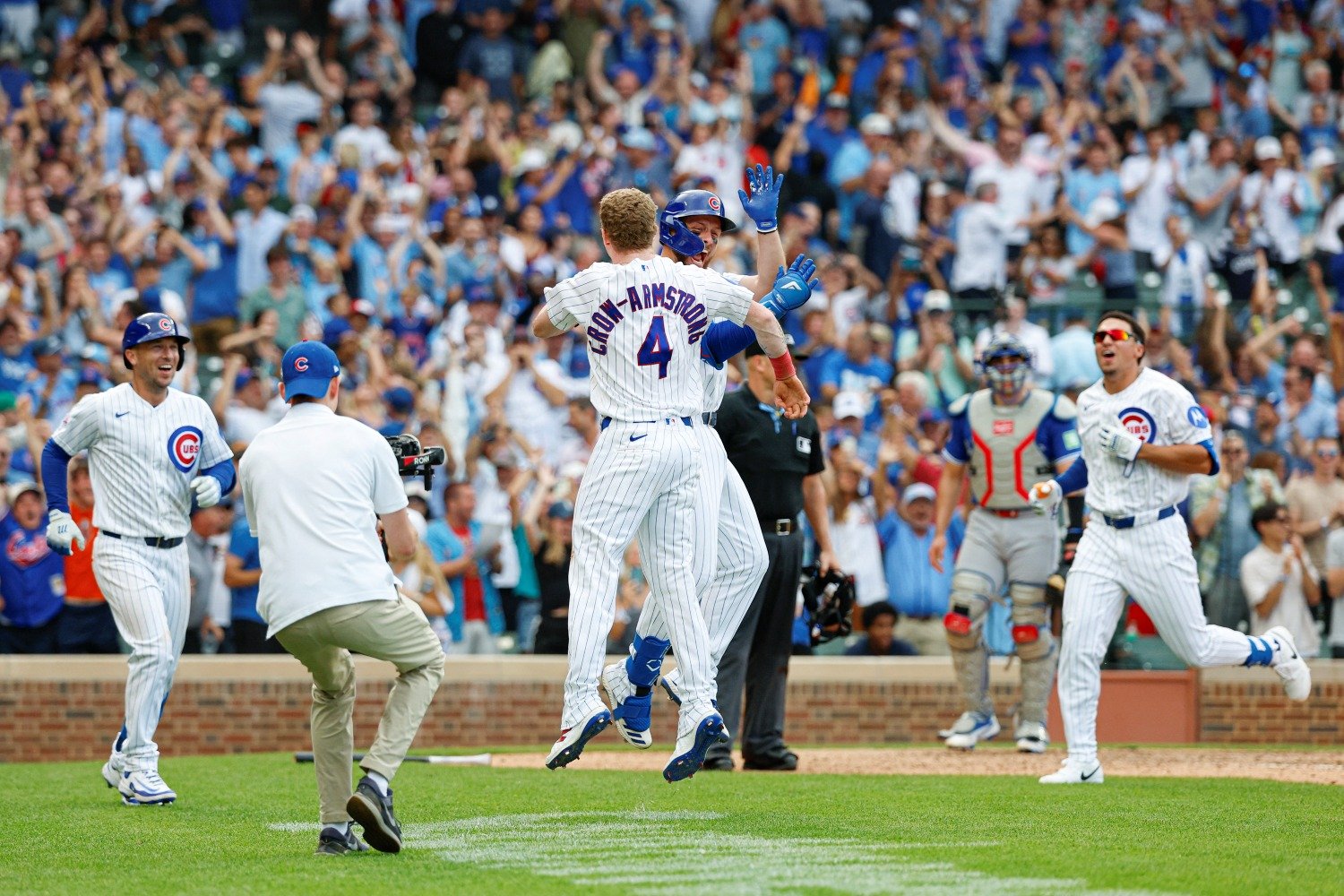
Crow-Armstrong hadn't been anticipating a celebration or thinking too conservatively, though. The throw came through to the plate and thwarted Kelly, but when it did so, Crow-Armstrong advanced to second. Thus, the winning run was right back in scoring position—and now, it was a guy who was utterly determined to score it.
Few runners try to steal third with a lefty in the batter's box. Pitchouts are vanishingly rare in the modern game, but catchers have a clear lane to make a short throw when a lefty is at bat. All year, the league only attempted 70 steals of third from the seventh inning on. At that moment, in early August, the Cubs had only attempted one such steal all season. Here it is:
Yep, it was Crow-Armstrong, and it came when the situation demanded it—putting him at third with less than two outs, when he carried the tying run in the final inning of the game. In that contest, the Cubs stranded him there and lost; they let Crow-Armstrong down a lot this year. But he hadn't been afraid then, and he wouldn't be afraid this time, either.
This time, things broke just right for Chicago. Crow-Armstrong had the base stolen, anyway, but then the ball trickled away. It didn't even go that far; this was no airmailed ball into the left-field corner. It was enough, though. As soon as it began to roll away, Crow-Armstrong was off toward the plate. He had willed his team to a fourth straight win. It looked like the Summer of PCA might never end.
Baseball doesn't always reward such courage, even when paired with great talent. But the game is at its best when someone has the temerity and the instincts to get a delicate thing like that right. In fact, life is at its best in moments like that, when someone takes a bold chance in the service of both themselves and others and it pays off. The magic of Crow-Armstrong, this year, was distilled as gorgeously in that moment as in any other play he made—in the field, at bat, or on the bases. It felt a whole lot like when Báez scintillated with the same clutchness and fire and unstoppable talent, eight years ago.
I hadn't even initially thought of this, but now that I have, I feel compelled to include it. There was another moment akin to this one, in a way, from earlier in my baseball season—way earlier, back on May 20. It wasn't Crow-Armstrong making this particular play, but I had a better seat for it.
I know I don't want my children's personalities to be as closely wired to sports as mine was when I was their age. I don't know whether I want them to view Crow-Armstrong (whom I have found thoughtful, sharp and generous in my few interactions with him, and whom most people say means well even off the field) as a role model, except in the limited context of the game. However, what Crow-Armstrong has tapped into over the last three seasons in Chicago is the same vein of positive intensity that Báez brought years ago, and the legacy of that kind of intensity—of that level of care put into one's work, with a fierce joy held right at the surface and a focus on how what you're doing serves those around you—is a profoundly positive one. It runs deeper than wins and losses, and it extends even beyond a bitter playoff disappointment. The Summer of PCA will, in some ways, never end, even if there aren't great music videos out there of his highlight-reel plays. Sports fans are edified by consuming this kind of baseball. The benefits might even spill beyond the foul lines.





Recommended Comments
There are no comments to display.
Create an account or sign in to comment
You need to be a member in order to leave a comment
Create an account
Sign up for a new account in our community. It's easy!
Register a new accountSign in
Already have an account? Sign in here.
Sign In Now