


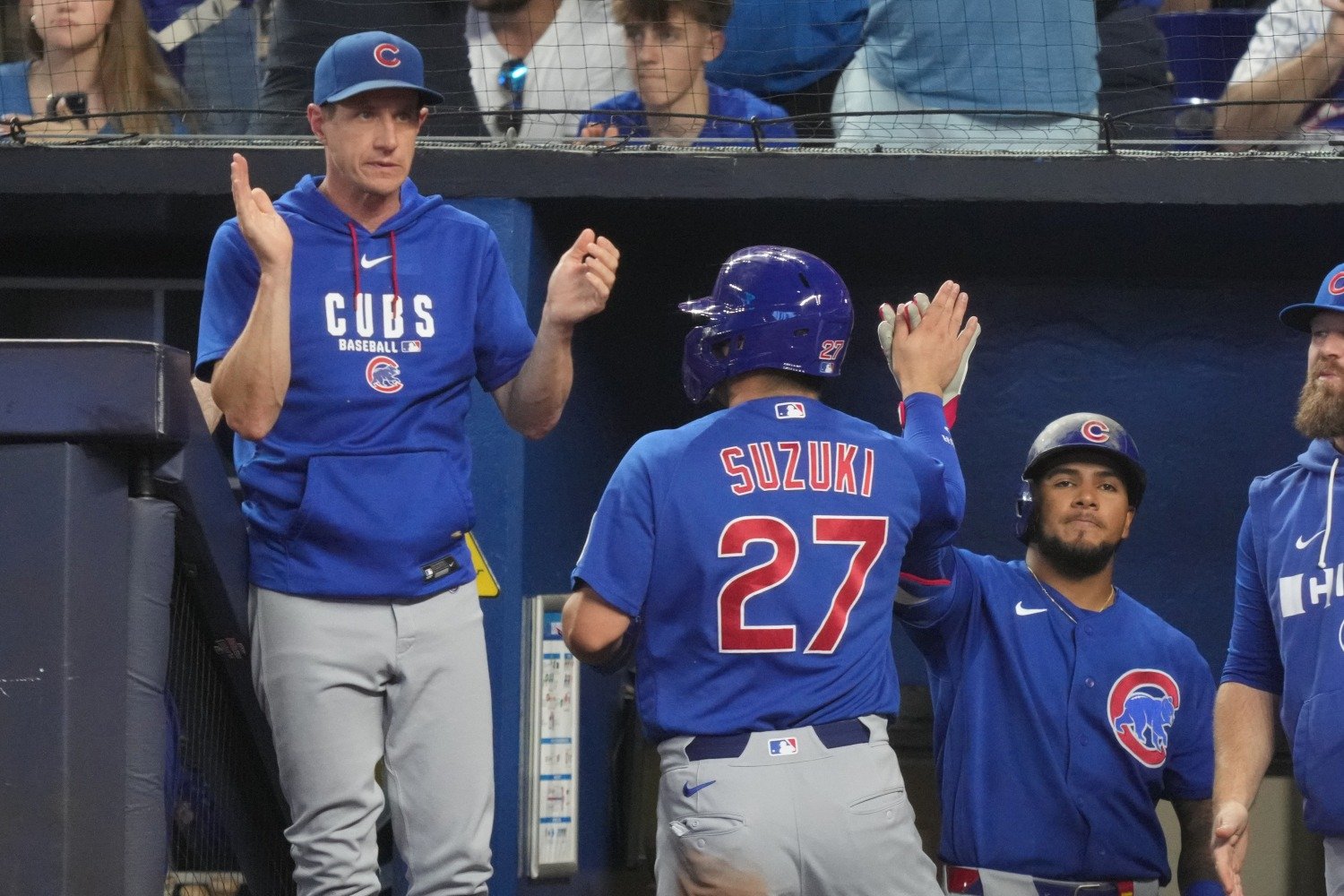
Cubs Video
The regular season is over. The good news is that the Chicago Cubs are in the playoffs for the second consecutive season. In a season in which the pitching staff was ravaged by injury and ineffectiveness, the offense (which led baseball in OPS and runs scored) was enough to keep the team firmly in the Wild Card picture. September was a rollercoaster in itself, as the Cubs went 11-13, moving from likely hosting the Phillies for the NL Wild Card Series to a set in San Diego.
The Padres went 18-6 in September, only losing one series in the entire month. There's no question who the hotter team is right now, with the Cubs ending the season on a weird series loss against Boston that featured a game played at Tropicana Field, and the Friars winning a home series versus the Diamondbacks, ending their playoff hopes in game 162. If the Cubs want another rematch with Milwaukee in the divisional round, they will need to go through the hottest team in baseball, who own a 51-30 record at home. Here's a look at some statistics that will loom large during this best-of-three set.
First under the microscope is the Padres’ offense, which has been a tale of two halves. Before the All-Star break, their .673 team OPS and 379 runs scored were last in the majors. Fernando Tatis Jr.’s power outage was still ongoing, as he came into the break with only five homers. Xander Bogaerts and Jackson Merrill each had an OPS closer to .600 than .700, and the 33-year-old Manny Machado seemed to be turning into a one-dimensional slugger with a rising strikeout rate and a .708 OPS that was propped up by 19 bombs. The offense was “carried” by Gavin Sheets, and aged castoff Nick Castellanos was still getting regular playing time.
The Cubs are 5-1 against San Diego this season, including taking two of three in April at Petco Park, but that might as well be a season ago, as the Padres have seemingly forgotten all about that first half offensive slump. The bats woke up, to say the least. Their .781 team OPS trails only the Cubs, and their 5.2 runs per game is tied with Milwaukee for the second-highest, once again behind only the Cubs.
Tatis’s power came back, as he launched 20 second-half home runs, while posting a batting average above .300. Since hitting his first homer of the year at the absurdly late date of May 30, he has a .914 OPS. Jackson Merrill and Ty France each hit over .300 with an OPS north of .900 in over 270 plate appearances. This second-half surge certainly would not have been possible without the contributions from role players and bench bats like Samad Taylor, Austin Hays and Dustin Harris, proving hitting to be contagious. Jake Cronenworth was the only regular with an OPS under .700 in the second half, but the rest of the lineup was able to mask the veteran infielder’s worst statistical season yet. In September alone, the swingin’ Friars led baseball in OPS and slugging, while smashing 33 homers, which was tied for the sixth most. The Cubs pitching staff needs to hope old trends die slowly: the Padres have slashed only .230/.287/.371 in eight home playoff games since 2021.
Speaking of the Cubs pitching, the key to win is to avoid the bullpen for as long as possible. The bullpen has been pitching better during the last month of regular season play, as their relief corps has a 3.95 collective xERA, 13th-best in baseball. Ryan Zeferjahn has looked like the guy they thought they traded for, posting a 2.14 xERA with a strong strikeout rate. Ryan Rolison has cemented himself as the club’s most trusted lefty over Caleb Thielbar, and Daniel Palencia is finally appearing healthy and closer to the force we saw last season. As a whole, the Cubs’ 2026 bullpen has been worth -0.6 fWAR, which was only higher than the Nationals and Royals.
Craig Counsell will roll with Matthew Boyd in Game 1. The wily southpaw is the hot hand, having allowed only two earned runs in his last two starts. After that, it will be one of the trade deadline acquisitions; either Kevin Gausman or Clay Holmes. Gausman has the postseason experience, which may give him the edge for Game 2, but Holmes is having the stronger season—although each of them have an ERA over 4.00 on the road.
Another important stat to note is that the Cubs pitching staff is pretty damn good when not allowing homers. Thanks to a good defense and their ability to avoid walks, they get more value than everyone but the Dodgers and Rays from all outcomes other than the long ball. The problem, of course, is that only the A's allowed more homers this year.
The Padres are bottom-third in the league in home runs at home, so with any luck, they'll be forced to generate traffic on the bases to score runs, which is easier said than done against the Cubs’ elite defense.
The Padres will counter Boyd with Michael King in Game 1. King has been their best starter this season, and owns a 2.74 ERA at home, although he was touched for five runs against the Dodgers in his last start of the regular season. After him, it should be Nick Pivetta, who has only made eight starts this season due to injury but has allowed only three earned runs in four starts since his return from the IL. Should the series go to three games, the Padres could turn to Randy Vasquez, but he did start the final game of the season on Sunday, wherein he went six innings against Arizona. The other options are veterans Robbie Ray and Walker Buehler, but each of them have been shaky of late, and Buehler was the starter when the Cubs scored 23 runs on July 1. Should the series go to three games, the Cubs should have an advantage with their starting pitching.
The Cubs will need to score early and often against the starters, because if they falter, rookie manager Craig Stammen can turn to the best bullpen in baseball, anchored by closer Mason Miller and his 47.4% strikeout rate. The bullpen as a whole has been worth 8.9 fWAR, and has the lowest xERA in the game. After Miller, they can lean on Adrian Morejon, Bradgley Rodriguez and Yuki Matsui, who have a combined 4.6 fWAR. Southpaws Morejon and Matsui will each play a major role this series to deal with Pete Crow-Armstrong, as well as Michael Busch, and Ian Happ, who has been a non-factor against left-handed pitching this season. Matt Shaw and Tyrone Taylor will probably pinch-hit in key situations against a lefty, with the Padres going with a right-handed starter for at least two out of the three games.
Speaking of right-handed hitters, Seiya Suzuki collected four hits in the two games he started back in the April series at Petco, but this was so long ago that Crow-Armstrong was still hitting ninth most games. The Cubs still have the league’s highest-scoring offense on the road, so there should be some optimism for the lineup to continue to rake at Petco Park.
For the Cubs to win this series against the team they bounced from the playoffs last fall, they'll to need to hit early and build a significant lead for their bullpen, which should be able to hold a lead under limited exposure. In the 2025 Wild Card Series at Wrigley Field, the Cubs didn't have a starter pitch more than 4 1/3 innings, but this year’s team has a (hoefully) more reliable rotation—and they need to get five or six innings from someone. If the Padres get to their bullpen with a comfortable lead, they can shorten the game to seven innings with the back end of their bullpen. This is not the same Padres team the Cubs hosted last year. They're the hottest team in baseball, with the best bullpen and a lineup where nearly everyone is hitting. The Cubs are here to show how far the bats can take them, but the Padres are out looking for revenge after an early dismissal last season. Forget about the Yankees and Red Sox or the Atlantas and Phillies. This is shaping up to be the most exciting Wild Card Series of the week.




Recommended Comments
Create an account or sign in to comment
You need to be a member in order to leave a comment
Create an account
Sign up for a new account in our community. It's easy!
Register a new accountSign in
Already have an account? Sign in here.
Sign In Now