


Cubs Video
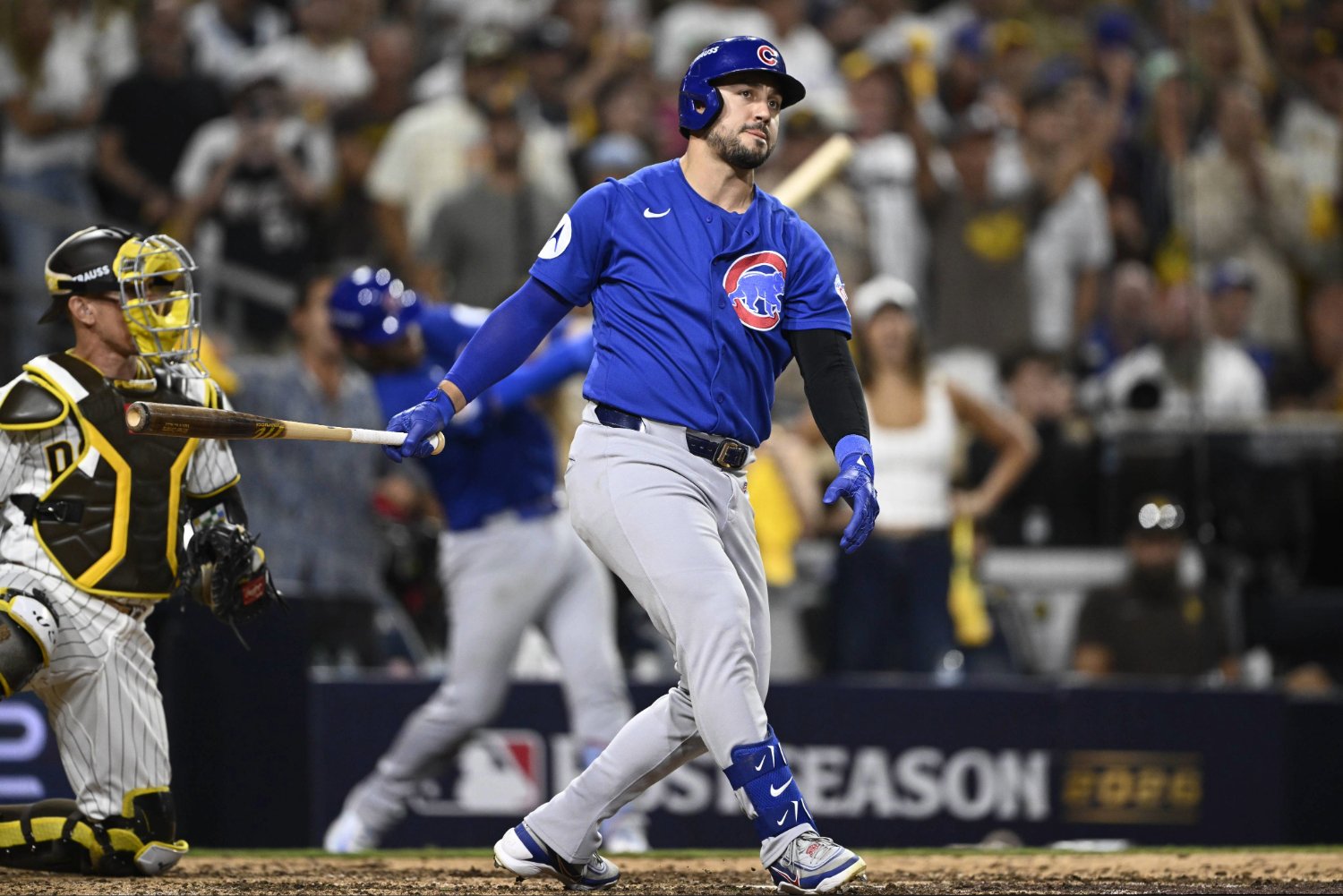
In a manner that felt so similar to Tuesday night’s debacle, the Chicago Cubs were immediately thrown into an overwhelming situation in Wednesday night’s Game 2 against the San Diego Padres.
Following a first-pitch ball, Pete Crow-Armstrong missed two very hittable four-seam fastballs in the middle of the zone. Ahead in the count 1-2, Nick Pivetta came back with a curveball that, to anyone watching the broadcast, appeared to clearly clip the inside corner of the plate:
Now, it’s easy for me to say that that pitch was clearly a strike. I am watching at home, with the benefit of the strike zone overlayed on my television screen. This is, surely, much harder in real time. In Crow-Armstrong’s defense, there have certainly been more egregious challenges this season.
The challenge system, though, isn’t always about being right or wrong so much as it is challenging at the correct times. The star center fielder was correct on 50 percent of his challenges this season, slightly above the average rate for a hitter of 49 percent, according to Baseball Savant. Fielders, though, notch an overturn 58 percent of the time, and Carson Kelly, the Cubs’ catcher last night, won 69 percent of his challenges.
Suddenly, the Cubs were not only down an out, but a challenge as well. That might feel like a small thing, and it is, but every one of those little small things matters in the playoffs. The real concern might have been what that challenge said at that moment: the Cubs were pressing. This didn’t seem like the presumptive MVP issuing a challenge because he thought that the pitch was a ball; it felt like he was grasping at straws, and hoping that the pitch was a ball, when deep down, he knew that it wasn’t.
Let’s fast-forward a couple of innings to the top of the third. After a leadoff walk to Matt Shaw and a line drive single from Carson Kelly, the Cubs were mounting what was their first real offensive threat of the entire series. Dansby Swanson was in the driver’s seat, ahead in the count 3-1. Given that Swanson is a fastball hitter, and Pivetta a fastball pitcher, this felt like an opportunity for the Cubs to truly do some damage. The Cubs’ shortstop, then, swung at this pitch:

To twist the knife on that, here is a contour map of Swanson’s slugging percentages against four-seam fastballs this season, via FanGraphs:

Given that he was ahead in the count 3-1, Swanson had zero need to chase a pitch outside of the strike zone. He should have been looking for a fastball out over the plate, in that big red, and even blue, area of the chart above. Under no circumstances should you be swinging at fastballs off of the outside corner.
Still, the count was now 3-2. The shortstop was still breathing in a meaningful way. There was another pitch yet to come:
Yikes. The 3-1 pitch was, at least, in the vicinity of the strike zone. You could convince me it was close to being a strike, and I can assign some benefit of the doubt on that. That 3-2 pitch, though, was never close. It was low enough to be in what is considered the chase zone, and typically, you get chases down there on breaking balls, not fastballs. Fastballs, much more typically, get chases up and out of the zone.
In fact, this season, pitchers threw 6,655 four-seam fastballs in the chase zone below the strike zone. Only 295 of those generated swings, according to Baseball Savant. That’s a swing rate of just 4.4 percent. Swanson himself saw 11 of those pitches, and didn’t swing at any of them. Until Wednesday night.
This, it should be noted, is pretty atypical of Swanson. While not exactly Juan Soto in terms of patience, he chases pitches outside of the strike zone less often than the average hitter.
Looking at where the Padres’ catcher, Ethan Salas, is set up prior to the pitch, it seems that Pivetta was willing to challenge Swanson with the fastball. A walk there would have loaded the bases with nobody out and Crow-Armstrong coming to the plate, followed by Alex Bregman. Pivetta didn’t execute his pitch. Swanson, in turn, also didn’t execute. He was simply way too over-aggressive.
I am going to be cliché for a moment and reference one of the most famous baseball movies of all time, The Sandlot. When Benny first brings Smalls to play baseball with his friends, they all learn pretty quickly that Smalls can’t catch the ball. Benny, in a pep talk to Smalls, lays things out pretty clearly to the baseball newbie. “Man, this is baseball. You gotta stop thinking. Just have fun. If you were having fun, you would have caught that ball.”
I cannot recall a baseball team making the playoffs look less fun than the 2026 Chicago Cubs. You might argue that the Houston Astros outdid them just a few hours earlier; I’d argue right back that that Astros team, at 81-81 and being the worst team by record to ever make the postseason, had no legitimate expectations. This Cubs team did.
They looked like a team that was pressing. They looked like a team that was trying too hard. Baseball simply isn’t a sport conducive to that. It’s a sport where you just have to make a bunch of really small, correct decisions consecutively. Sometimes, they might not pay off, but in the long run, they usually do.
The beauty and the agony of playoff baseball is that those small decisions don’t always pay off in such a small sample size; the Cubs, though, can’t even claim themselves victims of small sample size. They simply didn’t make many of those decisions correctly. In a different world, we might be talking about how Pivetta lost control in the third inning, and the Cubs took advantage to force a Game 3. In the real world, however, the Cubs didn’t make those small decisions correctly.
The Padres, on the other hand, sure looked like a team that was having fun. From the first pitch that Fernando Tatis Jr. saw on Tuesday night, to Joe Musgrove serving as a human victory cigar, to Mason Miller shutting the door on the series, they played loose. They played with exuberance and joy. The Cubs now face a long and cold offseason about what could have been.





Recommended Comments
Create an account or sign in to comment
You need to be a member in order to leave a comment
Create an account
Sign up for a new account in our community. It's easy!
Register a new accountSign in
Already have an account? Sign in here.
Sign In Now